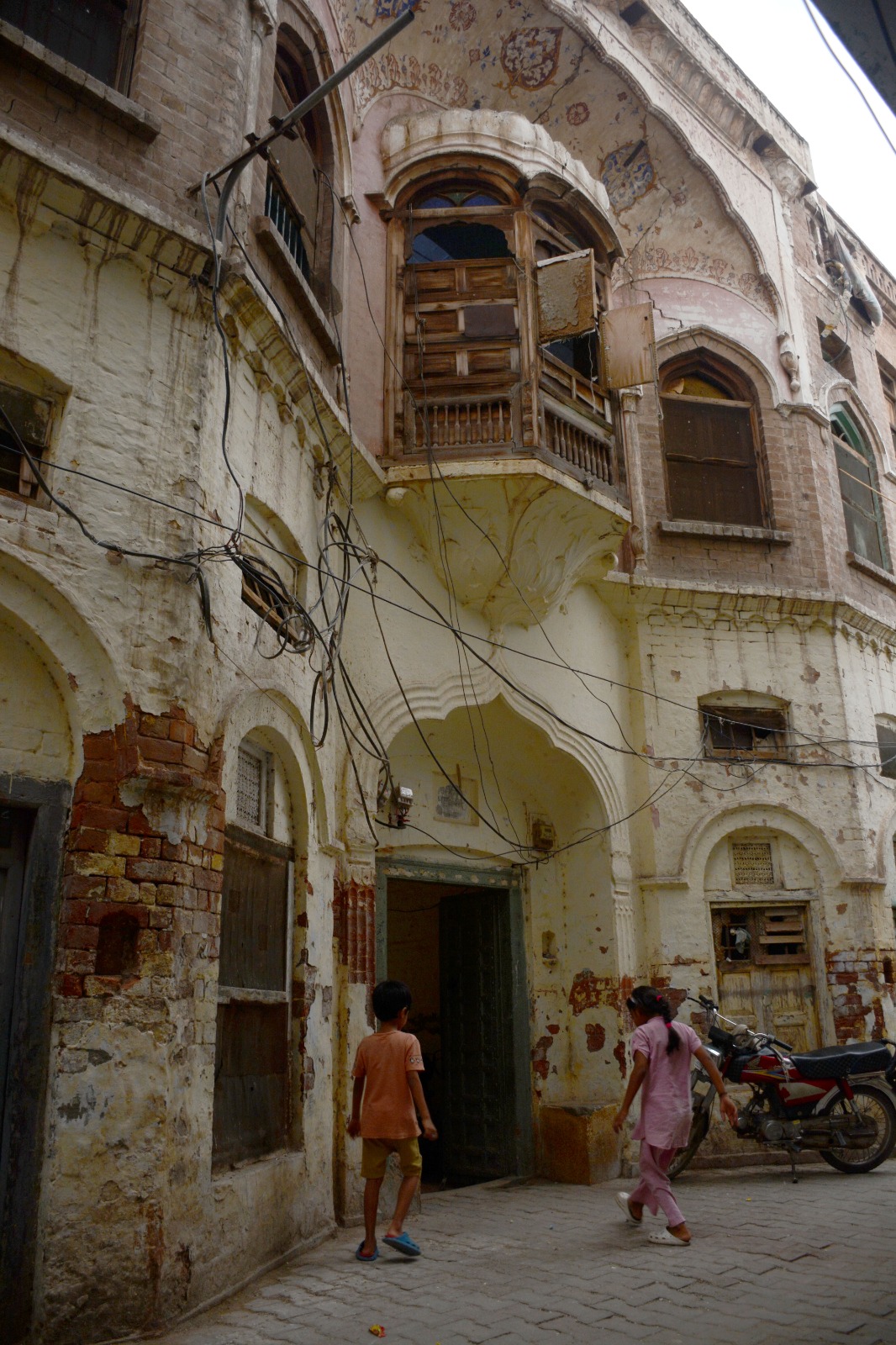
The ancient Walled City of Multan is often celebrated for its magnificent Sufi shrines, centuries-old bazaars and spiritual heritage. Yet, hidden behind narrow streets, weathered gateways and busy neighborhoods stands another priceless chapter of the city’s history: its pre-partition magnificent “Havelis”.
M Aatif Ismail
Multan,July 22 (APP):The ancient Walled City of Multan is often celebrated for its magnificent Sufi shrines, centuries-old bazaars and spiritual heritage. Yet, hidden behind narrow streets, weathered gateways and busy neighborhoods stands another priceless chapter of the city’s history: its pre-partition magnificent “Havelis”.
These grand residences (havelis), built mainly during the late Mughal, Sikh, and British periods, are far more than old houses; they are timeless architectural treasures that preserve Multan’s rich social, cultural and artistic identity for generations.
Walled City Guide Aamir Bashir, who has spent years documenting the city’s historic buildings, while talking to APP, stated that every haveli in Multan has its own grandeur, its own story as well as its architectural language.

According to him, these structures collectively narrate the evolution of Multan’s prosperous merchant class, influential families and wealthy landlords who once shaped the city’s economy and
culture.
Assistant Director of the Walled City Authority, Umair Ghazanfar, believes these historic havelis deserve the same recognition and protection as monuments and shrines, as they stand as enduring symbols of Multan’s master craftsmanship, architectural brilliance, thoughtful urban planning and vibrant cultural
legacy.
However, among the most iconic landmarks are the famous Red Havelis of Malik Jela Ram and Malik Nathu Ram, two brothers whose six-storey residences continue to dominate the skyline of the old city.
Distinguished by their striking red facade, elongated architectural layout and unusually rounded
rooms, these buildings are regarded as some of the tallest surviving historic residential structures in Multan, claimed Amir Bashir. Their imposing height and distinctive color earned them the title of the city’s legendary Red Havelis, making them instantly recognizable to heritage enthusiasts.
Another architectural masterpiece is the Khanna Mansion, originally owned by the Khanna family. Built during the British colonial period, the mansion presents a graceful white exterior that contrasts sharply with the red brick architecture of many neighboring buildings.
Its elegant proportions and colonial influence illustrate how European architectural ideas blended with indigenous craftsmanship during the nineteenth and early twentieth centuries.
The Haveli of Malik Jasu Ram, once one of Multan’s wealthiest citizens, represents the prosperity enjoyed by the city’s merchant elite.
This impressive five-storey white mansion showcases extraordinary craftsmanship in timber, carved stone and wrought iron. Every balcony, window and decorative element reflects the remarkable skills of artisans who transformed ordinary construction materials into works of art.
Aamir, however, terms the most beautiful haveli in Multan to belong to Karam Narain Bagai. Rising four storeys on a relatively small six-Marla plot, the haveli is marked for its remarkable balance of design and functionality.
Finely carved wooden doors, intricately crafted stonework, spacious windows and an intelligent ventilation system demonstrate how traditional architecture responded naturally to Multan’s intense summer climate. Every corner of the residence presents artistic excellence rather than extravagance.
Another Haveli, once owned by Burj Lal advocate, has 127 doors and windows. Similarly, only fragments now remain of the once magnificent Somnath Kapoor Haveli, yet even its surviving rooms continue to fascinate visitors. According to Aamir Bashir, the residence was designed in an Italian architectural style, a rare feature in Multan, making it one of the city’s most unusual heritage buildings despite the passage of time and partial destruction.
The Haveli of Jaswant Rai Kapoor, a police officer before the Partition of the Subcontinent, is another remarkable example of traditional craftsmanship. Its greatest distinction lies in the extensive use of finely carved timber throughout the structure. The intricate woodwork covering doors, ceilings and interiors reflects the exceptional standards of artisans working during that era.
Located in Mohalla Maharaja, the Mohan Lal Haveli stands as another five-storey architectural treasure from the British period. Rich wooden interiors, airy rooms and elegant planning make the building particularly attractive.
One of its most fascinating features is its flooring, which, according to local historians, resembles the flooring used in the famous Noor Mahal of Bahawalpur, adding further historical significance to the residence.
The Haveli of Gulshan Rai, a renowned Hindu moneylender of Multan, gave its name to the locality now known as Mohalla Gulshan Rai.
Constructed in 1935, the building represents a transition in architectural techniques as cement had become increasingly available by then. Its magnificent entrance, beautifully decorated rear facade and harmonious combination of timber, carved stone and cement ornamentation make it one of the city’s finest examples of early twentieth-century residential architecture, said Aamir.
Equally captivating is the Haveli of Dhanpat Rai, famous for its massive wooden entrance doors that continue to astonish visitors with their durability and craftsmanship. Inside, beautifully designed wooden galleries surround the central living spaces, a characteristic feature of affluent Hindu residences of the period.
Above the house stands an elegant “Baradari”, a twelve-doored rooftop pavilion where family members gathered during cool evenings or rainy weather to enjoy fresh air and panoramic views of the city.
Perhaps the most romantic story belongs to Uttam Parkash’s Dhanni Palace. Built as an expression of love for his wife, the residence has earned admiration for its magnificent exterior, which resembles Mughal imperial architecture. Because of its elegance and the love story associated with its construction, Aamir Bashir affectionately refers to it as “The Taj Mahal of Multan.”
The palace remains one of the city’s most emotionally significant heritage buildings, symbolizing affection expressed through architecture.
On the outskirts of Multan, the Haveli of Bakkhu Ram in Nawabpur, Basti Nau, was once regarded as the largest haveli in the region and became famous as the “Sheran Wali Haveli”. Within its vast premises stood a temple, while an elaborate well supplied water for daily household needs. In fact, wells formed an essential feature of almost every historic haveli in Multan, providing reliable access to water long before modern municipal systems emerged, claimed Aamir.
According to Assistant Director Walled City Authority Umair Ghazanfar, nearly every grand haveli in the old city was designed with climate, privacy and family life in mind.
High ceilings, thick walls, spacious courtyards, carved wooden balconies, ornamental windows, heavy wooden doors, decorative stonework and internal wells created comfortable living spaces capable of withstanding Multan’s harsh summers while displaying the wealth and refined tastes of their owners.
Umair Ghazanfar observed that these buildings collectively represent a living museum of traditional craftsmanship. Their carved timber, hand-cut stone, ornamental ironwork and innovative ventilation techniques preserve construction knowledge that is becoming increasingly rare in modern architecture.
Unfortunately, time has not treated every haveli equally.
While some continue to stand in relatively good condition, others have partially collapsed or deteriorated because of neglect, encroachments and lack of conservation. Decorative facades have faded, wooden balconies have weakened and many priceless architectural details risk disappearing forever, remarked Malik Arif, a PhD scholar, while talking to APP.
He added preserving these havelis is essential for safeguarding the city’s architectural identity for future generations.
However, for tourist guide Aamir Bashir, losing these havelis would mean losing chapters of Multan’s collective memory. Every carved doorway, every weathered courtyard and every rooftop pavilion carries stories of merchants, landlords, families, celebrations and everyday life that shaped one of South Asia’s oldest continuously inhabited cities.
Preserving these remarkable residences is therefore not simply about protecting old buildings. It is about safeguarding Multan’s identity, celebrating centuries of extraordinary craftsmanship and ensuring that future generations can continue walking through the carved doors where history still quietly lives, he concludes.