

By Fakhar e Alam
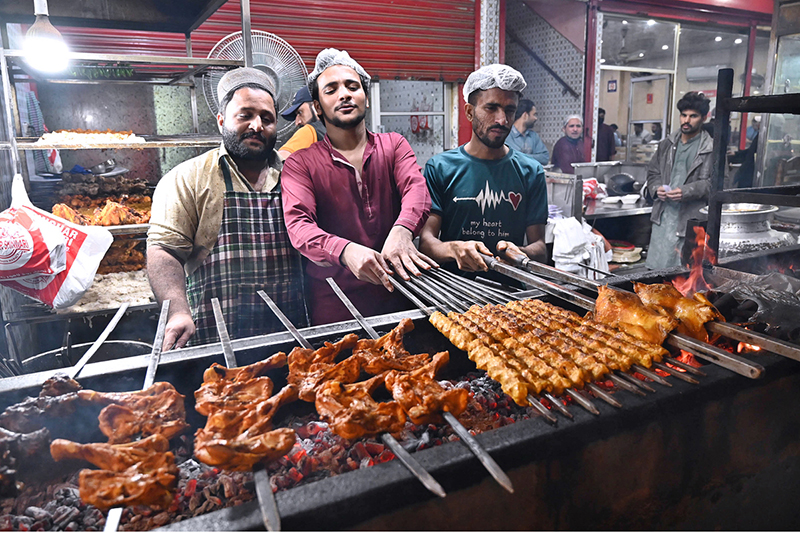
PESHAWAR, Mar 01 (APP):As the holy month of Ramadan continues, a unique trend has emerged in Peshawar’s vibrant food scene i.e grilled fish and Chappli Kabab became a favorite dishes for iftar parties which attracted a substantial number of fasting people to the famous Namak Mandi food street on weekend.
On Sunday, the famous bazzar along with Fawara Chowk cantt food street buzzed with food sale activity, as locals and visitors gathered to indulge in the mouthwatering taste of fish grilled and Chappli Kabab to perfection with a variety of spicy sauces at hotels and restaurants besides taking parcels for loved ones at homes.
Riaz Ali, a 65-year-old fish vendor who operates a popular eatery at Namak Mandi, was seen working tirelessly to fulfill an ever-growing number of orders for Iftar.
Surrounded by a substantial stocks of freshly unloaded fish, Ali and his team of three laborers cleaned and cocked various types of fish, including rahu, shermai, mahsher, and grass carp as its demands soars for Ifar parties.
Riaz’s efforts, despite the pressure of the busy iftar rush, were focused on serving timely meals to the ever-growing number of customers many of whom demands for parcels for homes parties.
“The recent rise in the prices of meat and chicken has led to a shift in food choices during iftar. Seafood, particularly grilled fish, has become a more popular and affordable option for people here in Khyber Pakhtunkhwa,” he explained.
He noted that the demand for fish and Chappli Kabab has soared, not only in Peshawar but across the province, providing a positive economic boost to local businesses.
According to him, nearly 200,000 people are directly or indirectly involved in the fisheries sector in Khyber Pakhtunkhwa.
He added that the province’s native fish species were more suited for local markets, as transportation costs from places like Karachi and Balochistan made the fish less economical.
Many customers, like Fayaz Khan, a resident of Nowshera, have developed a preference for grilled fish and Chappli Kabab at iftar. “Grilled fish and Chappli Kabab are my favorite dish, especially during Ramazan,” Khan said, adding that he and his family had visited Namak Mandi to enjoy the delectable bites with sauces flavors.
He also said that the prices of grilled fish were significantly lower than meat in Peshawar and he has ordered two kilogram fish for his married daughter also for Iftar.
While Namak Mandi is becoming an increasingly popular food street for locals, Riaz called for official recognition of the area as a designated food street, hoping to attract more visitors and boost the local economy after Ramazan.
“My iftar seems incomplete without grilled fish, “said Naveed Khan, a lecturer at Namak Mandi Peshawar.
Fisheries Department official said that fish demands increased during Ramazan after prices of meat soared in Khyber Pakhtunkhwa.
He said Pakistan, a country rich in water resources from marine, saline, and freshwater reservoirs, is home to a vast diversity of aquatic life.
In Pakistan, there are 531 species of fish across the country, including 233 freshwater species from rivers, lakes, and ponds in Khyber Pakhtunkhwa. Freshwater ponds cover an area of 60,470 hectares, and natural warm-water lakes span 110,000 hectares.
However, despite the abundance of resources and benefits, fish consumption in Pakistan remains low, with per capita consumption standing at just 2 kilograms per year compared to the global average of 17 kilograms in normal days.
Professor Dr. Naeem Khattak from the Economics Department at the University of Swabi highlighted the profitability of fish farming and the significant potential it holds for boosting Pakistan’s economy.
“If the country provides financial incentives to fish farmers, it could alleviate some of the economic challenges it faces,” Dr. Naeem said.
He pointed to a notable increase in seafood exports, which earned the country over Rs12.40 billion, and that the promising future of Pakistan’s fisheries sector, especially with the completion of the second phase of the China-Pakistan Economic Corridor (CPEC).
In recent years, fish production in Pakistan has risen sharply. In the 2016-17 financial year, the country produced 477,000 metric tons of fish, a significant increase from just 8,430 metric tons in 2010.
However, challenges such as overfishing, water pollution, and the impacts of climate change continue to pose a threat to the sustainability of fish farming in Pakistan.
The indigenous shermai fish, found in the River Kabul, is particularly vulnerable due to pollution and overfishing.
He emphasized the need to take strict action to protect this endangered species, suggesting that measures like banning hunting and preventing the discharge of contaminated water into the river could help preserve it for future generations.
In Khyber Pakhtunkhwa, the demand for fish farming is on the rise, and the provincial government is taking steps to support the industry’s growth.
Under the “Development of Cold Water Fisheries Resources” project, efforts are underway to establish 297 trout lakes in Malakand and Hazara divisions.
Additionally, trout farming has become increasingly popular in these areas, with projects like the “Trout Village” initiative seeing the establishment of 93 trout fish farms.
These efforts are expected to boost fish production in the province, potentially increasing it from 400 metric tons to 740 metric tons in the coming years.
Usman Ali, General Secretary of the Swat Trout Fish Farming Association, stressed the importance of supporting trout farmers with incentives and improved infrastructure.
He called for further development of trout farming in the region, citing the potential for substantial revenue generation. “A farmer with 50 marlas of land and proper water management can produce 3,000 kg of trout, earning about Rs2.5 million in profit,” he explained.
Despite the challenges faced by the fisheries sector, such as the impact of climate change on trout farming, the potential for growth remains significant. With the right investments and policies, Pakistan could further tap into its fisheries resources, bolstering both its economy and food security.
As grilled fish continues to gain popularity in Peshawar’s iftar scenes, the province’s fisheries industry is poised for growth after investment.
With increased demand for seafood, particularly during Ramazan, and governmental support for fish farming, the sector has the potential to make a lasting impact on the local economy and provide a sustainable source of income for thousands of families in Khyber Pakhtunkhwa.