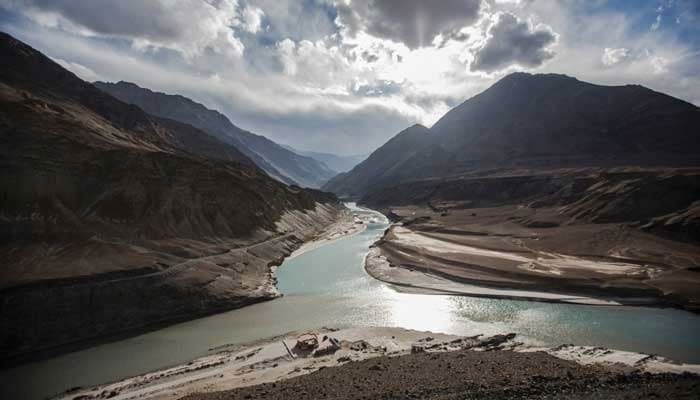
PESHAWAR, Apr 05 (APP):At dawn in the villages around Sindh River, Nasir Ali (45) wades into his fish ponds, clearing mud from narrow water channels with hove amid starting of summer in his hometown Swabi district.
Edge of uncertainty: KP’s water lifeline at risk amid IWT violations by India
By Fakhar-e-Alam
PESHAWAR, Apr 05 (APP):At dawn in the villages around Sindh River, Nasir Ali (45) wades into his fish ponds, clearing mud from narrow water channels with hove amid starting of summer in his hometown Swabi district.
Largely depends on the River Indus water, Nasir along with his brothers at Razar town wakes early in the morning and starts cleaning of water channels for smoth flow to his fish pond.
“If water becomes uncertain, how will we survive?” he asks quietly amid worry after continued IWT violations by India. For Nasir and thousands like him across Khyber Pakhtunkhwa, the Indus Waters Treaty violations by India are no longer distant diplomatic headlines but they are a daily struggle for survival for people depended on water based agricultural industries.
The unilateral decision by India to hold the treaty in abeyance in April last year has triggered alarm across KP, especially in its water-dependent regions.
The historic agreement, signed in 1960 between then President Ayub Khan and Indian PM Jawaharlal Nehru, had long been seen as a rare pillar of cooperation between the two countries.
Now, experts warned that its weakening could ripple through every layer of life such as from crops and fisheries to energy and industry.
“This is about food, not just water for millions of Pakistanis,” Professor Dr. Zilakat Malik at University of Peshawar explains the stakes in stark terms.
“Nearly 80 percent of Pakistan’s agriculture depends on the Indus basin,” he said. “If water flows become irregular, crop yields could fall sharply by as much as 40 percent in the worst cases.”
Fields that once yielded wheat, sugarcane, and vegetables are likely to turning barren in KP, Azad Kashmir and Punjab, exposing millions of people to hunger and starvation.
Orchards of citrus, bananas, watermelon, mangoes and peaches across KP may wither. For farmers already battling rising costs, even a small disruption can mean the difference between survival and debt.
For former fisheries chief Muhammad Shafi Marwat, the water crisis amid IWT violations is even more immediate that will make negative effects on fisheries sector.
“Fisheries cannot survive on uncertain water,” he reiterated. “If flows are restricted, breeding cycles can collapse overnight.”
Cold water species like trout that is thriving in rivers such as Neelum River depend on precise temperatures and steady flows. A sudden drop or surge can wipe them out entirely.
“In lower regions of KP such as Charsadda, Nowshera and Peshawar, species like Mahseer are also at risk,” he added. “Disrupt one river, and you destabilize the entire ecological chain.”
Dr. Zilakat sees the water crisis extending far beyond rivers and farms if IWT violations continue.
“This is not just a resource or diplomatic issue but a food security emergency in the making,” he warned.
Glacier-fed systems from the Himalayas, Karakoram, and Hindu Kush sustained millions. Any disruption in water flow, he said, could push entire communities toward hunger.
Reduced water also means loss of nutrient-rich silt and nature’s fertilizer. Without it, soil fertility declines, fish breeding grounds shrink, and productivity drops across the board.
Communities and fishermen have already witnessed the dangers of erratic flows.
“If water is held and then suddenly released, it triggers floods,” Marwat explained, recalling recent surges in rivers like Jhelum River and Ravi River recently that destroyed crops and fish farms.
At other times, reduced flows leave canals dry, forcing farmers and fishermen to rely on costly groundwater pumping—an option many simply cannot afford due to rising electricity and petrol cost.
Back in his village, Nasir watches as his children help carry buckets of water and fish feed to sustain the pond.
Nasir said the cost of fish feed is rising and electricity bills for tube wells are climbing while market prices for food are becoming unpredictable in KP.
“If this continues, small farmers and fishermen will be pushed out of the food system entirely,” said Dr Zilakat.
Experts are urging global intervention, particularly from the World Bank to force India to reverse its illegal decision, which served as a guarantor of the treaty.
They emphasized the need for strengthened water diplomacy, better storage and irrigation systems and efficient water management.
But above all, they stressed that the Indus Waters Treaty must be preserved as water is survival for agriculture based economy.”
As the sun sets over the riverbanks, Nasir’s question lingers in the air.
“If the water stops, everything stops,” Nasir said amid uncertainty about fate of IWT.
For millions in Khyber Pakhtunkhwa, water is no longer just a resource. It is food, income, culture and survival itself.
And as uncertainty grows, so does the fear that what flows through their rivers today may determine whether their future runs dry.