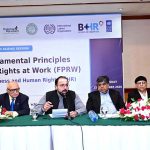
GILGIT, Sep 23 (APP):Ambassador of the European Union to Pakistan Raimundas Karoblis has reaffirmed the EU’s support for sustainable and climate-resilient agricultural development in Gilgit-Baltistan, improving livelihoods and strengthening the resilience of communities affected by climate change. The Ambassador was speaking at a high-level meeting at the launching ceremony of the proposed new Agriculture Policy and Action Plan 2027–2036 Gilgit-Baltistan, that has been developed as part of EU Policy Support …
EU reiterates support for climate-resilient agriculture in Gilgit-Baltistan
GILGIT, Sep 23 (APP):Ambassador of the European Union to Pakistan Raimundas Karoblis has reaffirmed the EU’s support for sustainable and climate-resilient agricultural development in Gilgit-Baltistan, improving livelihoods and strengthening the resilience of communities affected by climate change.
The Ambassador was speaking at a high-level meeting at the launching ceremony of the proposed new Agriculture Policy and Action Plan 2027–2036 Gilgit-Baltistan, that has been developed as part of EU Policy Support Project to Government of Gilgit-Baltistan.
He further said that the European Union remained committed to strengthening the economic self-reliance of communities affected by climate change and promoting innovation and sustainability in agriculture.
“Following the successful completion of this important phase of policy formulation, the European Union will further expand its technical and financial cooperation with the Government of Gilgit-Baltistan in the coming years to help achieve the objectives of agricultural transformation and economic prosperity,” he said.
The event was attended by Minister for Agriculture and Livestock Anwar Ali, Secretary Agriculture, Livestock and Fisheries Usman Ahmed, senior officials of the Government of Gilgit-Baltistan, Team Leader of the EU Policy Support Project Ashab Ullah Baig, and Agriculture Expert Zafar Khan.
A detailed presentation was made on the key features, vision and 10-year action plan of the proposed agriculture policy. It noted that fragmented landholdings, limited access to modern agricultural facilities and inadequate post-harvest infrastructure contribute to significant losses in fruit production, estimated at around 23 per cent overall. Losses are particularly high for mulberries (51 per cent), peaches (28 per cent) and apricots (24 per cent).
The proposed policy seeks to modernise the agricultural sector, strengthen its links with domestic and international markets, and support the Gilgit-Baltistan Chief Minister’s vision of creating employment and prosperity through agriculture, livestock and fisheries. It also promotes organic farming, carbon farming and climate-smart agriculture as important pathways for sustainable agricultural development.
The policy’s 10-year action plan is structured around three phases: a Foundation Phase (2027–2029), an Expansion Phase (2030–2032) and a Consolidation Phase (2033–2036). Key priorities include establishing and strengthening farmers’ cooperatives, expanding cold-chain and processing facilities, improving productivity and value addition, and enhancing access to domestic and international markets.
At the conclusion of the event, representatives and senior officials of the Government of Gilgit-Baltistan expressed their appreciation to the EU Ambassador and his team for the European Union’s technical and financial support.
They reaffirmed the government’s commitment to advancing the policy’s priorities and supporting its effective implementation.