
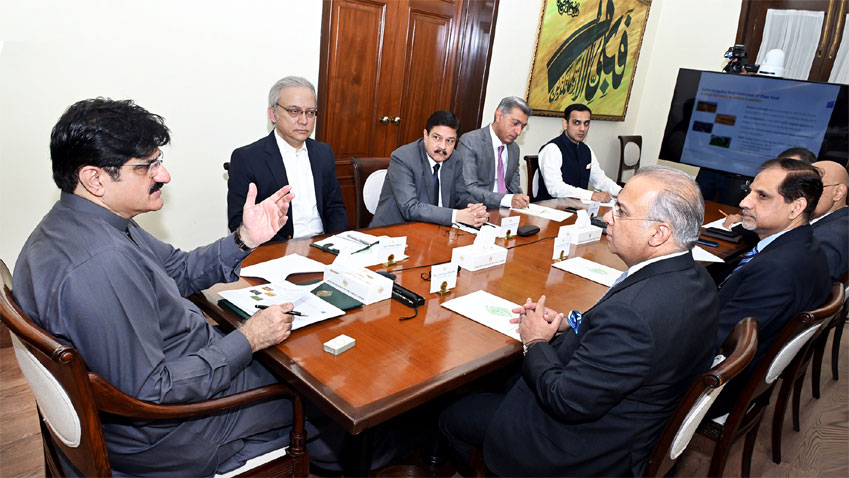

KARACHI, Feb 20 (APP): Sindh Chief Minister Syed Murad Ali Shah, while reviewing the progress and finalising the strategic roadmap for Pakistan’s flagship Coal-to-Fertiliser (C2F) initiative – the Thar coal-based urea project being executed by Fauji Fertiliser Company (FFC), said it will reduce reliance on imported fertiliser, create jobs, generate exports, and add value to the country’s indigenous coal resources.
The delegation, led by FFC Chief Executive Officer Jahangir Piracha, briefed the chief minister on the technical, financial and environmental aspects of the $1.12 billion project, which aims to utilise Thar’s indigenous coal reserves to strengthen Pakistan’s fertiliser security and reduce import dependence.
The meeting at the CM House was attended by Principal Secretary to the CM Agha Wasif; Energy Secretary Shahab Ansari, Managing Director of Thar Coal Tariq Shah; and senior officials. The FFC team included Chief Technical Officer Syed Aamir Abbas, Head of Government and Public Relations Shahbaz A. Khan and Saad Lodhi.
FFC team briefed the chief minister that the project has achieved a critical milestone with the completion of its Bankable Feasibility Study (BFS) in November 2025, prepared by internationally reputed consultants. With the BFS finalised, the project has now entered the front-end engineering design (FEED) and project agreements phase.
Under the current timeline, financial close is targeted between late 2026 and 2027, while the Commercial Operations Date (COD) is projected for January 2031.
Describing the initiative as a “game changer”, FFC highlighted that the C2F project will produce 717,000 tonnes of urea annually, with production evenly split between domestic consumption and exports. Annual urea exports are expected to generate revenues of up to $260 million.
The project is also projected to create over 3,500 direct jobs and around 7,000 indirect employment opportunities, while generating estimated annual royalties of $5.5 million for the Sindh Government through the extraction of approximately 2.1 million tonnes of coal per year.
The integrated plant will convert Thar coal into synthesis gas through gasification, followed by desulphurisation and shift conversion to produce hydrogen for ammonia and urea manufacturing. Phase-I includes the production of bulk and bagged urea, 10.4 thousand tonnes per year of sulphur, and 717 thousand tonnes per year of surplus CO2 for downstream industrial use.
Phase-II envisages the expansion of urea capacity and the introduction of green ammonia, including pilot-scale production aligned with emerging global sustainability standards.
FFC noted that over $50 million has been committed to environmental safeguards, including NOx and SOx control systems, PM2.5 particulate control, zero liquid discharge through reverse osmosis, sewage treatment, rainwater harvesting, and a waste-to-value approach producing industrial-grade gypsum, sulphur, slag and fly ash.
The chief minister said that to ensure project viability, the Sindh government will continue facilitation in main areas, including allocation of 12 cusecs of water from Makhi Farash, land allocation for the plant site and an employees’ residential colony in Islamkot.
Chief Minister Murad Ali Shah reaffirmed the provincial government’s full commitment to the project, terming it strategically vital for Pakistan’s food security, industrial growth and economic stability.
“This project is of immense importance not only for Sindh but for the entire country. It will reduce reliance on imported fertiliser, create jobs, generate exports and add value to our indigenous coal resources,” the chief minister said. He assured FFC of the provincial government’s support in facilitating land, water and policy coordination, in line with applicable laws and regulations.
The chief minister added that sustainable industrial development and strict environmental compliance would remain key priorities as the project moves toward execution.
Once operational, the C2F project is expected to play a pivotal role in strengthening Pakistan’s fertiliser supply chain, supporting farmers, and promoting cleaner, value-added industrial use of Thar coal with the backing of both the Government of Pakistan and the Sindh government.