
Khalid Taimur Akram
Balochistan is the largest province of Pakistan by area. It is rich in resources but unfortunately, poor in opportunities. For decades, the people of Balochistan have faced challenges such as lack of infrastructure, unemployment, limited access to markets, and underdevelopment. These challenges and lack of opportunities, as compared to other provinces of Pakistan, led the people of Balochistan to develop a sense of neglect. In such circumstances, the China-Pakistan Economic Corridor (CPEC), the flagship project under BRI, served as a beacon of hope and opened a new chapter of progress and development for Balochistan.
CPEC is termed as a game changer for Pakistan in general and Balochistan in particular. It is not just a collection of projects. It is a vision for regional connectivity and shared growth. Now the question is, why is CPEC so important for Balochistan? The reason is that this province connects Pakistan to the Central Asia, Middle East, and beyond. So, by improving infrastructure and creating economic opportunities, CPEC is actually helping Balochistan to move from isolation towards integration.
Thanks to CPEC, Balochistan is witnessing major transformation in the development landscape. Whether we talk about energy projects, roads and connectivity, Gwadar development, social sector projects, or industrial zones, substantial progress is recorded in every sector.
According to official documents, several large-scale projects, funded through a combination of grants, Build-Operate-Transfer (BOT) models, Public Sector Development Programme (PSDP) financing and Chinese investments, have reached completion or are advancing rapidly, cementing CPEC’s role as the main driver of regional development.
Development of Gwadar Port
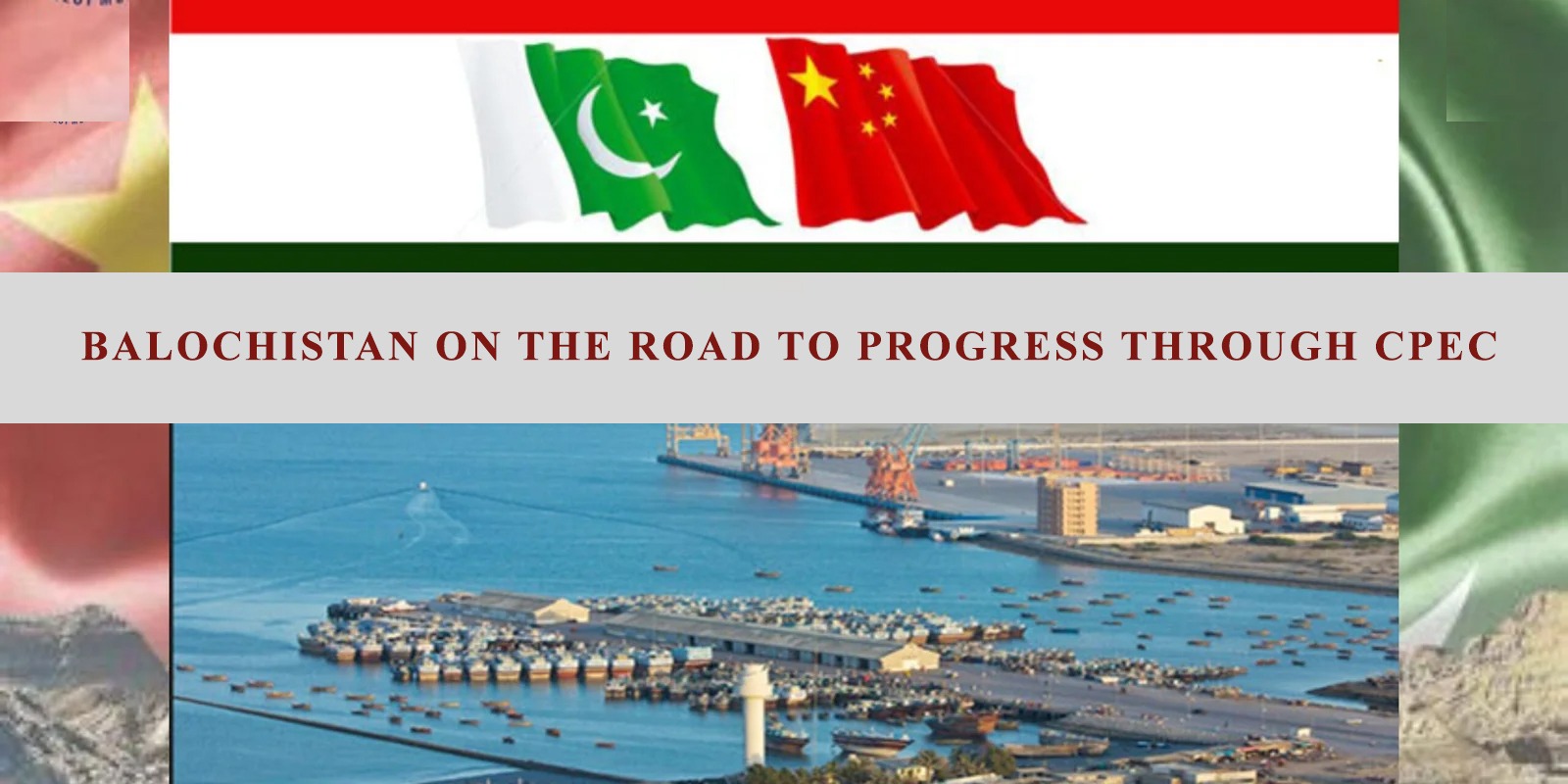
One of the most significant CPEC projects in Balochistan is the development of Gwadar Port. Gwadar, situated in Balochistan, was once known as a small fishing town but now it is emerging as a modern deep-sea port regarded as the “crown jewel” of CPEC. Now it is of global importance. Gwadar Port, situated on the Arabian Sea, near the Strait of Hormuz, where nearly 20% of the world’s oil trade passes, provides Pakistan direct access to global sea trade routes and reduces dependency on Karachi and Port Qasim. It also serves as a potential gateway for Central Asian and Middle Eastern trade. It gives Balochistan a central role in regional trade. With the development of port facilities, storage areas, and free zones, Gwadar is creating new jobs for local people and attracting investors from within and outside Pakistan.
In addition to the development of Gwadar Port, the Gwadar Free Zone is another major step towards economic growth. Gwadar Free Zone is a major industrial and commercial area location in Gwadar. It is being developed as a key component of CPEC. It is known as Free Zone because it offers significant tax exemptions and facilities to attract local and foreign investment. The zone is designed to serve as a regional trade and logistics hub. In this Free Zone, various industries such as logistics, fisheries, and warehousing are being encouraged. These initiatives will help in diversifying local economy and reduced dependence on traditional livelihoods. It will generate job opportunities, which will in turn help improve the living standards of the people of Balochistan.
Gwadar Free Zone has 2 phases or zones. Phase 1 or the Initial Zone is completed. It focused on essential port infrastructure, basic services like power, water, roads, telecom, and attracting early businesses, with some companies already operating. Phase 2 or the Main Zone is focused on innovation and industrial upgrades. Work is underway on Gwadar Free Zone Phase-II, with an estimated BOT investment of $285 million.
Another landmark project is New Gwadar International Airport which is completed now and it cost $230 million. Equipped with cutting-edge technology and capable of accommodating large aircraft, including Airbus and Boeing models, the New Gwadar International Airport is built to international standards. The operationalization of Gwadar’s airport is more than a logistical achievement; it is a harbinger of economic transformation for the region and beyond. It is aptly described as “a gateway to progress”. The airport is expected to enhance tourism industry in Pakistan, foster trade, and attract investment, creating numerous economic opportunities.
Roads and Connectivity
Road infrastructure is another area where CPEC is making a visible difference. For many years, poor roads made travel within Balochistan slow, unsafe, and expensive. CPEC has changed this situation by connecting remote areas to major cities and trade routes. Projects such as the M-8 motorway (connecting Gwadar to Ratodero), the N-85 highway, and the Quetta–Zhob road have improved connectivity across the province. These roads reduce travel time, lower transport costs, and make it easier for people to access education, healthcare, and markets.
Projects completed across the province include Eastbay Expressway Phase-I ($179 million) and Khuzdar Basima Road ($118 million). Eastbay Expressway is the main artery of Gwadar Port through which the entire traffic of the port will flow. The objective of Eastbay Expressway is to provide primary connectivity of the Port & its Free Zone with the network of National Highways for smooth logistic transportation of import, export, and transit goods. The N-30 or National Highway, also known as the Khuzdar Basima Road, is a 110km national highway in Pakistan which extends from Basima to Khuzdar in Balochistan province. The project is located in District Khuzdar in Balochistan. It has created 600 jobs for local people.
Under-construction connectivity projects, critical for unlocking Balochistan’s economic potential, include Awaran–Naal Road (168 km), cost $107 million, Nokundi–Mashkhel Road (103 km), $47 million, Hoshab–Awaran Section of M-8 (146 km), $161 million and Zhob-Quetta Road (298 km), $391 million.
Better roads also help local businesses and farmers. When farmers can transport their products quickly to markets, they earn better prices. When small businesses can receive raw materials and send finished goods without delay, their profits increase. In this way, road networks under CPEC are strengthening the local economy from the ground up.
Energy Projects
A major area where CPEC is making a positive difference is energy. Reliable electricity is essential for development, still many parts of Balochistan have suffered from shortages. Such shortages directly affected the daily life of the people of Balochistan. Now, after suffering for so many years, power projects linked to CPEC are helping improve electricity supply and reliability. Among the flagship energy achievements is the successful completion of the 1,320MW China Hub Coal Power Plant, a $1.9 billion Independent Power Producer (IPP) initiative providing essential baseload power to the national grid. In addition, 300MW Gwadar Coal Power Project, a $542 million investment designed to stabilize power supply to Gwadar and surrounding districts, is under construction.
With better energy access, industries can operate smoothly, schools and hospitals can function more effectively, and households can enjoy a better quality of life. Energy availability is a basic requirement for development, and CPEC is helping Balochistan move in this direction.
Social Sector Projects
It is worth pointing out that China and Pakistan, through CPEC, are not only focusing on improving connectivity, road infrastructure, industries, and the energy sectors in Balochistan, but they are also determined to improve the living standards of the people of Balochistan. Along with various infrastructure and energy projects, CPEC has also launched some social sector development projects in Balochistan that focus on health, education, poverty alleviation, and community uplift, including establishing Burns Centers, upgrading schools with smart classrooms, providing medical equipment (like for Gwadar Hospital), vocational training, and clean water/solar projects, aiming to improve livelihoods and support the province’s economic growth, though challenges in full implementation remain.
Socioeconomic uplift remains central to CPEC’s development strategy. Completed grant-based initiatives include Gwadar Smart Port City Master Plan ($4 million), Freshwater treatment and supply schemes ($130 million), Pak-China Friendship Hospital ($100 million), Technical and Vocational Institute Gwadar (USD 10 million), 1.2 MGD Gwadar Desalination Plant ($13.97 million) and Provision of 15,000 solar lighting units for underserved communities.
Under construction projects in social sector development include:
- China-Pakistan Joint Agricultural Technology Laboratory
- Provision of Agricultural equipment and tools
- Establishment of 50-Smart Classroom for Higher education in Pakistan
- China-Pakistan Joint Agricultural demonstrations
- Establishment of Burn Centers in Punjab, Khyber Pakhtunkhwa, Balochistan, AJK and Gilgit Baltistan.
- Medical Emergency center in Quetta, Balochistan
Special Economic Zones (SEZs)
Special Economic Zones (SEZs) planned under CPEC in Balochistan are another source of hope. The key ones are the Bostan SEZ, Hub SEZ, and the Gwadar Free Trade Zone. These zones are designed to attract investment in sectors like agriculture, mining, tech, and manufacturing, by offering facilities and incentives to industries. Given the province’s resources and strategic location for regional connectivity, SEZs can become centers of manufacturing, processing, and services. As industries grow, they create jobs, transfer skills, and generate revenue for the province. Over time, this can reduce poverty and promote balanced regional development.
A Final Perspective
Based on the foregoing discussion, it can be argued that the CPEC has improved the strategic importance of Balochistan within Pakistan. The province which was once being neglected and underdeveloped now stands at the crossroads of connectivity. It is now undergoing some huge transformations which nobody expected and all credit goes to China-Pakistan Economic Corridor. With the improved connectivity, the province becomes a bridge between regions rather than a distant frontier.
It is important to acknowledge that challenges still exist. Development takes time, and benefits may not reach everyone immediately. However, the direction is clear. CPEC has laid the foundation for long-term growth in Balochistan. With continued commitment, transparency, and local participation, these projects can bring lasting positive change.
The writer is Executive Director, Pakistan Research Center for a Community with Shared Future (PRCCSF), Islamabad.