Uzbekistan is actively working to deepen its economic ties within the Shanghai Cooperation Organization (SCO) as the organization approaches its 25th anniversary in 2026, marking a new phase of regional integration and development.
ISLAMABAD, Aug 28 (APP):Uzbekistan is actively working to deepen its economic ties within the Shanghai Cooperation Organization (SCO) as the organization approaches its 25th anniversary in 2026, marking a new phase of regional integration and development.
Since its inception in 2001, the SCO has grown significantly, now comprising 10 member states China, Russia, Kazakhstan, Kyrgyzstan, Tajikistan, Uzbekistan, India, Pakistan, Iran, and Belarus and 17 partner countries. Covering over 65 percent of Eurasia and home to approximately 3.4 billion people, the SCO has become a major economic platform, with a combined nominal GDP exceeding US$ 26 trillion and a share of over one-third of global Gross Domestic Product based on purchasing power parity.
The trade among SCO countries has surged in recent years, nearly doubling from US$ 271 billion in 2015 to US$ 674 billion in 2024. For Uzbekistan, the organization has become central to its foreign economic strategy.
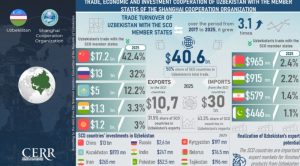
According to the article written by Ziyoda Rizaeva, Center for Economic Research and Reforms, Uzbekistan’s trade volume with SCO nations increased 3.1 times between 2017 and 2025, rising from US$ 12.9 billion to US$ 40.6 billion. Exports grew from US$ 5.8 billion to US$ 10.65 billion, while imports soared from US$ 7.1 billion to nearly US$ 30 billion.
By 2025, roughly half of Uzbekistan’s foreign trade was with SCO members, with China, Russia, and Kazakhstan remaining its primary partners. Trade with China alone reached US$ 17.2 billion, highlighting the strategic importance of these relationships.
Uzbekistan exports a variety of products to SCO markets, including fruits, vegetables, textiles, electrical goods, and automotive parts, while its imports mainly consist of machinery, industrial equipment, raw materials, and food products.
The rapid growth in trade is paving the way for deeper economic integration based on investment and industrial cooperation. In 2025, foreign investment and loans in Uzbekistan’s fixed capital totaled US$ 33.5 billion, with manufacturing accounting for a third of this figure.
During the same year, SCO member states invested US$ 17.5 billion in Uzbekistan, with China contributing the largest share at US$ 13 billion, followed by Russia with US$ 2.6 billion.
Looking ahead, Uzbekistan aims to move beyond traditional trade towards joint ventures, technology transfer, industrial partnerships, and raw material processing. President Shavkat Mirziyoyev emphasized these priorities at the 2025 SCO summit in Tianjin, advocating for the development of production and logistics chains, harmonization of standards, and a new “SCO Invest” forum to promote direct business cooperation.
Practical steps followed in 2026 with the organization of the SCO Investment and Business Forum in Bishkek, focusing on innovation, digital economy, artificial intelligence, and new industrialization.
Transport connectivity is another critical area of cooperation. Due to its strategic geographic location, Uzbekistan serves as a transit hub connecting major Eurasian trade routes.
Freight transportation between Uzbekistan and SCO countries increased by 40 percent over the past five years, reaching 33.5 million tonnes in 2025. The country’s Ministry of Transport estimates this could rise to 47 million tonnes by 2030.
Notable projects include the China-Kyrgyzstan-Uzbekistan railway, which began construction in December 2024 and is expected to shorten transit distances by around 900 kilometers and reduce delivery times by a week or more.
Another significant project is the Uzbekistan-Afghanistan-Pakistan railway, for which a feasibility study is underway following a framework agreement signed in 2025. These corridors aim to create a seamless transport network linking China with Central Asia, Afghanistan, Pakistan, and Indian Ocean ports.
Beyond trade and transport, SCO’s economic agenda is expanding into technology, energy, environment, agriculture, and tourism.
Uzbekistan has proposed establishing an “SCO Network of Innovation and Technology Hubs” to promote AI, big data, robotics, and alternative energy solutions. Energy cooperation is gaining momentum, with SCO countries reaching a renewable capacity of over 2.3 billion kilowatts by 2024.
Uzbekistan has also proposed an SCO Energy Consortium and regional platforms for climate adaptation and decarbonization.
Environmental initiatives focus on ecosystem monitoring, water resource management, and restoration efforts in the Aral Sea region, alongside agricultural cooperation to improve food security.
Humanitarian and tourism initiatives are also part of Uzbekistan’s broader economic vision. These include proposals for an online SCO university campus, innovation competitions, cultural dialogues, and tourism corridors, aimed at fostering regional cooperation and cultural exchange.
The 2025 Tianjin Summit marked a key milestone with the adoption of the SCO Development Strategy through 2035 and the proposal to establish an SCO Development Bank. This new financial institution aims to fund infrastructure and industrial projects across the organization, though its mechanisms are still being developed.
The next phase of SCO economic cooperation will focus on translating political agreements into tangible projects, emphasizing technological advancement, industrial localization, and transport infrastructure.
For Uzbekistan, leveraging the organization’s expanding institutional framework could significantly bolster its position as a regional trade and transit hub, contributing to sustainable development and regional stability.