PSIB launch a milestone in economic reforms, human capital development: Aurangzeb
PSIB launch a milestone in economic reforms, human capital development: Aurangzeb
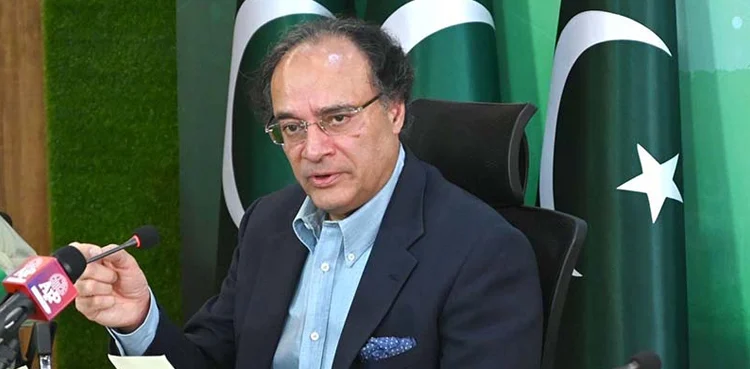
ISLAMABAD, Dec 30 (APP): Minister for Finance and Revenue Senator Muhammad Aurangzeb on Tuesday termed the launch of Pakistan’s first private-capital-funded Pakistan Skills Impact Bond (PSIB) as a major milestone in the country’s economic reforms agenda and human capital development strategy.
Addressing a signing ceremony of financing documents under the Pakistan Skills Impact Bond (PSIB), launched by the National Vocational and Technical Training Commission (NAVTTC), the minister said the initiative marked an important moment for education and skills training, stressing that Pakistan’s demographic dividend can only be realized through large-scale upskilling and reskilling of youth.
He noted that NAVTTC lies at the center of this national vision, particularly as global demand shifts toward high-value digital skills such as blockchain, which offer significant earning potential for Pakistani youth. Pakistan, he added, already ranks as the world’s third-largest freelancer community.
Aurangzeb emphasized that the PSIB is part of a wider, government-led strategic shift away from traditional budget-based social spending toward outcomes, evidence and accountability, reflecting a deliberate departure from input-driven systems that rely solely on public financing.
Aurangzeb recalled that the prime minister had tasked him last year with chairing a multi-stakeholder committee on Social Impact Financing, which brought together policymakers, development experts, technology partners, international organizations and financial sector practitioners to develop Pakistan’s first Social Impact Financing Framework.
The framework identifies six national priority pillars: education and human capital, gender equality, health and well-being, population stabilization, climate resilience, and poverty and migration.
Highlighting gender inclusion, the minister welcomed the recommendation led by the British Asian Trust to allocate 40% of PSIB traineeships to women. He said women’s participation and leadership in the workforce would be decisive for Pakistan’s long-term economic trajectory.
He explained that the Ministry of Finance’s Rs 1 billion guarantee is intended to be catalytic, aimed at crowding in private investment and establishing credibility for the pioneering structure. The support, he said, is non-structural and designed strictly as a proof of concept, with a clear roadmap toward reducing reliance on sovereign guarantees and and leads ultimately to a model that functions without government balance-sheet exposure.
The minister added that only through such structured public-private partnerships can Pakistan achieve scale, credibility and sustainability in human capital development.
The PSIB will operationalize the inaugural Rs 1 billion pilot tranche of a three-year instrument to fund a scalable technical skills development program.
It is designed to deliver measurable outcomes, including certification, job placement and at least six months of employment retention for each trainee, the PSIB represents a fundamental restructuring of how Pakistan finances skill development, shifting decisively from input-based public spending to outcome-driven, private-sector-enabled social investment.
The model will gradually evolve so that subsequent tranches link repayment to a nominal portion of trainee salaries, embedding long-term sustainability while monetizing Pakistan’s demographic dividend both domestically and through the export of certified talent.
The launch ceremony, which also featured the signing of Financing Documents including Investor and Issuer Agreements, was attended by senior government officials, development partners, private sector leaders and representatives of international organizations.
Senator Aurangzeb congratulated NAVTTC’s leadership, the programme’s steering committee, the Foreign, Commonwealth and Development Office (FCDO) and the Bank of Punjab for advancing this landmark initiative.
He reaffirmed the government’s commitment to embedding skills, productivity and employment at the core of economic planning and concluded by reiterating confidence in Pakistan’s ability to deliver measurable impact through this new financing model.
Earlier, Muhammad Amir Jan, Executive Director NAVTTC, delivered the welcome address, describing the PSIB as a defining moment in Pakistan’s skill development journey and a clear demonstration of NAVTTC’s transition toward a coherent, demand-driven, outcome-based skills ecosystem.
He highlighted the extensive reforms undertaken in governance, financial transparency, provincial coordination and industry linkages, noting that NAVTTC has repositioned skills training as a strategic investment in human capital rather than a series of fragmented interventions.
He acknowledged the support of the Prime Minister, SIFC leadership, the Planning Commission, development partners and private sector collaborators including Bank of Punjab, British Asian Trust and EY for their role in enabling the PSIB’s launch.
Dr. Khalid Maqbool Siddiqui, Minister for Education and Professional Training, also addressed the ceremony, describing the signing ceremony as a major step toward a “better Pakistan and a better future.”
He emphasized that Pakistan stands at a decisive crossroads and that commitment, coordination and well-thought-out action are essential to meeting national challenges.
He expressed gratitude to Pakistan’s development partners, especially FCDO and the British Asian Trust, for their contribution.
The ceremony was also addressed by Zafar Masud, President Bank of Punjab, who provided a strategic overview of the PSIB and its role in Pakistan’s emerging social impact financing landscape.
Asif Rangoonwala Vice Chairperson, British Asian Trust, outlined the Trust’s role as Programme Manager of the PSIB, while Matt Cannell, British Deputy High Commissioner to Pakistan, shared insights on FCDO’s partnership and long-term commitment to Pakistan’s skills and employment agenda.
Gulmina Bilal Ahmad, Chairperson of NAVTTC, delivered the concluding remarks and vote of thanks, acknowledging all partners and reaffirming NAVTTC’s commitment to delivering measurable, youth-centered results under the Pakistan Skills Impact Bond.