Federal Minister for Finance and Revenue Senator Muhammad Aurangzeb on Thursday said Pakistan’s economy was moving in the right direction, with the government focused on consolidating macroeconomic stability and creating an enabling environment for private sector-led sustainable growth and investment.
Private sector to lead Pakistan’s sustainable growth, investment: Aurangzeb
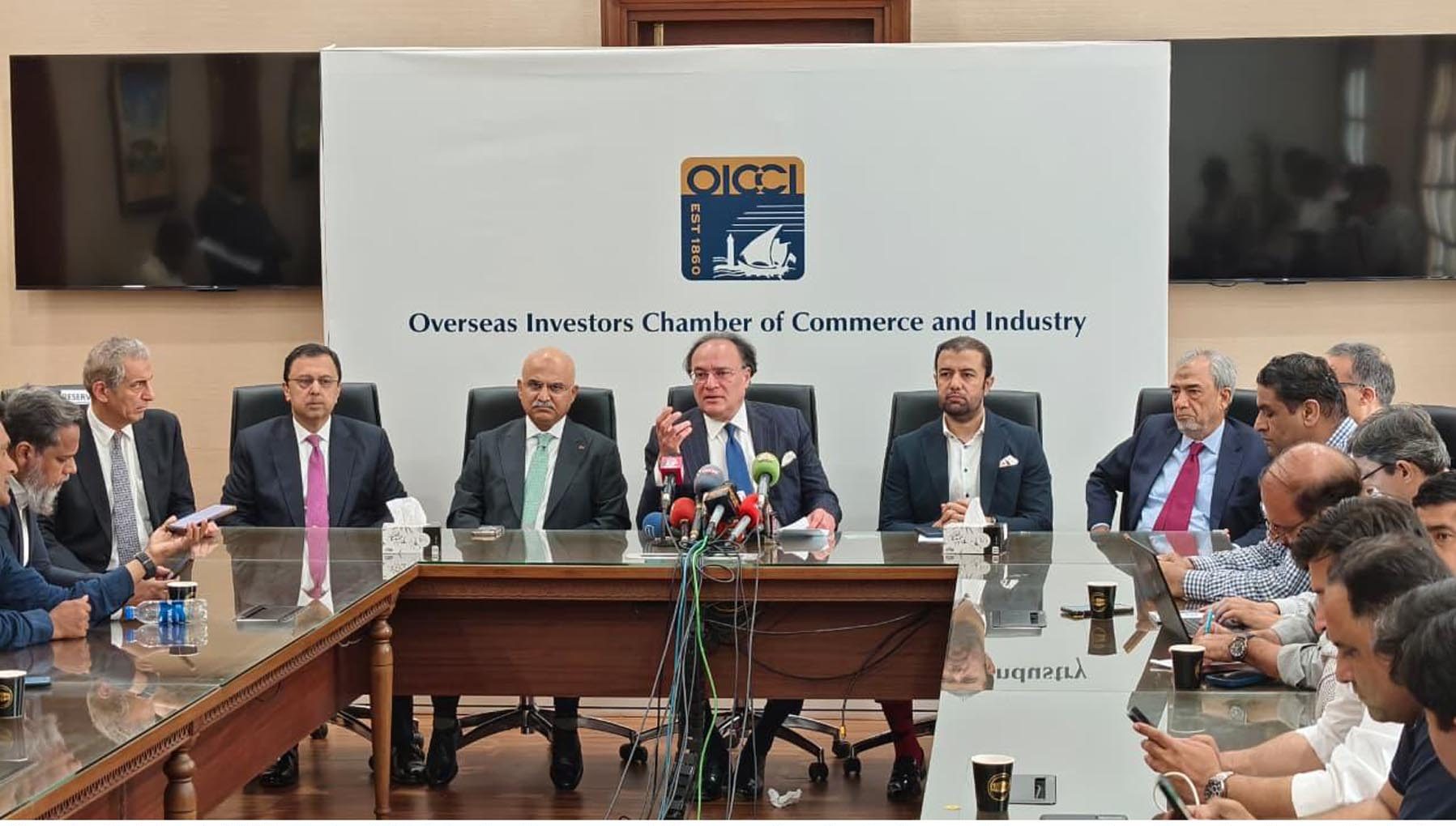
KARACHI, Oct 01 (APP): Federal Minister for Finance and Revenue Senator Muhammad Aurangzeb on Thursday said Pakistan’s economy was moving in the right direction, with the government focused on consolidating macroeconomic stability and creating an enabling environment for private sector-led sustainable growth and investment.
Addressing members and stakeholders of the Overseas Investors Chamber of Commerce and Industry (OICCI) during his visit here, the Finance Minister said sustainable economic growth would have to be led by the private sector, while the government would continue to provide a conducive business environment, policy framework and investment ecosystem.
Aurangzeb outlined the government’s six economic priorities, including bringing permanence to macroeconomic stability through lasting fiscal and external resilience and stronger shock-absorbing capacity; shifting from stabilization to sustainable, inclusive and responsible growth driven by productivity, investment, exports and jobs; and maintaining the pace of structural reforms through sustained, credible and implementation-focused measures.
The priorities also include shifting from aid to trade and investment by reorienting Pakistan’s global economic engagement towards trade, investment and private capital flows; expanding access to finance for SMEs, agriculture, housing and underserved segments; and positioning Pakistan for the New Economy by harnessing digitalization, blockchain, Web 3.0 and emerging technologies.
“Three years ago, the country’s economy had contracted. Today, we have moved from stabilization towards growth, and we have to make sure that this growth remains sustainable,” he said.
The Finance Minister stressed the need to consolidate these gains, bring permanence to macroeconomic stability and break away from the boom-and-bust cycle, saying growth should increasingly be driven by productivity, investment, exports and employment rather than temporary liquidity injections and consumption-led expansion.
Highlighting domestic investment and capital formation, he referred to the PIA transaction, where major Pakistani business groups demonstrated their ability to work together and collectively mobilize close to US$1.2 billion.
“The Government’s job is to provide a business-friendly and enabling environment; the private sector has to lead economic growth,” he said, adding that the government would continue to provide policy framework, regulatory facilitation and an investment ecosystem, including through engagement with US EXIM Bank, other export credit agencies and international partners, as well as tariff discussions and negotiations.
On foreign investment, he highlighted emerging investor interest in mining and minerals, technology, agriculture, oil and gas, refinery upgrades and other sectors.
He also noted interest from Turkish investors in the privatisation of electricity distribution companies and growing interest from Saudi and other international investors.
He stressed that foreign investment took time to materialize and required policy continuity, effective facilitation and a conducive investment ecosystem.
On structural reforms, Senator Muhammad Aurangzeb said reforms had moved beyond the design phase into execution, covering taxation, energy, State-Owned Enterprises, privatisation and public finance.
He noted that the number of tax filers had crossed 5.7 million, compared with around 3.9 million last year and approximately 1.8 to 1.9 million in 2022.
He said revenue mobilization would continue alongside taxpayer facilitation and efforts to build greater trust, with digitalization and data playing an increasing role in strengthening tax administration.
Stronger and more efficient revenue collection, he added, was essential for maintaining fiscal stability and creating greater space for productive investment.
On access to finance, the Finance Minister highlighted efforts to expand financing opportunities for SMEs, agriculture, housing and underserved segments.
Referring to the Prime Minister’s Apna Ghar Programme, he said around Rs60 billion had already been financed, while banks had approved a substantial additional financing pipeline.
He said the challenge was increasingly shifting from availability of financing towards strengthening the supply side and ensuring that available credit translated into construction, investment, employment and broader economic activity.
The Finance Minister also stressed the need to deepen Pakistan’s capital markets so domestic savings could increasingly be channelled into productive investment, including infrastructure, housing, privatisation and private-sector expansion.
He said the government was working to strengthen the broader capital-market ecosystem and create greater avenues for capital formation and investment.
He reiterated the government’s objective of moving bilateral economic relationships from aid towards trade and investment flows while positioning Pakistan for the New Economy, highlighting opportunities in digitalization, blockchain, Web 3.0 and emerging technologies to support investment, innovation, exports and employment.
During the interaction, OICCI representatives shared their perspectives on the business and investment environment and discussed opportunities for greater participation by international investors.
The discussion also covered measures to improve the business environment, facilitate investment and strengthen private sector-led growth.
Aurangzeb said Pakistan’s economic trajectory would increasingly depend on the private sector’s ability to invest, innovate, create employment and expand productive capacity, while the government would focus on policy continuity, facilitation and sound economic governance.
He reaffirmed the government’s resolve to bring permanence to macroeconomic stability, strengthen investor confidence and create an enabling environment for sustainable, inclusive and private sector-led growth.