
LAHORE, Dec 15 (APP):The implementation on National SME and Worker Formalization Roadmap will pave way for competitive economic growth of Pakistan by promoting stronger institutions, higher productivity, and improved working conditions of the SME sector.
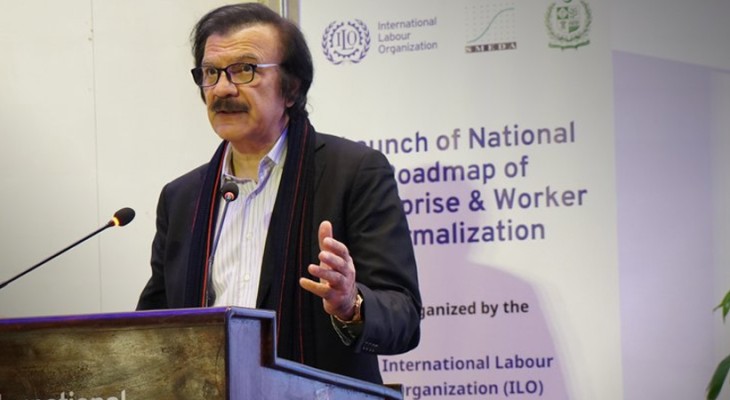
This was the crux of comments on the roadmap shared here Monday by Haroon Akhtar Khan, Special Assistant to PM on Industries and Production (SAPM), Malik Aman, Joint Secretary MoIP, Ms. Nadia Jehangir Seth, CEO SMEDA and Mr. Geir T. Tonstol, Country Director ILO in Pakistan.
SAPM Haroon Akhtar Khan described the Roadmap as a central pillar of Pakistan’s economic transformation. He explained that formalization expands opportunities by improving access to finance, technology, export markets, and decent work. With 44 percent of GDP remaining informal and millions of workers outside social protection, he emphasized the need for structural reforms that align Pakistan with modern supply chain expectations.
Joint Secretary Industries & Production, Malik Aman, highlighted that initiative reflects government’s effort driven through the Ministry’s Technical Working Group. The Roadmap, he noted, presents realistic and actionable pathways for simplifying SME on boarding, harmonizing labour definitions across federal and provincial institutions, and expanding digital mechanisms for easing compliance.
Ms. Nadia Jahangir Seth, CEO SMEDA, emphasized that SMEs are central to Pakistan’s economic activity and that formalization is vital for unlocking their growth potential. She reaffirmed SMEDA’s commitment to strengthening the SME Registration Portal, expanding advisory and business development services, and supporting SMEs and home-based workers in meeting sustainability and traceability requirements.
She noted that the Roadmap is the result of a year-long collaborative effort that documents sector challenges and provides a unified framework for simplifying registration and improving compliance pathways. She added that SMEDA will advance the SME One Window Initiative and ensure informal enterprises are actively engaged in policy dialogue through both digital and physical outreach platforms.
She informed that ILO and SMEDA will roll out nationwide awareness programs, capacity-building workshops, and technical support to help SMEs navigate the transition to formalization. Help desks in Lahore and Karachi are already operational, and new digital tools, enterprise training modules, and sector-based pilot initiatives will guide SMEs in adopting formal practices and strengthening their integration into national and global value chains, she added.
Mr. Geir T. Tonstol, Director ILO Country Office for Pakistan, reaffirmed the ILO’s commitment to supporting the Government of Pakistan and SMEDA in this national effort. He said that the Roadmap’s focus on simplifying procedures, improving compliance mechanisms, and enabling SMEs to meet global standards will contribute to a more resilient and inclusive economic environment.
It is notable that Pakistan continues to face widespread informality, with 84 percent of the workforce operating outside the formal sector. This undermines productivity, limits access to finance, weakens global competitiveness, and makes it difficult for enterprises to meet international requirements such as GSP+ commitments, EU Green Deal provisions, and emerging global due-diligence standards. The Roadmap responds to these challenges by aligning national perspectives and introducing practical, sequenced reforms that make formalization more accessible and beneficial for SMEs.