
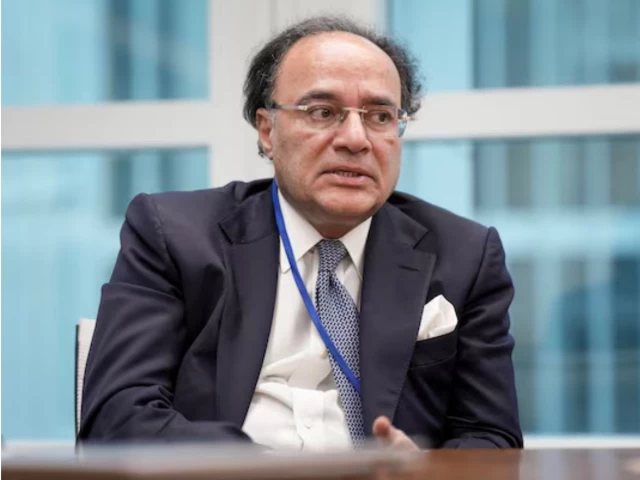

ISLAMABAD, Jan 15 (APP):Federal Minister for Finance and Revenue, Senator Muhammad Aurangzeb, held a meeting on Thursday at the Finance Division with Ms. Bolormaa Amgaabazar, Country Director, World Bank Pakistan, along with their respective teams, to review ongoing collaboration and discuss priority areas under the World Bank’s Country Partnership Framework (CPF) with Pakistan.
Federal Minister for Finance and Revenue, Senator Muhammad Aurangzeb, held a meeting on Thursday at the Finance Division with Ms. Bolormaa Amgaabazar, Country Director, World Bank Pakistan, along with their respective teams, to review ongoing collaboration and discuss priority areas under the World Bank’s Country Partnership Framework (CPF) with Pakistan, said a release issued here.
During the meeting, the World Bank team briefed the Finance Minister on the progress of ongoing operations and projects under the CPF, including recent developments in fiscal and revenue reforms, macroeconomic stabilisation efforts, and policy-based engagements, said a release issued here.
Both sides acknowledged that Pakistan has made progress toward macroeconomic stability through prudent fiscal and monetary policies, and emphasized the need to translate this stability into sustained economic growth, higher investment, and job creation.
The World Bank highlighted the importance of accelerating private investment, noting that investment levels remain below the CPF target.
The discussion focused on designing a coherent, programmatic investment framework aligned with CPF objectives, covering business environment reforms, state-owned enterprise reforms, trade facilitation, capital market development, and export competitiveness.
The World Bank proposed a results-based approach with clearly defined policy milestones, performance indicators, and targeted technical assistance to support implementation.
Senator Muhammad Aurangzeb underscored the government’s commitment to structural reforms already underway, including tariff rationalisation, improved SOE governance, regulatory modernisation, and transparency initiatives.
He also emphasized the importance of deepening capital markets, expanding access to long-term finance, and strengthening institutional coordination to support private sector–led growth.
The meeting also discussed employment and skills development as a critical pillar of economic growth.
The Finance Minister highlighted the need for market-driven vocational and technical training, closer public-private collaboration, and alignment of skills development with domestic and overseas labour market demand, particularly in sectors such as IT, healthcare, nursing, hospitality, and construction.
The World Bank shared its ongoing work on labour mobility, skills matching, and digital labour market platforms to enhance workforce productivity and overseas employment opportunities.
Sectoral priorities including digital services exports, agriculture and agribusiness, minerals and mining, healthcare, and selected manufacturing segments were also discussed as potential focus areas for future World Bank-supported operations.
Both sides agreed that targeted sectoral interventions, supported by regulatory and institutional reforms, could generate high-impact employment and export growth.
The World Bank also briefed the Finance Minister on the potential use of policy-based guarantees as part of future operations to support Pakistan’s liability management, refinancing of high-cost debt, and innovative financing approaches, subject to achievement of agreed policy milestones.
Climate finance, regulatory streamlining, and coordination with provincial governments were also discussed in the broader context of development financing and reform implementation.
The meeting concluded with an agreement to continue technical-level engagements to further refine priorities, narrow the scope of proposed interventions, and advance preparation of future World Bank-supported programs in line with Pakistan’s reform agenda and the objectives of the Country Partnership Framework.