ISLAMABAD, Sep 7 (APP):Pakistan needs to strengthen its institutional capacity and realign its economic strategy with China’s changing priorities to secure greater benefits from bilateral cooperation, a policy paper said. The recommendation was made in a policy paper titled “Understanding China: China’s Economy and Industrial Policy,” launched by the China Desk of EMPAK Strategies at a ceremony attended by Federal Minister for Board of Investment (BOI) Qaiser Ahmed Sheikh as …
China’s shifting priorities require Pakistan to build institutional capacity

ISLAMABAD, Sep 7 (APP):Pakistan needs to strengthen its institutional capacity and realign its economic strategy with China’s changing priorities to secure greater benefits from bilateral cooperation, a policy paper said.
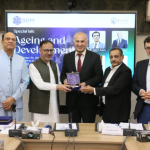
The recommendation was made in a policy paper titled “Understanding China: China’s Economy and Industrial Policy,” launched by the China Desk of EMPAK Strategies at a ceremony attended by Federal Minister for Board of Investment (BOI) Qaiser Ahmed Sheikh as chief guest said a release issued here on Monday.
The report said China’s 15th Five-Year Plan for 2026-2030 focuses on industrial and technological development, productive capacity and innovation, while the first decade of Pakistan-China economic cooperation largely revolved around infrastructure and financing.
It said China had now moved beyond that model, requiring Pakistan to revise its strategy and align its priorities with the new direction of the Chinese economy.
According to the report, the central concept of China’s industrial policy is “new quality productive forces”, which prioritizes technology, innovation and productivity rather than low-cost labour.
China accounted for 54 percent of industrial robots installed worldwide in 2024, with 295,000 robots installed during the year. It also spent 3.93 trillion yuan on research and development in 2025, the report added.
The report noted that despite a record increase in Pakistan’s exports to China, the bilateral trade imbalance continued to widen.
During fiscal year 2025-26, Pakistan’s exports to China increased by around 10 percent to $2.67 billion, making China the second-largest market for Pakistani products after the United States.
Meanwhile, imports from China rose by 14 percent to approximately $22.2 billion, resulting in a bilateral trade deficit of around $19.53 billion, an increase of approximately $2.4 billion in one year.
Addressing the launching ceremony, Federal Minister for Board of Investment (BOI) Qaiser Ahmed Sheikh said China was a sincere friend of Pakistan and had supported the country in every difficult situation.
The minister said it was up to Pakistan to determine how much benefit it could derive from Chinese cooperation.
The minister acknowledged that CPEC projects had suffered setbacks in the past, but said the present government was providing better conditions and facilities to investors from China and other countries.
Chairperson of China Global Professional Technical Certification and former Chairperson of NAVTTC Pakistan Gulmina Bilal said China was prioritizing eight strategic sectors, including next-generation information technology, new energy, robotics, biomedicine, high-end equipment, aviation and aerospace.
She said six future industries, including quantum technology, biomanufacturing, hydrogen and fusion energy, brain-computer interfaces and 6G, were also being developed.
Pakistan, she said, should focus on these emerging sectors and prepare a workforce equipped with internationally competitive technical skills.