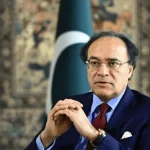
Federal Minister for Planning, Development and Special Initiatives Professor Ahsan Iqbal on Wednesday urged the private sector to formulate five-year export plans and move beyond discussions to concrete action, stressing that export-led growth was essential for Pakistan’s economic stability, self-reliance and sustainable development.
Ahsan urges industry to set five-year export targets

ISLAMABAD, Aug 12 (APP):Federal Minister for Planning, Development and Special Initiatives Professor Ahsan Iqbal on Wednesday urged the private sector to formulate five-year export plans and move beyond discussions to concrete action, stressing that export-led growth was essential for Pakistan’s economic stability, self-reliance and sustainable development.
He was addressing a policy dialogue titled “Unlocking Pakistan’s High-Value Export Potential: Threats and Opportunities for the Automotive Industry,” hosted by the Planning Commission and attended by private sector representatives, academics, senior government officials and international development partners.
The session was jointly chaired by Ahsan Iqbal, Federal Minister for Energy Sardar Awais Ahmad Khan Leghari and Adviser the Prime Minister on Industries and Production Haroon Akhtar Khan.
Ahsan Iqbal said export-led growth was the foremost component of URAAN Pakistan and must be treated not merely as an economic objective but as a national priority.
“The only sustainable path to strengthening Pakistan’s economy is through exports,” he said, emphasizing the need to transform the country’s economic orientation from an inward-looking domestic market to a globally competitive, export-driven economy.
The minister said increasing Pakistan’s exports to $100 billion was a matter of national importance and required a fundamental shift in the country’s approach to industry, investment, infrastructure and economic policy.
He said Pakistan already had industrial clusters and productive capacities that could be further developed to enhance competitiveness in international markets.
However, he stressed the need to modernize these clusters, improve productivity, strengthen infrastructure, adopt new technologies and create an enabling policy environment for exports.
Ahsan Iqbal said the automotive industry had a particularly important role to play in transforming Pakistan into a competitive export economy, noting that the sector had the potential to move beyond serving the domestic market and become a major contributor to global exports.
He expressed confidence that the new Auto Policy 2.0, under the leadership of Prime Minister Muhammad Shehbaz Sharif, would help change the orientation of Pakistan’s automotive industry and facilitate its integration into global markets.
The minister stressed that Pakistan could not achieve sustainable economic strength by relying on borrowing and short-term measures.
“Pakistan needs a strong economy to secure a respectable place in the comity of nations, and the foundation of that strength must be exports,” he said.
Ahsan Iqbal urged the private sector to take the lead in driving the country’s export agenda, saying exporters, manufacturers, investors and industry leaders must adopt a growth-oriented mindset and make international markets a central part of their business strategies.
He emphasized that the private sector was the principal driver of exports and would have to play a more proactive role in expanding Pakistan’s presence in global markets.
Calling for stronger government-private sector collaboration, the minister said both sides must work together to identify new export opportunities, remove bottlenecks and establish clear priorities for export-oriented growth.
He urged chambers of commerce and industry across the country to encourage investors to explore export missions and develop sector-specific strategies for accessing international markets.
The minister called upon industry stakeholders to sit together and formulate five-year export plans, clearly identifying the contribution each sector could make to national exports and the support required from the government to achieve those targets.
“We have no other choice; we must increase exports,” he said, emphasizing that the time had come to move from discussions and complaints to concrete action and implementation.
The minister said Pakistan needed a comprehensive district-level export development plan covering all regions and sectors of the country, with particular attention to areas where existing industrial capacities could be transformed into globally competitive export clusters.
He reiterated that increasing exports was critical to meeting Pakistan’s foreign exchange requirements and strengthening its economic sovereignty.
“Pakistan needs dollars, and sustainable foreign exchange earnings can only come through a stronger and more diversified export base,” he said.
The participants discussed challenges and opportunities facing Pakistan’s automotive export sector, including competitiveness, investment, productivity, technology, infrastructure, market access and policy facilitation.
The dialogue was part of a consultative series organized by the Planning Commission to promote Pakistan’s high-value export sectors and clusters and contribute towards the $63 billion export target under URAAN Pakistan.