
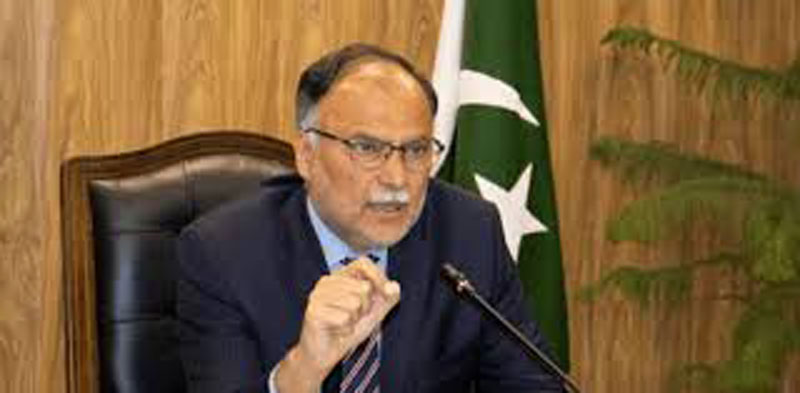
ISLAMABAD, Dec 10 (APP): Federal Minister for Planning, Development and Special Initiatives Professor Ahsan Iqbal on Wednesday said Pakistan sought a deeper, future-focused partnership with the United States to support national development, particularly in the fields of science, technology and higher education.
He expressed these views during a meeting with US Department of State’s Principal Deputy Assistant Secretary for Educational and Cultural Affairs Sherry Keneson-Hall, who called on the minister along with her delegation.
The meeting discussed matters of mutual interest, including ongoing cooperation in education, human resource development and technological advancement.
Ahsan Iqbal said Pakistan and the United States enjoyed “deep-rooted and historic relations,” adding that Islamabad wished to strengthen its development partnership with Washington in areas that could accelerate inclusive growth. “We want a relationship of partnership with the U.S. in national development,” he remarked.
He said education, knowledge creation and scientific collaboration were central to Pakistan’s future economic trajectory. “We want to further expand cooperation in scientific and educational fields,” he said, adding that a large number of Pakistani students were pursuing higher studies in the United States through the Fulbright Programme.
The minister underlined that human resource development was the “fundamental software” that enabled infrastructure and institutions to deliver optimal results. “Quality universities and a strong higher education system transform nations into superpowers,” he added.
Discussing regional challenges, Ahsan Iqbal said India was committing “water aggression” against Pakistan.
He reaffirmed the government’s resolve to transform Pakistan into a US$1 trillion economy by 2035, emphasising that long-term reforms under the Uraan Pakistan initiative had placed special focus on the education sector. The programme, he said, aimed at overhauling curriculum design, institutional capacity and research systems to prepare youth for future economic demands.
Highlighting the importance of sustained academic collaboration, the minister said Pakistan was working with the United States to expand the Pakistan–U.S. Knowledge Corridor, with the goal of producing 10,000 high-quality PhD scholars over the next ten years.
He expressed confidence that enhanced cooperation in education, science and technology would help unlock Pakistan’s development potential and further strengthen bilateral ties.