:Federal Minister for Finance and Revenue Senator Muhammad Aurangzeb on Thursday termed Pakistan’s successful issuance of a $3 billion dual-tranche Eurobond a “positive development”, saying the record transaction reflected renewed confidence of international investors in the country’s economy and future direction.
$3bn Eurobond reflects renewed confidence in Pakistan’s economy: Aurangzeb
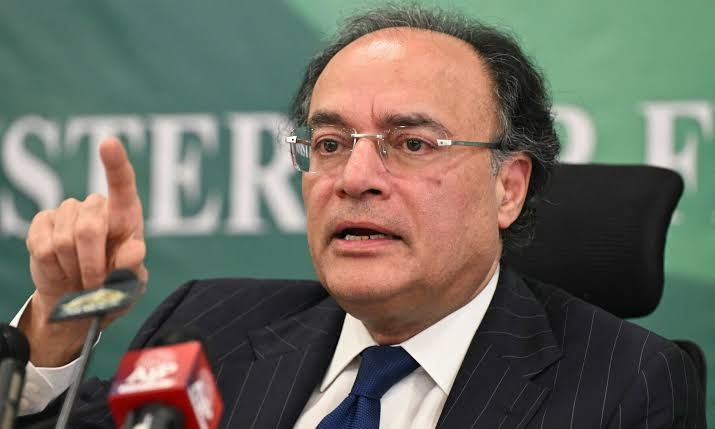
ISLAMABAD, Sep 3 (APP):Federal Minister for Finance and Revenue Senator Muhammad Aurangzeb on Thursday termed Pakistan’s successful issuance of a $3 billion dual-tranche Eurobond a “positive development”, saying the record transaction reflected renewed confidence of international investors in the country’s economy and future direction.
Addressing the “High-Level Dialogues on Taxation for Fiscal Sustainability”, organized by the Asian Development Bank (ADB) in collaboration with the Government of Pakistan, he said the transaction was the “single largest” in Pakistan’s history and reflected the external validation received from international rating agencies.
“Let me start by talking about a positive development which has happened overnight where Pakistan as a sovereign has printed a $3 billion bond,” the minister said.
Aurangzeb said Pakistan had received three rating upgrades since April 2025, while the order book for the Eurobond was twice the size of the amount issued.
He said the diversified investor base, spanning Asia, the Middle East, Europe and the United States, demonstrated renewed confidence in Pakistan’s economy.
“That shows the renewed confidence of the international investor base on the economy of Pakistan, where we are, but more importantly, where we are going,” he said.
The minister said the pricing received for the two Eurobond tranches, carrying maturities of 5.5 years and 10 years, was also encouraging.
He stressed that the transaction was not an ad-hoc borrowing exercise but part of the government’s broader debt-management strategy.
“This is not an ad-hoc trade,” Aurangzeb said, explaining that the government was pursuing on the external financing side the same approach adopted domestically to reduce rollover risks, increase maturities and undertake liability-management operations.
“This is very much part of our three-year medium-term GMTN strategy,” he said.
He said the Eurobond was the first component of the strategy, while the government was also looking at Sukuk, rupee-denominated dollar-settled bonds and Panda bonds, for which Pakistan had already undertaken an inaugural issue.
The strategy, he said, was aimed at repaying expensive short-term debt, extending maturities and reducing rollover risks.
“It’s all about repaying short-term expensive debt, extending our maturities, reducing our rollover risk, so it’s very much part of the deliberate strategy,” he added.
Under the transaction, Pakistan issued a US$1.75 billion, 5.5-year Eurobond carrying a 7.50 per cent coupon, while the 10-year tranche amounted to US$1.25 billion with a 7.90 per cent coupon. The total issuance stood at US$3 billion against global demand of nearly US$6 billion.
The strong demand, particularly for the 10-year tenor, demonstrated Pakistan’s ability to mobilize sizeable longer-term financing as international investors reassessed the country’s improving macroeconomic and credit fundamentals.
The transaction was the first issuance under Pakistan’s renewed strategic Global Medium-Term Note (GMTN) Programme, following the successful inaugural Panda Bond and improvements in the country’s sovereign credit profile.
The programme aims to diversify financing sources, extend maturities and reduce refinancing and rollover risks, while creating opportunities to replace shorter-term and more expensive obligations with longer-duration financing where economically beneficial.
Aurangzeb said Pakistan had also made significant progress in addressing its twin structural deficits, which had stood at around 12.5 per cent of GDP a few years ago.
He said the fiscal deficit had declined to around 2.6 per cent of GDP by the end of June, its lowest level in 22 years, while the country had also achieved three consecutive years of primary surpluses.
The improved fiscal position indicated a certain level of sustainability in fiscal discipline, he said, emphasizing that Pakistan needed to “stay the course.”
The minister said the transformation of the Federal Board of Revenue (FBR) had played a “very, very important role” in the reform journey.
He said FBR tax collection had increased by 40 per cent over the last two years, reaching Rs13 trillion at the end of the previous year, while the tax-to-GDP ratio had improved from 8.8 per cent to around 10.3 per cent.
Aurangzeb said further progress would require sustained reforms in people, processes and technology, with technology set to be a key driver of transformation.He said digital production monitoring had moved beyond the design stage into execution and was generating additional sales tax revenues, while digital invoicing was also underway, covering roughly 75-80 per cent of national sales turnover in terms of registrations.
The minister said the government was determined to continue structural reforms to prevent Pakistan from returning to previous boom-and-bust cycles.
“The only difference this time around as compared to other boom and bust cycles is that we are very, very clear that these structural reforms have to go through,” he said.
Aurangzeb said there was full ownership of the reform agenda at the Prime Minister, Cabinet and political leadership levels.
“Our direction of travel is right. We need to do more,” he said, appreciating ADB’s support for Pakistan’s reform efforts.
He said the government was also exploring the use of artificial intelligence, integrated data and digital technologies in tax administration, adding that some legislative changes might be required.
Aurangzeb said increasing the tax-to-GDP ratio from the current 10.3 per cent towards 13 per cent over time would be important for strengthening fiscal sustainability.