ISLAMABAD, Nov 26 (APP):Mauritius has given a new international dimension to its annual commemoration of Allama Dr Muhammad Iqbal, transforming Iqbal Day 2026 into a significant platform for cultural diplomacy, intellectual exchange and stronger bilateral relations with Pakistan. The celebrations, spearheaded by Mauritius High Commissioner to Pakistan H.E. Munsoo Kurrimbaccus, brought together a distinguished Pakistani delegation led by Mr. Walid Iqbal, grandson of the renowned philosopher and poet, for a …
ISLAMABAD, Nov 26 (APP):Mauritius has given a new international dimension to its annual commemoration of Allama Dr Muhammad Iqbal, transforming Iqbal Day 2026 into a significant platform for cultural diplomacy, intellectual exchange and stronger bilateral relations with Pakistan.
The celebrations, spearheaded by Mauritius High Commissioner to Pakistan H.E. Munsoo Kurrimbaccus, brought together a distinguished Pakistani delegation led by Mr. Walid Iqbal, grandson of the renowned philosopher and poet, for a series of cultural activities and high-level engagements with the Mauritian leadership.
Traditionally observed on November 9 by organisations including Friends of Pakistan, Iqbal Day in Mauritius had largely remained a modest commemorative occasion with limited public visibility. However, High Commissioner Kurrimbaccus envisioned a broader initiative that would introduce Allama Iqbal’s universal philosophy to a wider Mauritian audience while strengthening the longstanding friendship between the two countries.
The initiative originated when Friends of Pakistan approached Mr. Sohail Yaseen Suleman, Honorary Consul of Mauritius in Karachi, to help identify an academic personality for a conference on Iqbal. Following consultations with the High Commissioner, the proposal evolved into a comprehensive cultural and diplomatic programme.
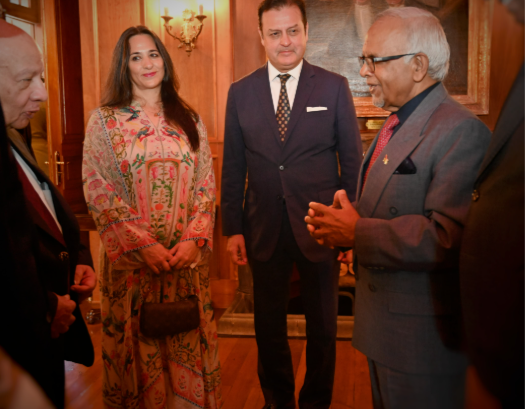
One of the High Commissioner’s foremost initiatives was securing the participation of Mr. Walid Iqbal as the principal speaker. A grandson of Allama Iqbal, Walid Iqbal is an Advocate of the High Court of Pakistan and a former Senator who served from 2018 to 2024, chairing the Senate Standing Committees on Human Rights and Defence.
His presence brought a distinctive historical and intellectual dimension to the celebrations, allowing Mauritians to engage directly with a member of the family of one of the subcontinent’s most influential thinkers. His addresses and interactions explored the continuing relevance of Iqbal’s philosophy, particularly his emphasis on self-realisation, human dignity, education, moral courage and the pursuit of excellence.
Mauritius High Commissioner Munsoo Kurrimbaccus took responsibility for shaping the initiative, mobilizing a distinguished delegation from Pakistan, the visiting delegation also included Mr. Sohail Yaseen Suleman, Honorary Consul of Mauritius in Karachi, and Mr. Shahid Sethi, Honorary Consul of Mauritius in Lahore, accompanied by their respective spouses and Walid Iqbal’s spouse. Mr. Faisal Zahid Malik, CEO and Editor-in-Chief of Pakistan Observer, joined the delegation, adding an important media dimension to the visit. With the assistance of Mr. Asad Bhugla, complementary activities were also arranged in collaboration with organisations including the Urdu Speaking Union and the Muslim Youth Federation.
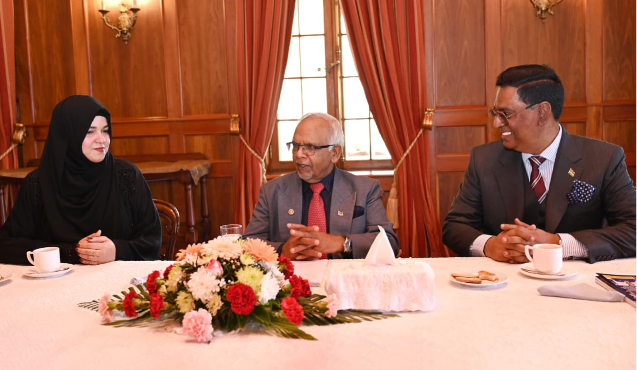
A major highlight of the visit was the delegation’s meeting with the President of the Republic of Mauritius, His Excellency Mr. Dharamveer Gokhool, at State House, Le Réduit, on November 12, 2026. The delegation was led by High Commissioner Kurrimbaccus and accompanied by Pakistan’s Deputy High Commissioner to Mauritius, Ms. Khadijah Khalid Khan. President Gokhool warmly welcomed Walid Iqbal and his spouse, along with the other distinguished members of the delegation.
The discussions covered Allama Iqbal’s intellectual legacy, Mauritius’ rich multicultural identity and the importance of preserving the country’s linguistic and cultural heritage.
The President shared insights into the history of Château du Réduit and its institutional significance, as well as his constitutional responsibilities as Head of State. Particular attention was given to Mauritius’ multilingual, multi-ethnic and multi-religious character, including the place of Urdu among the many languages that contribute to the nation’s cultural diversity.
Allama Iqbal’s celebrated philosophy of Khudi, or the elevation and development of the self, featured prominently during the exchange. His famous verse, “Khudi ko kar buland itna”, was discussed in the context of self-belief, knowledge, character, moral courage and the realisation of human potential.
The discussions highlighted how Iqbal’s message transcends national boundaries and continues to inspire individuals and societies across different cultures. The longstanding diplomatic relations between Mauritius and Pakistan, formally established in 1970, were also highlighted, with both sides recognising the importance of expanding cooperation through cultural, educational and people-to-people exchanges.
The delegation subsequently called on the Deputy Prime Minister of Mauritius, the Honourable Arianne Navarre-Marie, at Government House in Port Louis. The meeting focused on the protection of the family as the fundamental unit of society, particularly the welfare, safety and protection of children.
The Deputy Prime Minister shared insights into legislation recently passed by Parliament to strengthen safeguards for children and families. Walid Iqbal, drawing on his experience as a former senator and his involvement in parliamentary human rights affairs, participated in a meaningful exchange on these issues.
The engagement broadened the scope of the visit beyond cultural commemoration to include matters of shared social concern and public policy.
Another significant engagement was the courtesy call on the Minister of Arts and Culture, the Honourable Mahen Gondeea, who warmly welcomed the delegation and discussed Mauritius’ diverse cultural heritage and the importance of preserving the traditions that shape its national identity. The Minister also recalled his previous visit to Pakistan, expressing admiration for its history and culture.
The meeting was particularly relevant as the principal Iqbal Day conference was hosted at the Islamic Cultural Centre, which operates under the aegis of the Ministry of Arts and Culture.
During the discussions, High Commissioner Kurrimbaccus proposed that Iqbal Day should become an annual feature of Mauritius’ cultural calendar. He emphasised that Allama Iqbal’s philosophy should not be viewed exclusively as the intellectual heritage of one country or community, as its universal messages of unity, human dignity, self-development, knowledge and social harmony hold relevance for the entire Mauritian society.
He called for closer cooperation between the Ministry, the High Commission and participating organisations to develop future editions of the celebrations. He also proposed holding future events at prominent national institutions, including the University of Mauritius, to encourage academic participation, intellectual debate and greater involvement of younger generations.
The 2026 initiative reflected a proactive approach to modern diplomacy, demonstrating how cultural heritage and intellectual engagement can strengthen relations beyond traditional official channels. High Commissioner Kurrimbaccus played a central role at every stage, from developing the original concept and securing prominent Pakistani participation to mobilising the Honorary Consuls, engaging Mauritian institutions and arranging meetings with the country’s highest authorities.
His efforts were supported by his entire team in Islamabad, whose contribution was instrumental in coordinating and advancing the initiative.
The celebrations also highlighted the importance of community support and private-sector participation in promoting international friendship. Following the successful conclusion of the programme, the High Commissioner expressed sincere appreciation to the two Honorary Consuls, Mr. Sohail Yaseen Suleman and Mr. Shahid Sethi, acknowledging their valuable support and active involvement.
He particularly thanked Mr. Sohail Yaseen, whose initial approach had set the initiative in motion. Special recognition was also extended to Walid Iqbal for his distinguished participation, intellectual depth, eloquence and contribution to bringing his grandfather’s timeless message closer to the people of Mauritius.
A special acknowledgement went to Mr. Tariq Bhatti, a Pakistani entrepreneur with a strong attachment to Mauritius, whose exceptional generosity and hospitality played an indispensable role in facilitating the visit.
He graciously hosted the entire delegation at his tourist residence, Blue Rawal, in Bain de Boeuf, northern Mauritius. His contribution reflected a spirit of friendship and commitment to promoting Pakistan and strengthening its presence in Mauritius.
The High Commissioner also thanked the Islamic Cultural Centre, Friends of Pakistan, the Muslim Youth Federation and the Urdu Speaking Union for their cooperation, institutional support and participation, while acknowledging everyone who worked behind the scenes to ensure the success of the programme.
The 2026 Iqbal Day celebrations have opened new opportunities for Mauritius and Pakistan to deepen their cultural and intellectual partnership.
For Mauritius, the initiative offered an opportunity to explore the universal philosophy of one of the subcontinent’s greatest thinkers, while for Pakistan it provided a valuable platform to share its intellectual heritage with a friendly and culturally diverse nation.
More significantly, the initiative demonstrated that cultural diplomacy can begin with a simple idea and develop into meaningful international engagement through vision, commitment and institutional cooperation.
The ambition now is to transform Iqbal Day from a modest annual remembrance into an established feature of Mauritius’ cultural calendar, bringing together academics, universities, students, cultural organisations and communities to celebrate a philosophy whose message continues to transcend borders and generations.