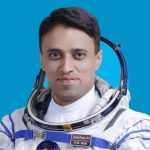
BEIJING, Nov 25 (APP):The Shenzhou-24 crewed spacecraft and its three-member crew, comprising Chinese astronaut and mission commander Tang Hongbo, Chinese flight engineer Wu Yi and Pakistani payload specialist Mohammad Zeeshan Ali, were carried by the Long March-2F Y24 carrier rocket, which lifted off at 8:18 am from the Jiuquan Satellite Launch Center in Northwest China's Gobi Desert on Wednesday, marking China's first crewed spaceflight involving a foreign astronaut. After entering …
Shenzhou-24 mission showcases tech innovations as China Space Station welcomes first foreign astronaut
BEIJING, Nov 25 (APP):The Shenzhou-24 crewed spacecraft and its three-member crew, comprising Chinese astronaut and mission commander Tang Hongbo, Chinese flight engineer Wu Yi and Pakistani payload specialist Mohammad Zeeshan Ali, were carried by the Long March-2F Y24 carrier rocket, which lifted off at 8:18 am from the Jiuquan Satellite Launch Center in Northwest China’s Gobi Desert on Wednesday, marking China’s first crewed spaceflight involving a foreign astronaut.
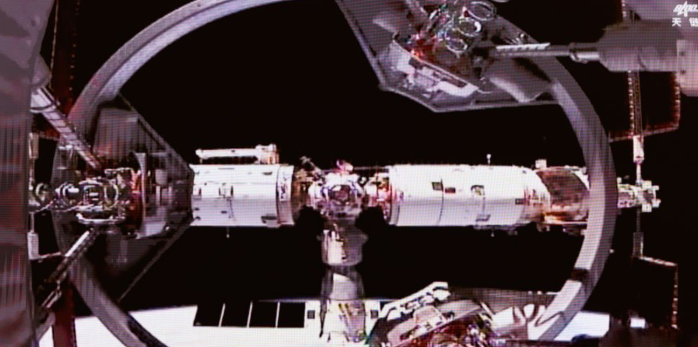
After entering orbit, the Shenzhou-24 crewed spacecraft successfully docked with the forward port of the space station’s Tianhe core module at 11:56 am Beijing time on Wednesday. The entire docking process took approximately 3.5 hours, according to China Manned Space Agency.
The mission showcased China’s continued technological innovations in the Long March rocket, Shenzhou spacecraft and Tiangong space station, supporting the opening-up and shared use of the China Space Station and multilateral cooperation under China’s manned space program.
Rocket upgrades
This was the 8th crewed launch mission since the implementation of the China Space Station application and development program, and the 41st flight mission of China’s manned space program. The Long March-2F carrier rocket maintained its stable condition for the high-profile mission.
“Although the overall mission plan remained largely unchanged, the rocket team completed 12 technical improvements to further strengthen safety for the flight,” Li Wenqing, a technical expert with China Aerospace Science and Technology Corporation (CASC), told the Global Times. The improvements covered both rocket and ground systems, focusing on reliability, safety redundancy and more efficient launch-site operations.
The team optimized the structure and rubber compound formulation of seals in the rocket’s pressurization and propellant feed system, while tightening acceptance standards. These improvements enhanced the system’s sealing performance, reliability and safety redundancy, Li said.
The rocket team also added a manual forced-separation control channel between the rocket and launch tower as a backup for the automatic system, while increasing redundancy in separation signals between systems to improve launch reliability.
The movable launch platform also underwent considerable upgrades, including improved displays and human-machine interaction, automatic rotation and speed adjustment, and an upgraded health monitoring system. These changes improved its automation, reliability and operational safety, Li said
He Pengju, the overall technical lead for launch and tracking operations, told the Global Times that strong winds and sandstorms were more likely during the seasonal transition. The center implemented zoned temperature and humidity controls in the launch area.
After the launch, the Long March-2F Y25 carrier rocket will enter emergency rescue standby under the program’s rolling backup plan, continuing to support space station missions, the Global Times learned from the launch center.
Rapid docking
The mission marked the first time a Shenzhou crewed spacecraft carried a foreign astronaut on a round trip between Earth and space, as well as the first joint flight involving Chinese and foreign astronauts in China’s manned space program. The mission represents a major step forward in international cooperation at the China Space Station.
Li Zhe, an expert with the CASC, told the Global Times that the spacecraft and space station teams coordinated closely and made detailed preparations for the Pakistani astronaut’s flight.
The development team conducted multiple rounds of integrated crew-spacecraft tests involving the primary and backup Shenzhou-24 crews, including the Pakistani astronaut. After arriving at the Jiuquan launch site, the crew also took part in spacecraft familiarization and a full-system launch rehearsal, while the space station team provided training on in-orbit living arrangements, equipment operations, experiments and emergency procedures, Li said.
The Pakistani astronaut also experienced the spacecraft’s rapid rendezvous and docking capability. After liftoff, Shenzhou-24 used an autonomous rapid rendezvous and docking mode lasting only 3.5 hours and successfully docked with the forward port of the space station’s Tianhe core module. This marked the fourth time a Shenzhou spacecraft had used the 3.5-hour docking mode.
“Unlike radial rendezvous and docking, which requires continuous dynamic adjustments, front-port docking has a stable parking point and is relatively less demanding in terms of flight control,” Li said. The 3.5-hour mode is the standard plan, but ground controllers can switch to a 5-hour or longer docking plan if necessary to ensure the safety of the astronauts, spacecraft and space station.
“The value of 3.5-hour rapid rendezvous and docking goes beyond speed,” Li said. Early Shenzhou missions took two days and dozens of orbits to complete rendezvous and docking. The faster mode reduces astronauts’ physical fatigue and psychological stress during the journey to orbit, while improving the space station’s ability to conduct emergency rescue and evacuation.
The joint flight with a foreign astronaut and the use of mature rapid rendezvous and docking technology highlight the China Space Station’s openness to international cooperation and the continued development of China’s manned spaceflight capabilities.
Joint space experiments
The mission will also feature four scientific experiments carried out by both Chinese and Pakistani astronauts aboard the China Space Station, covering biology, crops and advanced materials. The Pakistani astronaut will operate the experiments in orbit, collecting data for joint researches in space.
The four experiments focus on cyanobacteria, quinoa, graphene hybrid composites and self-healing carbon fiber composites. Some will be conducted in the life-ecology experiment cabinet in the Wentian lab module, while others will expose materials to the vacuum, radiation and extreme temperature changes outside the space station.
“The cyanobacteria experiment aims to explore a potential ‘green microfactory’ for future deep-space missions,” Huang Kun, an expert with the China Space Station’s space application system, told the Global Times.
Proposed by Pakistan’s Space and Upper Atmosphere Research Commission (SUPARCO), the experiment will examine how microgravity and space radiation affect cyanobacteria’s photosynthesis, growth and carbon-fixation capacity. The findings could support research into oxygen regeneration and space-based biomanufacturing, Huang said.
The quinoa experiment focuses on food security in space. Led by the University of Agriculture Faisalabad (UAF), in Pakistan, it will send 32 quinoa seed samples outside the cabin to study how cosmic radiation and microgravity affect their longevity and nutritional properties. The findings could help identify high-quality varieties for space cultivation and provide reference data for crop breeding on Earth, Huang said.
Huang said graphene hybrid composites are lightweight and offer radiation-shielding potential, while self-healing carbon fiber composites are designed to repair microcracks caused by temperature changes, radiation and micrometeoroid impacts, using solar heating outside the cabin to restore their mechanical properties.
Both materials experiments will use the space station’s external materials exposure facility. The graphene hybrid material will be exposed alongside an aluminum control sample for one year, with detectors recording particle tracks for later comparison of their shielding, mechanical and thermal properties. The self-healing carbon fiber samples, including pre-cracked and intact controls, will be monitored by imaging in orbit and retrieved after one year to assess crack repair, Huang said.
With the Pakistani astronaut operating the experiments in orbit, China-Pakistan space cooperation will extend beyond joint spaceflight to the joint design and implementation of scientific experiments.