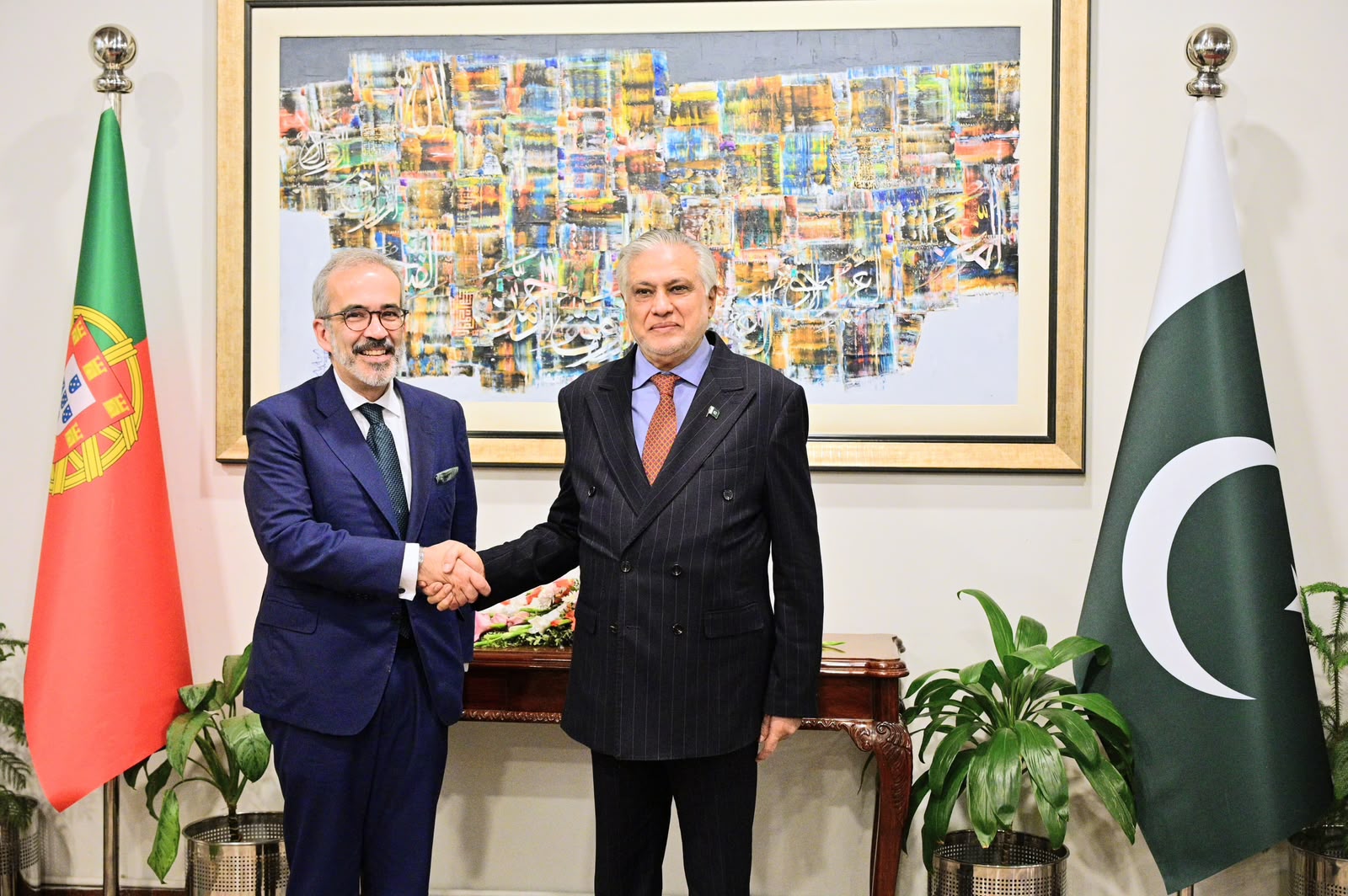
The cooperation between Pakistan and Portugal were discussed during the one-on-one and delegation-level talks between Deputy Prime Minister and Foreign Minister Senator Ishaq Dar and Portuguese Minister of State and Foreign Affairs Paulo Rangel, who is here on a two-day official visit, coinciding with the 77 years of diplomatic relations between the two countries.
Pakistan, Portugal agree to establish Joint Ministerial Commission to boost trade, investment
ISLAMABAD, Nov 23 (APP): Pakistan and Portugal on Monday agreed to establish a Joint Ministerial Commission (JMC) as an intergovernmental mechanism to oversee and expand cooperation across multiple sectors, including trade, investment, agriculture, energy and information technology.
The bilateral ties and cooperation were discussed during the one-on-one and delegation-level talks between Deputy Prime Minister and Foreign Minister Senator Ishaq Dar and Portuguese Minister of State and Foreign Affairs Paulo Rangel, who is here on a two-day official visit, coinciding with the 77 years of diplomatic relations between the two countries.
The two leaders, addressing a joint press stakeout following the talks and signing of a Memorandum of Understanding (MoU) on visa abolition for diplomatic passport holders, admitted that there was immense potential to promote bilateral cooperation in trade and investment.
Welcoming the Portuguese delegation in the month marking the 77th anniversary of bilateral diplomatic relations established on November 7, 1949, Deputy Prime Minister Dar said that the talks built upon their May 21 meeting in New York and the fourth round of Bilateral Political Consultations held in Islamabad in July.
Both leaders acknowledged that current bilateral trade, largely restricted to textiles, fell well short of its true potential. To address trade barriers and diversify commerce into agri-food, information technology, and footwear, Ishaq Dar proposed a Joint Working Group on Trade and Economic Cooperation.
DPM Dar also accepted the invitation to visit Lisbon, when JMC would hold its inaugural session, followed by a second round in Islamabad. Dar also proposed holding a bilateral leadership summit in the third or fourth quarter of 2027, alongside establishing Parliamentary Friendship Groups in both houses of Pakistan’s Parliament and the Portuguese legislature.
The deputy prime minister invited Portuguese enterprises to invest in Pakistan through the Special Investment Facilitation Council (SIFC).
He told the media that the Board of Investment (BOI) and Portugal’s trade and investment agency (AICEP) would sign an MoU on investment protection later in the day at the Pakistan-Portugal Business Forum.
Both sides also reviewed progress on amending their Double Taxation Convention and updating investment protection frameworks.
He said that the two countries signed a MoU abolishing visa requirements for diplomatic passport holders, expressing the hope that similar arrangements would follow for official passports and eventually ordinary passports after the JMC convenes.
Dar emphasized learning from Portugal’s expertise in olive cultivation and processing following Pakistan’s admission as a permanent member of the International Olive Council in Lisbon on June 30.
He welcomed the partnership between Portuguese football club FC Porto and the Sialkot Football Academy to launch the youth training program, proposing broader exchanges in coaching, youth tournaments, and sports science.
Deputy Prime Minister Dar thanked Portugal for supporting Pakistan’s European Union GSP+ status and sought Lisbon’s continued backing under the upcoming EU framework, referring to Prime Minister Shehbaz Sharif’s recent positive engagements with EU leadership on the sidelines of the UN General Assembly.
Congratulating Portugal on its election as a non-permanent member of the UN Security Council (UNSC) for the 2027–2028 term, succeeding Pakistan, Dar pledged close bilateral coordination at the United Nations.
The deputy prime minister reaffirmed unwavering support for the Palestinian people’s inalienable rights, condemned illegal settlements and attempts to alter the status of Al-Quds Al-Sharif, and called for unhindered humanitarian aid to Gaza.
He also stressed the need for a peaceful resolution of the Jammu and Kashmir dispute in accordance with relevant UNSC resolutions, besides condemning India’s unilateral decision to hold the Indus Waters Treaty in abeyance as a material breach of international law and a dangerous weaponization of water threatening the food, water, and energy security of 250 million Pakistanis.
Dar also underscored that Afghan territory must not be used for terrorism against any country, particularly Pakistan.
In his remarks, Foreign Minister Rangel praised the peaceful integration of the Pakistani diaspora in Portugal and highlighted that Portugal’s business-managed “Green Path” recruitment mechanism provided safe, regulated legal pathways with guaranteed employment and decent accommodation in high-demand sectors such as construction, hospitality, healthcare, and IT, while protecting workers from human traffickers and smugglers.
Foreign Minister Rangel commended Pakistan’s two-year tenure on the UNSC and lauded the Pakistani leadership’s constructive mediation efforts to de-escalate conflicts in the Middle East.
He also welcomed Pakistan’s regional diplomatic engagements, including its defense cooperation with Türkiye and Saudi Arabia and the E4 dialogue framework involving Egypt, Saudi Arabia, Pakistan, and Türkiye alongside European partners in Istanbul.
Foreign Minister Rangel termed his visit a “landmark”, opening a new chapter in bilateral ties, to improve the dimension of bilateral relationship in a very strong manner as both sides had a huge room to improve cooperation in agriculture, energy, and renewable energies.
He said that Portugal highly valued Pakistan’s engagement with the European Union as the country was a very important economic player.