Speakers at a public forum have called for closer bilateral coordination between Pakistan and Türkiye to counter growing threats from cyberattacks, disinformation and hybrid warfare, stressing the need for stronger institutional and security cooperation.
Experts call for stronger Pakistan-Türkiye cooperation amid changing security landscape
ISLAMABAD, Nov 19 (APP): Speakers at a public forum have called for closer bilateral coordination between Pakistan and Türkiye to counter growing threats from cyberattacks, disinformation and hybrid warfare, stressing the need for stronger institutional and security cooperation.
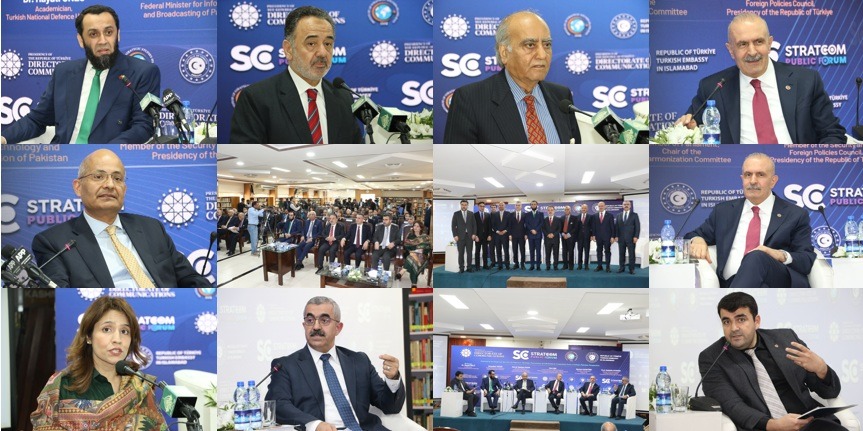
The call was made at a STRATCOM Public Forum titled “Reshaping Regional Security Architecture: Strategic Partnership and Multilateral Cooperation from a Türkiye-Pakistan Perspective”, organised jointly by the Centre for Afghanistan, Middle East and Africa (CAMEA) at the Institute of Strategic Studies Islamabad (ISSI), the Presidency of the Republic of Türkiye Directorate of Communications and the Embassy of Türkiye in Islamabad, said a press release.
In his opening remarks, Ambassador Khalid Mahmood, Chairman BOG, ISSI, highlighted the deep-rooted historical, cultural and strategic bonds between Pakistan and Türkiye, reaffirming their commitment to strengthening cooperation in defence, security, trade, technology and regional connectivity, as well as promoting regional peace, stability and a balanced international order.
Ambassador Irfan Neziroglu, Ambassador of Türkiye to Pakistan, emphasised the unique people-to-people bonds underpinning bilateral relations. He stressed the need to counter disinformation, strengthen information resilience and explore opportunities arising from growing trade ties and Turkish investment in Pakistan.
Professor Dr. Burhanettin Duran, Head of Communications, Presidency of the Republic of Türkiye, highlighted the growing importance of strategic communication amid geopolitical and technological transformations. He underscored the challenges posed by disinformation and digital manipulation, emphasising international cooperation, information integrity and public trust, while highlighting the STRATCOM Summit’s role in fostering dialogue and societal resilience.
A panel discussion followed, moderated by Dr. Hayati ÜNLÜ, Faculty Member, Turkish National Defence University.
Fikri Isik, Former Minister of National Defence of Türkiye, emphasised accelerating bilateral cooperation against hybrid threats, cyberattacks and technological competition. He called for moving beyond traditional defence cooperation towards joint research, development and production, alongside stronger institutional mechanisms and inclusive regional security partnerships.
Burhan Kayatürk, Member of Parliament and Chair of the EU Harmonization Committee, Türkiye, underscored the historical bonds and mutual solidarity between the two countries. He called for greater economic cooperation, including achieving the $5 billion bilateral trade target, and highlighted the Makkah Accord’s significance in strengthening regional security and collective security partnerships.
Zarrar Hasham Khan, Secretary, Ministry of Information Technology and Telecommunication, highlighted emerging threats from cyberattacks, disinformation and vulnerabilities in critical information infrastructure. He stressed institutionalising Pakistan–Türkiye cybersecurity cooperation through a bilateral agreement, strengthening digital connectivity and infrastructure resilience, and establishing sustained mechanisms for dialogue and coordination.
Prof. Muhittin Ataman, Member of the Security and Foreign Policies Council, Presidency of the Republic of Türkiye, described Pakistan and Türkiye as key pillars of an emerging regional security architecture. He highlighted regional initiatives, including the Makkah Accord, and emphasised regionalism, complementarity, strategic autonomy and regional ownership as essential to addressing regional challenges and promoting lasting peace and stability.
Earlier, a closed-door STRATCOM Roundtable titled “Türkiye and Pakistan in a Changing Regional Security Architecture: Strategic Cooperation in an Age of Global Crises” brought together senior policymakers, diplomats, security experts and academics from both countries.
In his opening remarks, Prof. Ferhat Pirinççi, Deputy Head of Communications, Presidency of the Republic of Türkiye, stressed enhanced cooperation against hybrid threats, cyberattacks, terrorism and disinformation.
Ambassador Moin ul Haque, Director General ISSI, highlighted the longstanding strategic partnership and called for greater cooperation in defence, emerging technologies and counterterrorism. Dr. Amina Khan, Director CAMEA, moderated the discussion and highlighted the need for sustained dialogue, closer coordination and stronger Pakistan-Türkiye cooperation amid evolving regional security dynamics.
The roundtable focused on the evolving regional security architecture, particularly the Makkah Accord, collective security and regional cooperation. Participants emphasised strengthening cybersecurity, strategic communications, economic ties and institutional cooperation to promote regional peace and stability.