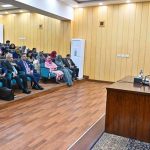
SAARC Chamber of Commerce and Industry former President Iftikhar Ali Malik on Tuesday hailed the new long-term education policy, “Education 2.0”, describing it as a significant step towards replacing the outdated colonial-era education system with a modern framework aligned with Pakistan’s technological and developmental needs.
Iftikhar Ali Malik hails Education 2.0 policy as step towards modern education system

LAHORE, Nov 17 (APP): SAARC Chamber of Commerce and Industry former President Iftikhar Ali Malik on Tuesday hailed the new long-term education policy, “Education 2.0”, describing it as a significant step towards replacing the outdated colonial-era education system with a modern framework aligned with Pakistan’s technological and developmental needs.
In a congratulatory letter addressed to Federal Minister for Planning, Development and Special Initiatives Ahsan Iqbal, he appreciated the formulation of a balanced and comprehensive policy aimed at bringing the country’s educational standards at par with developed nations and preparing future generations to meet the challenges of technological transformation.
Iftikhar Ali Malik said the policy appropriately positioned artificial intelligence and modern technology as tools to support educators rather than replace them, while also emphasizing the development of indigenous digital and educational resources. He said Education 2.0 also sought to address fragmentation in the education sector by introducing common learning standards across public, private,madrassa and international education systems.
He observed that the policy aimed to nurture confident, ethical and capable Pakistanis equipped with independent thinking, adaptability and the skills required to contribute to national progress. He said Pakistan’s future fundamentally depended on the quality of education imparted to children today, adding that the proposed framework would replace the remnants of the colonial-era education model associated with Macaulay’s 1835 system with an approach suited to an independent, innovative and ethical Pakistan. He noted that the traditional education model largely emphasized memorization, examination performance and reproduction of information rather than independent inquiry and critical thinking.
Iftikhar Ali Malik said the need for educational reforms had become more urgent in the wake of artificial intelligence, automation and Industry 4.0, as machines could now reproduce information rapidly.
Therefore, students needed to develop problem-solving abilities, critical thinking, evidence-based reasoning and the capacity to make responsible decisions.
He added that the policy would also address the ethical and social implications of emerging technologies and prepare young people for the evolving demands of Industry 5.0.