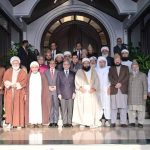
Faisalabad Chamber of Commerce & Industry (FCCI) President Arif Ehsan Malik has claimed that Small and Medium Enterprises (SMEs) are poised to gain easier access to commercial financing as Prime Minister Muhammad Shehbaz Sharif has agreed in principle to his proposal for abolishing the mandatory 80 percent export condition for obtaining business loans.
PM agrees in principle to scrap 80% export condition for SME loans, FCCI President claims

FAISALABAD, Nov 16 (APP): Faisalabad Chamber of Commerce & Industry (FCCI) President Arif Ehsan Malik has claimed that Small and Medium Enterprises (SMEs) are poised to gain easier access to commercial financing as Prime Minister Muhammad Shehbaz Sharif has agreed in principle to his proposal for abolishing the mandatory 80 percent export condition for obtaining business loans.
In a statement here on Monday, the FCCI President said that he had a meeting with the prime minister in PM Secretariat where he floated the proposal for exemption of 80% export condition for SME loans and the premier agreed with it. This development would help SMEs address one of their major financial constraints, he added.
Talking about meeting with the prime minister, the FCCI President said that he had highlighted several issues confronting the business community and presented proposals aimed at strengthening the industrial sector, improving access to commercial credit, modernizing the power looms industry and transforming Faisalabad into Pakistan’s first Textile Circular City.
He said that SMEs constituted the backbone of national economy, contributing significantly to employment opportunities, industrial activity and exports, but restricted access to financial resources had remained a major obstacle to their expansion and modernization.
The existing requirement of generating at least 80 percent exports to qualify for commercial loans was preventing a large number of small and medium-sized businesses from accessing bank financing, he said and appealed to the government to abolish this condition so that a wider range of enterprises could benefit from institutional credit and expand their operations.
He also proposed introducing collateral-free commercial loans for entrepreneurs who had viable business plans but lacked adequate property or other assets to secure conventional bank financing. The prime minister appreciated the proposals and agreed in principle to the removal of 80 percent export requirement while emphasizing the need for progress on the relevant matters. He also directed that the proposal concerning collateral-free loans should be examined, FCCI Chief added.
Highlighting the challenges facing the power looms sector, Arif Ehsan Malik stressed the need for a dedicated, ring-fenced financing facility to help industrialists replace outdated machinery with modern equipment.
He said that technological up-gradation was imperative to reduce production costs, improve manufacturing efficiency and enhance the competitiveness of Pakistani textile products in international markets.
He said that the power looms industry was an integral part of Pakistan’s textile value chain and its modernization would not only strengthen industrial productivity but also create additional employment opportunities and support the country’s export-oriented manufacturing base.
The FCCI president also presented an ambitious proposal to develop Faisalabad as Pakistan’s first Textile Circular City, saying that the country’s leading textile and industrial hub had the potential to become a model of sustainable industrial development through the adoption of modern circular economy principles.
Under the proposed initiative, industrial raw materials and resources would be reused and recycled, water consumption optimized, industrial waste minimized and environmental-friendly production systems promoted.
Such an integrated approach would improve resource efficiency, strengthen sustainability of textile manufacturing and enhance international competitiveness of Pakistani products particularly in markets increasingly demanding environmentally responsible production, he added.
Arif Ehsan Malik emphasized that sustained consultation and effective coordination between the government and business community were imperative for economic stability, industrial expansion and increased investment.
He assured the prime minister that FCCI would continue extending its full cooperation to government initiatives aimed at resolving business-related problems, promoting investment, strengthening industrial infrastructure and increasing exports.
He appreciated the prime minister’s positive response to the proposals and his assurance of cooperation in addressing the concerns of SMEs, expressing optimism that the proposed measures would provide fresh impetus to the country’s industrial, commercial and export sectors.
The FCCI president also invited Prime Minister Muhammad Shehbaz Sharif to visit Faisalabad Chamber of Commerce & Industry to interact with the local business community and discuss measures for further strengthening industrial and export potential of the city.