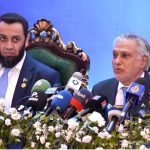
President Islamabad Chamber of Commerce and Industry (ICCI), Muhammad Zikria Akbar Zia, on Monday urged for fixing its domestic economic structure, promoting industrialization and ensuring consistent long-term policies to achieve sustainable economic growth.
Consistent industrial policy, structural reforms vital for economic revival: Zikria Akbar Zia

ISLAMABAD, Nov 16 (APP): President Islamabad Chamber of Commerce and Industry (ICCI), Muhammad Zikria Akbar Zia, on Monday urged for fixing its domestic economic structure, promoting industrialization and ensuring consistent long-term policies to achieve sustainable economic growth.
Speaking during a roundtable discussion titled ‘ Indo-US Economic Relations: Prospects and Opportunities for Pakistan ‘ hosted by the Institute of Strategic Institute Islamabad ( ISSI) he observed that Pakistan’s economic challenges largely stem from structural weaknesses, policy inconsistency and over-reliance on short-term financial arrangements.
He emphasised that industrial projects require long-term planning, as investors need several years to establish production facilities and recover their investments, said a press release.
He strongly advocated a strategic partnership with China through joint ventures, technology transfer and collaboration with local manufacturers.
He said Pakistan should attract Chinese companies to establish partnerships with domestic businesses rather than setting up completely independent operations.
Criticizing blanket subsidies and sector-specific incentives, he said these policies often benefit influential business lobbies instead of delivering relief to consumers or strengthening the wider economy.
He advocated replacing institutional subsidies with targeted income support for deserving households and ensuring a level playing field across industrial sectors.
He also called for strengthening small and medium enterprises (SMEs), describing them as essential drivers of sustainable economic growth.
Genuine ease of doing business, he maintained, would become possible when small businesses could operate without excessive regulatory hurdles, high borrowing costs and policy uncertainty.
Highlighting the importance of professional trade diplomacy, he urged to appoint commercially experienced professionals as trade officers abroad to identify business opportunities, facilitate investors and promote Pakistani exports.
He added that effective international trade required stronger business-to-business engagement rather than relying exclusively on government-to-government arrangements.
Concluding, Zikria Akbar Zia urged policymakers to move beyond short-term economic management and formulate a comprehensive, predictable and long-term industrial policy, warning that continued policy inconsistency, excessive incentives and neglect of domestic manufacturing would undermine Pakistan’s economic prospects.