
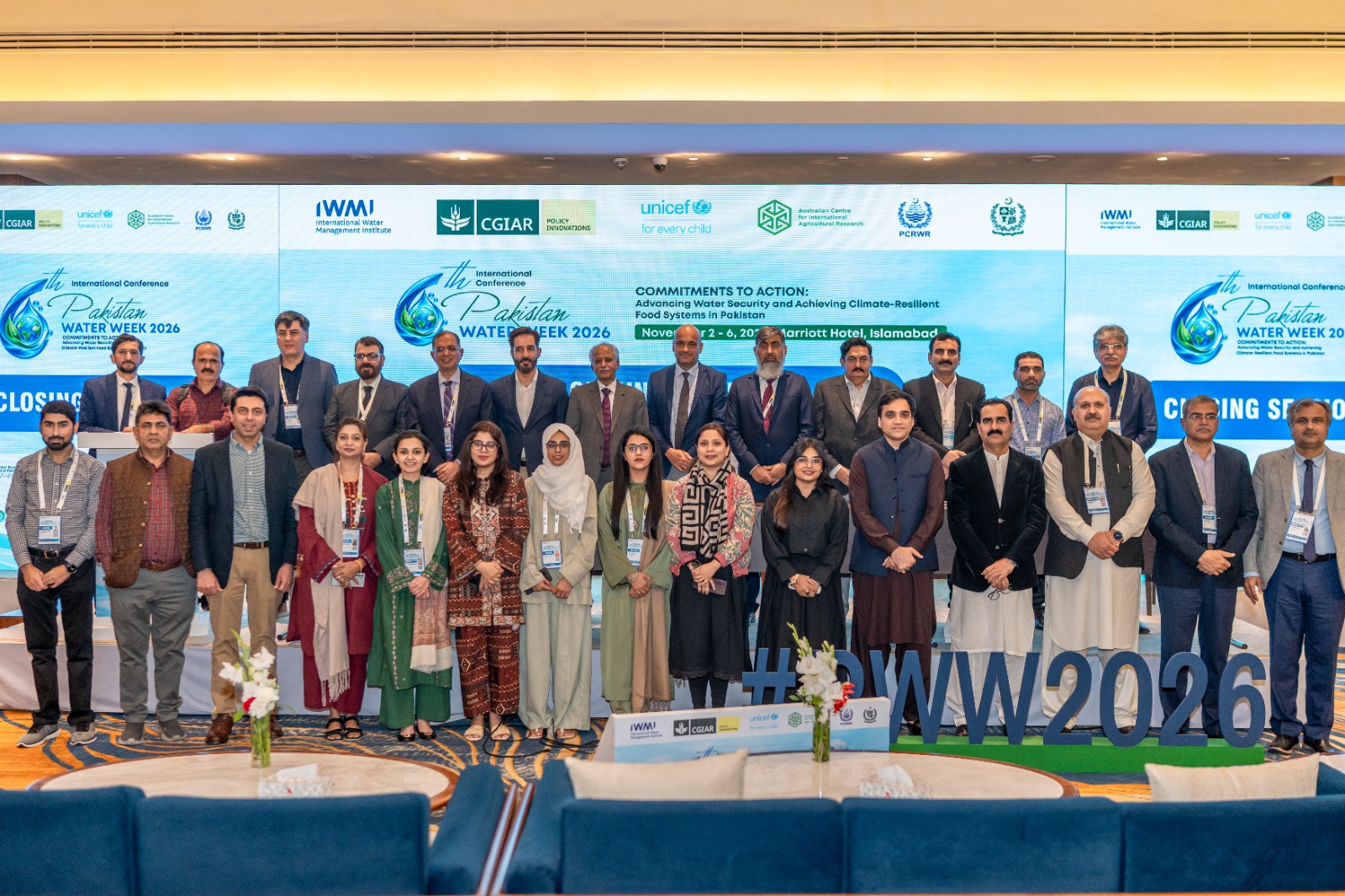
Hina Durrani ISLAMABAD, Nov 15 (APP):Pakistan Water Week 2026, a five-day international conference, received an overwhelming response in the Capital, drawing around 350 participants in person and more than 800 online. The conference, themed “Commitments to Action: Advancing Water Security and Achieving Climate-Resilient Food Systems in Pakistan,” was organised by the International Water Management Institute (IWMI) and the CGIAR Policy Innovations Science Program, in collaboration with the Pakistan Council of …
PWW2026 conference receives overwhelming response in Capital
Hina Durrani
ISLAMABAD, Nov 15 (APP):Pakistan Water Week 2026, a five-day international conference, received an overwhelming response in the Capital, drawing around 350 participants in person and more than 800 online.
The conference, themed “Commitments to Action: Advancing Water Security and Achieving Climate-Resilient Food Systems in Pakistan,” was organised by the International Water Management Institute (IWMI) and the CGIAR Policy Innovations Science Program, in collaboration with the Pakistan Council of Research in Water Resources (PCRWR) and the Ministry of Water Resources.
The event was supported by UNICEF, ICIMOD, FAO, EU and partners.
Federal and provincial officials, researchers, development partners, civil society, journalists and international experts took part in 26 sessions. The aim was to bring science, policy and practice together to identify priorities, determine responsibilities and establish mechanisms to track progress on water security and climate-resilient food systems.
The question that shaped the week was posed at the inaugural session by Senate Chairman Yousaf Raza Gilani, who asked what the commitments made would change for a farmer in Thar, a family living along the Ravi or a child in Quetta waiting for clean water. He pledged parliamentary support through legislation, oversight and budget allocations and called water security a national priority.
Johan Gély, IWMI’s Asia Director for Research Impact and Thematic Area 1 Lead (Policy to Practice), said the week’s central finding was about coordination rather than policy. We need named, accountable institutions at both levels, and evidence that shapes public investment rather than merely accompanying it,” he said.
He added that progress should be judged by results. “Outcomes, not expenditure, must become the measure of progress, through indicators such as water service reliability, agricultural productivity, groundwater levels and community resilience. A legal framework for groundwater governance, backed by investment in aquifer recharge, should be a priority,” he said.
Gély’s agenda for action also called for a greater role for nature-based solutions such as wetland restoration and floodplain management, and for a regional Himalayan commission on monitoring and early warning in the upper Indus Basin. He also welcomed the proposal for a youth innovator prize, so that the next generation helps shape the solutions.
At the closing session, the Thematic Area 2 Lead, Dr. Claudia Ringler of IFPRI, stressed that innovation without inclusion is not impact. She said tools such as drip irrigation, laser land levelling and soil moisture monitoring have already shown gains in Pakistani conditions, but subsidies, credit and extension services have yet to catch up.
Federal Minister for Water Resources Mian Muhammad Mueen Wattoo, the Chief Guest, asked the organising institutions to turn the recommendations into practical programmes. He named four priorities: clear responsibility for implementation, judging infrastructure by its performance, linking water investment to agricultural productivity, and protecting water quality while managing surface water and groundwater together.
Talking to APP, IWMI Country Representative Dr Muhammad Ashraf said the conference had been designed around delivery. “We asked every session to leave behind three things: a clear commitment, a named owner and a timeline. That is how recommendations from this week become action,” he said.
IWMI Strategic Program Director – Water, Food and Ecosystems, Dr Mohsin Hafeez, told APP that the task now was implementation. “Pakistan already has many of the policies, laws and plans it needs. The real challenge is implementation,” he said.
He said Pakistan Water Week was a platform for turning policy into better outcomes rather than an end in itself.
“Government leadership and water stewardship for communities, industry and the environment are essential. IWMI and CGIAR remain committed to a long-term partnership in Pakistan’s water security journey, and we look forward to building on these recommendations at Pakistan Water Week 2027,” he concluded.
