Experts at the Margalla Dialogue on Wednesday highlighted the growing influence of artificial intelligence (AI), advanced communication systems, semiconductors and digital platforms in transforming modern warfare and economic competition.
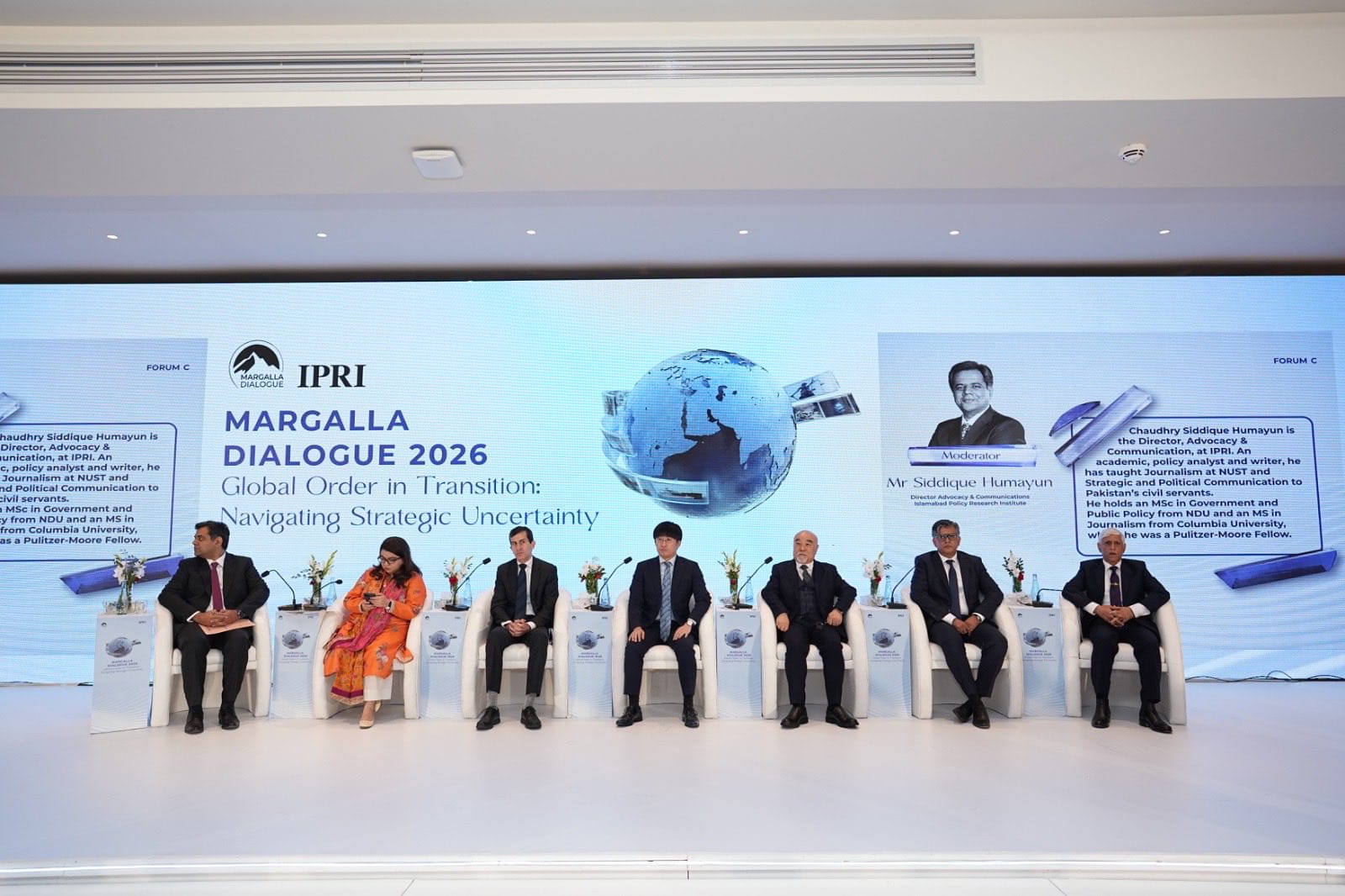
ISLAMABAD, Nov 11 (APP): Experts at the Margalla Dialogue on Wednesday highlighted the growing influence of artificial intelligence (AI), advanced communication systems, semiconductors and digital platforms in transforming modern warfare and economic competition.

Speaking at Forum C, titled “Technology and the Transformation of State & Society”, held on the second day of the dialogue under the theme “Global Order in Transition: Navigating Strategic Uncertainty”, they said technological capabilities were increasingly becoming a source of geopolitical power, while countries needed to balance innovation with national security, technological resilience, accountability and public trust.

Brigadier Dr Raashid Wali Janjua, SI (M) (Retd), Director, Research and Analysis at the Islamabad Policy Research Institute (IPRI), said artificial intelligence, advanced communication systems, and data-processing technologies are fundamentally transforming modern warfare, making it faster, more precise, and increasingly lethal.

Speaking on “The Changing Face of War in the Information Age”, he said future combat capabilities would largely depend on three key technological areas: advanced communication networks, AI-enabled data processing and analysis, and automated targeting systems.
He explained that satellite communications, software-defined radios and tactical data links were strengthening battlefield connectivity, while artificial intelligence and machine learning were accelerating target identification and decision-making through automated target recognition, smart munitions and loitering weapons.
Referring to conflicts in Ukraine and the Middle East, Dr Janjua highlighted the growing use of drones, autonomous systems and AI-assisted targeting. He said civilian infrastructure, technology companies and ordinary citizens were also becoming increasingly exposed to the consequences of modern warfare.
Mr Daniel Castro, President of the Information Technology and Innovation Foundation, USA, said technological capabilities, including artificial intelligence, semiconductors, cloud computing and digital platforms, were increasingly determining economic power, national security and geopolitical influence.
He said these technologies were reshaping international competition, trade, and relations between governments and private technology companies, while raising important questions about control, access, and regulation.
Castro observed that advanced AI capabilities were increasingly concentrated in a small number of technology companies. Their technical expertise, he said, was essential for governments in areas such as scientific research, cybersecurity, intelligence and national defence.
Highlighting the importance of an open global digital economy, Castro said it enabled entrepreneurs and small businesses to access international markets, provide services across borders and benefit from advanced computing infrastructure.
He said countries such as Pakistan needed to benefit from global technological progress while developing their domestic capabilities.
Akira Igata, Project Lecturer at the Economic Security Intelligence Lab, Research Center for Advanced Science and Technology (RCAST), University of Tokyo, Japan, said countries needed to balance the productivity benefits of artificial intelligence with national security, technological resilience and strategic autonomy to remain competitive in the changing global economy.
He said AI was transforming industries such as software development, translation, customer service, legal research and administrative work, while raising concerns about employment, particularly entry-level jobs traditionally performed by young professionals.
He said governments, businesses and societies needed to manage the transition carefully to ensure that technological progress did not undermine employment opportunities and social stability.
Developing indigenous AI capabilities and sovereign computing infrastructure, on the other hand, required substantial investment and could affect competitiveness if domestic technologies lagged behind global leaders.
Referring to Japan’s approach, he said its new AI Basic Plan promoted the concept of “open AI sovereignty”, enabling the country to benefit from foreign technologies while selectively strengthening domestic capabilities, including data centres and computing infrastructure.
Highlighting supply chain diversification, Igata said Japan was working to secure alternative sources of strategically important goods, including semiconductors, critical minerals, fertilisers, medicines, food and energy, to minimise disruptions caused by natural disasters or geopolitical tensions.
Dr Ilaria Mariani, Assistant Professor at Politecnico di Milano, Italy, said integrating artificial intelligence into public-sector decision-making and citizen participation required a human-centred approach to ensure transparency, accountability and public trust.
She said the technology should not be viewed merely as an innovation but as a means of improving relationships between citizens, public institutions and increasingly autonomous digital systems.
Drawing on her research experience in European initiatives, she stressed the importance of involving citizens and other stakeholders throughout the development, testing and evaluation of AI-based solutions to ensure that these technologies addressed public needs and expectations.
She outlined three possible roles of AI in public participation, describing it as an assistant, a guide and potentially a governor.
As an assistant, she said, AI could improve public service delivery through chatbots, automated responses, analysis of citizens’ petitions and summarisation of public feedback. As a guide, it could identify emerging issues, organise public discussions and present different viewpoints.
Executive Director of the Pakistan Digital Authority Rehan Tahir said artificial intelligence could transform public service delivery by making government services faster, improving subsidy distribution and reducing financial leakages through better monitoring of taxation, procurement and government payments.
He said AI-powered systems could also help citizens access government services in Urdu and regional languages through voice- and text-based platforms, making public services more accessible.
However, Tahir cautioned against blind reliance on automated decision-making. Citing international examples, including the Netherlands’ childcare benefits scandal, Australia’s Robodebt scheme and the United Kingdom’s 2020 A-level grading controversy, he said flawed algorithms had adversely affected thousands of people and forced authorities to reverse their decisions.
He said Pakistan had taken several steps towards digital transformation, including the enactment of the Digital Nation Pakistan Act in January 2025, approval of the National AI Policy in July 2025, establishment of the Pakistan Digital Authority in August 2025 and the Islamabad AI Declaration in February 2026, followed by consultations on the Data Governance Policy.
These initiatives, he said, provided a foundation for developing a sovereign, responsible and citizen-focused digital ecosystem. He added that Pakistan had improved its position by 14 places in the United Nations E-Government Development Index between 2022 and 2024.
Professor Li Xiguang, Director of the Pakistan Centre for Culture and Communication at Tsinghua University, China, also shared his views during the session.
The forum was moderated by Siddique Humayun, Director of Advocacy and Communications at IPRI. Federal Minister for Information Technology and Telecommunication, Shaza Fatima Khawaja, delivered the keynote address.