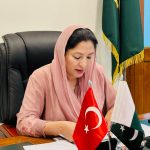
In a major push to improve public services, attract private investment and accelerate development across Sindh, Chief Minister Syed Murad Ali Shah on Tuesday approved a series of landmark initiatives through the Public-Private Partnership (PPP) framework, including the outsourcing of 750 schools, development of Keti Bandar as a maritime and economic hub, restructuring of Sukkur’s water supply and sewerage system, and major road connectivity projects.
CM approves major PPP initiatives to boost investment, improve public services

KARACHI, Nov 10 (APP): In a major push to improve public services, attract private investment and accelerate development across Sindh, Chief Minister Syed Murad Ali Shah on Tuesday approved a series of landmark initiatives through the Public-Private Partnership (PPP) framework, including the outsourcing of 750 schools, development of Keti Bandar as a maritime and economic hub, restructuring of Sukkur’s water supply and sewerage system, and major road connectivity projects.
Presiding over the 53rd meeting of the PPP Policy Board at the CM House, the chief minister also approved a revised joint venture model for Dhabeji Special Economic Zone (SEZ), bridge financing of Rs2 billion for the Ghotki-Kandhkot Bridge and several initiatives to strengthen Karachi’s infrastructure, expand industrial investment and introduce modern digital facilities.
The decisions, involving proposals from seven government departments, reflect the provincial government’s commitment to using private-sector expertise, investment and technology to improve essential services, create economic opportunities and deliver better facilities to citizens.
The meeting was attended by Provincial Ministers Syed Nasir Hussain Shah, Syed Sardar Shah and Jam Khan Shoro; Chief Secretary Asif Hyder Shah; MPAs Ghulam Qadir Chandio and Qasim Siraj Soomro; Special Assistants Syed Qasim Naveed and Muhammad Ali Rashid; Principal Secretary to the CM Agha Wasif; Chairman Planning and Development Board Najam Shah; Senior Member Board of Revenue Khalid Hyder Shah and other senior officials.
In a major education-sector decision, the Board approved Phase-II outsourcing of 750 schools under the Sindh Secondary Education Improvement Project (SSEIP), Sindh Early Learning Enhancement through Classroom Transformation (SELECT) programme and People’s Schools initiative.
The programme covers 453 SSEIP schools, including 401 under additional financing and 52 under original financing, 295 SELECT schools and two English-medium People’s Schools.
Education Management Organisations (EMOs) will manage the schools under 10-year service management contracts, following a three-month preparatory period. The private operators will be responsible for teachers’ salaries, non-teaching staff, operational expenses, uniforms, stationery and other essential services, with government funding.
The 750 schools have a combined capacity of 345,940 students, against current enrolment of 188,852, offering considerable potential to expand access to quality education.
The Board also approved the constitution of a Technical and Financial Evaluation Committee and the initiation of open national competitive bidding through the e-PADS platform, using Quality and Cost-Based Selection (QCBS).
To accelerate industrialisation and attract private investment, the Board approved a revised transaction structure for Dhabeji Special Economic Zone, replacing the earlier Build-Operate-Transfer model with a joint venture between the Sindh government, through Sindh Economic Zones Management Company (SEZMC), and private investors.
Under the arrangement, the government will contribute land, existing development works and other agreed inputs, while private partners will bring equity, technical expertise and investment to finance, develop and operate the industrial zone.
The project covers approximately 1,171 acres of saleable land, including 1,071 acres for industrial activities and 100 acres for commercial use. Development is planned in two phases over 36 months.
The Board approved investor solicitation through a competitive two-stage, two-envelope bidding process, including prequalification, investor dialogue and requests for proposals.
In another landmark decision, the Board approved the project concept for developing Keti Bandar into an integrated maritime, industrial, logistics and energy hub.
The initiative aims to unlock the economic potential of Sindh’s coastline and the Indus Delta through modern maritime infrastructure and domestic and international private investment.
The proposed development encompasses six major areas: energy and petroleum infrastructure, industrial and logistics facilities, port and marine infrastructure, shipbuilding and marine services, community and tourism facilities, and digital security systems.
The envisaged facilities include oil terminals, storage tanks, pipelines, cargo yards, warehouses, industrial and export zones, deep-water berths, a modern fishing harbour, shipyard, dry docks and marine training facilities. The plan also includes tourism, hotels, a marina, housing, healthcare and education facilities, supported by modern vessel-monitoring, surveillance and emergency-response systems.
The Board approved funding through the Project Development Facility (PDF) to engage transaction advisers for detailed feasibility studies and preparation of a bankable PPP structure, paving the way for private-sector participation.
Karachi Financial Centre initiative approved
The Board also approved the concept of the proposed Karachi Financial Centre, aimed at strengthening Karachi’s position as a regional financial and investment hub.
The initiative seeks to attract domestic and international investment in financial services, infrastructure, energy, housing and technology. PDF funding was approved to engage transaction advisers for a comprehensive feasibility study and development of the transaction structure.
Sindh Institute of Teacher Education under PPP
The Board approved the proposed PPP structure for establishing and operating the Sindh Institute of Teacher Education (SITE), Karachi, through a proposal submitted by M/s Durbeen.
The degree-awarding institution will focus on improving teacher education, educational leadership, research-based learning, modern teaching practices and professional development of faculty.
The Board approved the project scope, transaction structure, private partner’s capital and operational commitments, government support and risk-sharing arrangements. It also approved the revised framework, including the proponent’s Right of First Refusal and initiation of the investor-solicitation process, subject to applicable legal and regulatory requirements.
Karachi Port-Qayumabad Corridor and Shahrah-e-Bhutto
The Board considered key matters relating to the 16.5-kilometre Karachi Port to Qayumabad Corridor, an access-controlled, four-lane expressway connecting Shahrah-e-Bhutto with Karachi Port’s East Wharf.
Being developed under a Design, Finance, Build, Operate, Maintain and Transfer (DFBOT) arrangement, the project has a concession period of 27.5 years, including 2.5 years of construction and 25 years of operation and maintenance.
The Board considered the concessionaire’s proposal to introduce an Infrastructure Real Estate Investment Trust (REIT) structure in place of Class-A equity in the project company, along with matters relating to the Karachi Port Trust licence agreement and final No Objection Certificate.
For Shahrah-e-Bhutto Expressway, the Board approved riverbank protection works, including submerged groynes, an additional loop and ramp at Interchange No. 5 at Memon Goth, and street lighting along designated sections.
KDA Parking Plaza and 41 additional parking sites
To address Karachi’s growing parking needs, the Board approved the concept of a multi-level KDA Parking Plaza near Ziauddin Hospital, Clifton Block-2.
The proposed facility will be developed on a 1,352-square-yard KDA-owned plot and provide 96 car parking spaces and 160 motorcycle spaces, along with limited commercial facilities.
With an estimated cost of Rs1.61 billion, the project will be developed under a Design-Build-Operate-Transfer arrangement with a proposed 35-year concession period.
The Board also approved including an assessment of 41 additional KDA-owned parking sites across Clifton Blocks 1 to 7 and 9 in the transaction advisers’ scope, for possible development under the PPP framework.
The Board approved proposals for improved police facilitation and installation of intelligent surveillance cameras with solar-powered solutions along Shahrah-e-Bhutto Expressway.
The proposals include security and protective measures identified by the Senior Superintendents of Police of Korangi and Malir districts, as well as intelligent cameras to strengthen monitoring and law-enforcement arrangements.
The proposed measures will be implemented through adjustments to the concession scope or budgetary allocations to the Police Department, in accordance with applicable financial and project arrangements.
IFC’s $100 million guarantee facility approved
To facilitate financing for major infrastructure projects, the Board approved a draft mandate agreement with the International Finance Corporation (IFC) for a Partial Credit Guarantee facility of up to $100 million, equivalent to approximately Rs28.5 billion.
The proposed arrangement involving IFC, the Sindh Finance Department and Sindh Public-Private Partnership (Private) Limited will provide guarantees against the government’s termination-payment obligations to lenders financing selected PPP projects, subject to IFC’s due diligence and appraisal.
The facility is expected to strengthen lenders’ confidence, broaden financing options and facilitate financial closure of major development projects. The Board approved recommending the agreement to the provincial cabinet for formal approval.
Reviewing progress on the Ghotki-Kandhkot Bridge, the chief minister examined construction, financial closure, additional works and pending clearances from the National Highway Authority (NHA).
The Board ratified the chairman’s approval of a Rs2 billion bridge financing facility to maintain construction activities until commercial debt financing becomes available.
The project includes a 12.2-kilometre bridge across the Indus River, along with connecting approach roads, and is expected to improve connectivity between Ghotki and Kandhkot and facilitate regional trade and movement.
In an important step towards improving essential municipal services, the Board approved the transaction structure for the Sukkur Water Supply Project, paving the way for investor solicitation under the PPP framework.
Being developed through the Sukkur Water and Sewerage Corporation, the project aims to improve the city’s water supply, distribution network, sewerage and drainage infrastructure, while strengthening the corporation’s institutional capacity.
Based on an estimated population of 608,095 in 2026, water demand is projected to rise from the current 30 million gallons per day to 32 MGD in 2029 and 41 MGD by 2048.
The proposed interventions include water treatment and pumping facilities, distribution networks, billing meters, sewerage infrastructure, an eight-MGD sewage treatment plant, drainage improvements, digitisation and institutional capacity-building.
The Board approved the transaction and risk-allocation frameworks, along with the Unsolicited Proposal for competitive bidding. It also approved the proponent’s Right of First Refusal and exemption from prequalification, subject to formal acceptance of the revised proposal and applicable legal requirements, allowing the investor-solicitation process to proceed.
The chief minister emphasised the importance of moving approved initiatives towards implementation through transparent competitive processes, sound project preparation and effective coordination among the concerned departments. The government, he said, remained committed to mobilising private investment to improve public services and accelerate Sindh’s development.