Hamza Zamir Kiani ISLAMABAD, Nov 10 (APP): Imagine a Pakistan where a farmer receives an early warning about an approaching drought before his crops begin to wither, a patient in a remote village receives an AI-assisted diagnosis without travelling hundreds of miles, and a citizen obtains a government service within minutes rather than spending days navigating bureaucratic corridors. This is not a distant technological fantasy. It is the promise of …
From Digital Pakistan to Intelligent Pakistan: Turning AI into national transformation opportunity
Hamza Zamir Kiani
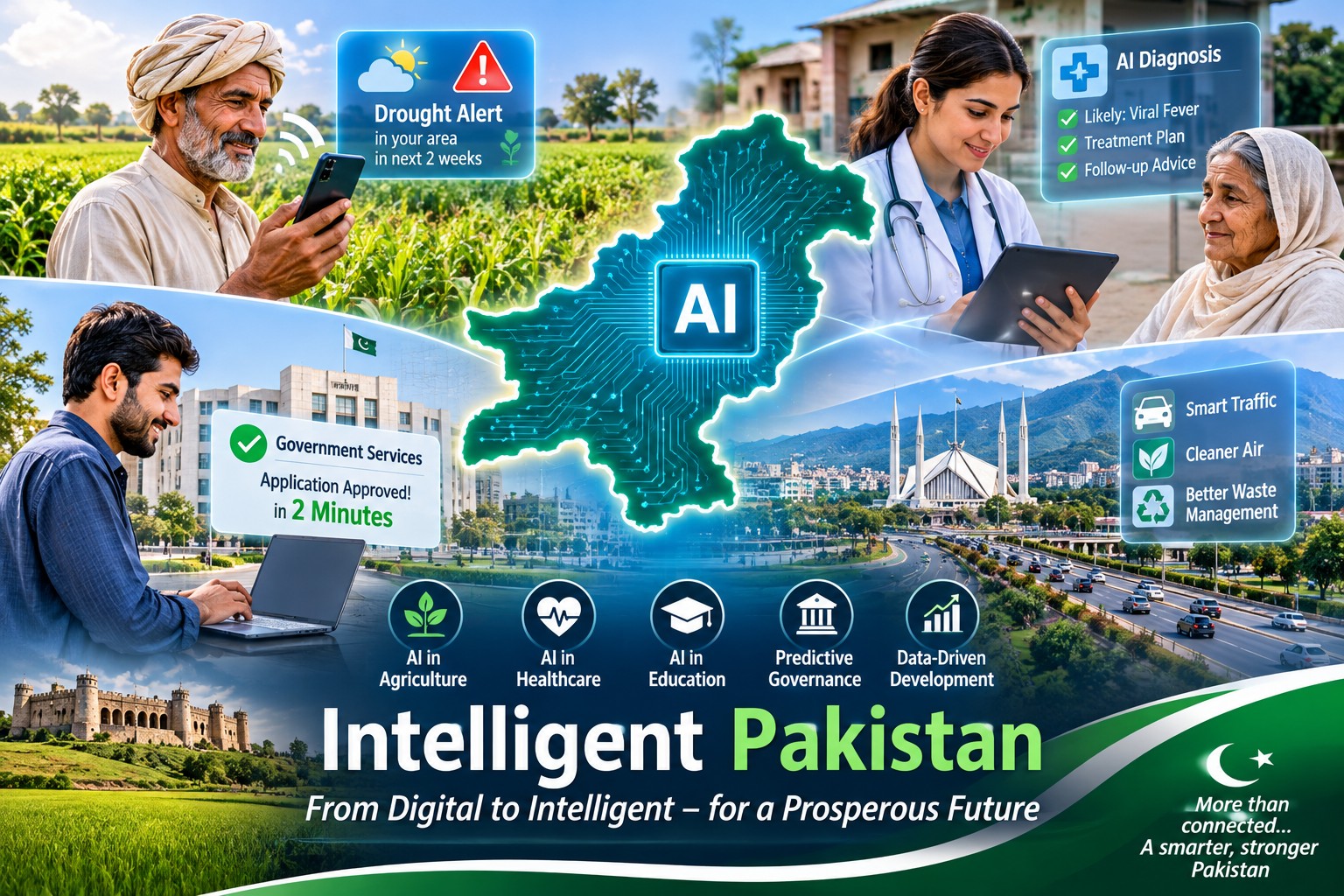
ISLAMABAD, Nov 10 (APP): Imagine a Pakistan where a farmer receives an early warning about an approaching drought before his crops begin to wither, a patient in a remote village receives an AI-assisted diagnosis without travelling hundreds of miles, and a citizen obtains a government service within minutes rather than spending days navigating bureaucratic corridors.
This is not a distant technological fantasy. It is the promise of Artificial Intelligence (AI), and it presents Pakistan with an opportunity to rethink the very foundations of national development.
For years, Pakistan’s digital transformation agenda has focused on expanding internet connectivity, introducing e-governance, digitising public records and promoting a cashless economy. These developments have been important stepping stones.
However, the next phase of transformation must go beyond putting information online. It must focus on making institutions intelligent, responsive and capable of anticipating challenges before they become national crises.
The distinction between a digital and an intelligent state is profound. A digital institution stores information electronically; an intelligent institution uses that information to make better decisions. This is where AI can become a catalyst for Pakistan’s institutional transformation.
Consider Pakistan’s public sector, where administrative delays, fragmented databases and procedural inefficiencies frequently obstruct service delivery. AI-powered systems could help government departments identify irregularities in public procurement, detect fraudulent transactions, analyse expenditure patterns and predict resource requirements. Rather than relying exclusively on reactive administrative mechanisms, institutions could adopt predictive governance, making decisions based on evidence, patterns and real-time information.
The possibilities extend far beyond government offices. Pakistan’s agricultural economy, which remains vulnerable to climate variability, water scarcity and unpredictable weather patterns, could benefit enormously from AI-driven precision agriculture. Satellite imagery, intelligent irrigation systems and predictive weather analytics could help farmers improve crop yields while conserving precious water resources. Similarly, AI-enabled urban planning could help cities manage traffic congestion, monitor air quality and improve waste management.
Healthcare and education also offer transformative opportunities. AI-assisted diagnostic tools could strengthen healthcare delivery, particularly in underserved communities, while intelligent learning platforms could provide students with personalised educational experiences. In a country with a rapidly growing young population, such technologies could help convert demographic pressure into a productive national asset.
Yet, technological ambition must be accompanied by strategic preparedness. Pakistan cannot build an intelligent future merely by importing AI applications or encouraging the use of foreign platforms. It needs a robust domestic ecosystem comprising skilled human capital, reliable digital infrastructure, research institutions, indigenous innovation, secure data systems and effective regulatory frameworks. Data protection, algorithmic transparency and responsible AI governance must remain central to this transition.
Most importantly, Pakistan must recognise that AI is not simply an IT-sector initiative; it is a national development imperative. Its successful integration requires coordination between policymakers, academia, industry and public institutions. Universities and research think tanks must contribute to evidence-based policymaking, while the government must create an environment where innovation can translate into tangible public benefits.
The real question, therefore, is not whether artificial intelligence will reshape the world — it already has. The question is whether Pakistan will remain a consumer of other nations’ technological breakthroughs or become an active participant in shaping the future of intelligent societies.
The ‘Digital Pakistan’ was an important beginning. An ‘Intelligent Pakistan’ must become the ambition. The country’s next transformation will not be measured by how many government services move online, but by how effectively technology improves the lives of its people, strengthens its institutions and prepares it for an increasingly complex world.
Pakistan does not merely need to become more connected; it needs to become more intelligent.
The writer is a researcher at NUST Institute of Policy Studies, a reputed think tank of Pakistan.