ISLAMABAD, Nov 07 (APP):The Millennium Institute of Technology & Entrepreneurship (MiTE) and the Centre for International Strategic Studies Sindh (CISSS) jointly launched Marka-e-Haq: Deterrence, Provocation, and Strategic Maturity in South Asia at MiTE, bringing together senior military figures, diplomats, academics, policymakers and strategic affairs experts to examine the May 2025 Pakistan-India conflict, regional security dynamics and the future of deterrence in South Asia, according to a press release received here. …
ISLAMABAD, Nov 07 (APP):The Millennium Institute of Technology & Entrepreneurship (MiTE) and the Centre for International Strategic Studies Sindh (CISSS) jointly launched Marka-e-Haq: Deterrence, Provocation, and Strategic Maturity in South Asia at MiTE, bringing together senior military figures, diplomats, academics, policymakers and strategic affairs experts to examine the May 2025 Pakistan-India conflict, regional security dynamics and the future of deterrence in South Asia, according to a press release received here.
The event was co-hosted by MiTE Rector Prof Dr Huma Baqai and CISSS Executive Director Ambassador (retd) Qazi Khalilullah, with former senator and federal minister Javed Jabbar as chief guest and Lt Gen (retd) Khalid Ahmed Kidwai delivering the keynote address.
The book, edited by Dr Zafar Khan, brings together contributions from senior military leaders, diplomats and scholars, offering diverse perspectives on the evolving security landscape of South Asia.
It examines the history of Pakistan-India relations, the May 2025 crisis, deterrence stability, strategic doctrines, lessons from recent confrontations and the challenges confronting regional peace.
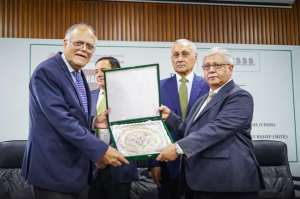
Addressing the gathering, Lt Gen (retd) Khalid Ahmed Kidwai, Advisor Development, National Command Authority, said India’s strategic ambitions far exceeded its political and military capabilities, while Pakistan’s nuclear capability and Full Spectrum Deterrence had offset the perceived conventional military imbalance between the two countries.
In his keynote address, based on his chapter titled Re-assessing Deterrence Stability in South Asia, Lessons from the May 2025 Crisis, Gen Kidwai examined India’s evolving nuclear posture, military doctrines and the concept of a ‘new normal’ following Operation Sindoor.
He argued that the emerging strategic environment was increasingly shaped by Pakistan’s deterrence capabilities, adding that the country’s conventional and nuclear forces had helped maintain strategic stability despite heightened tensions.
Reflecting on the lessons of the May 2025 crisis, he called for a reassessment of Pakistan’s conventional retaliatory strategy, suggesting an evolution from ‘Quid Pro Quo Plus’ to ‘Quid Pro Quo Plus Plus’.
He stressed that credible deterrence and the ability to impose costs were essential to preventing future escalation.
Earlier, Ambassador Khalilullah said the May 2025 Marka-e-Haq conflict had marked a defining chapter in Pakistan’s history, demonstrating national resilience, unity and the professionalism of its armed forces.
He said Pakistan’s investment in indigenous niche technologies had served as a force multiplier during the four-day conflict, while its Full Spectrum Deterrence had prevented further escalation.
He also maintained that Pakistan’s response had undermined India’s Operation Sindoor and strengthened the country’s diplomatic and strategic standing.
Introducing the book, Dr Zafar Khan said the volume sought to document evolving patterns of coercion, deterrence and crisis behaviour in South Asia.
He said it examined Pakistan’s strategic restraint alongside the risks posed by unilateral actions, nuclear posturing and disinformation in the region.
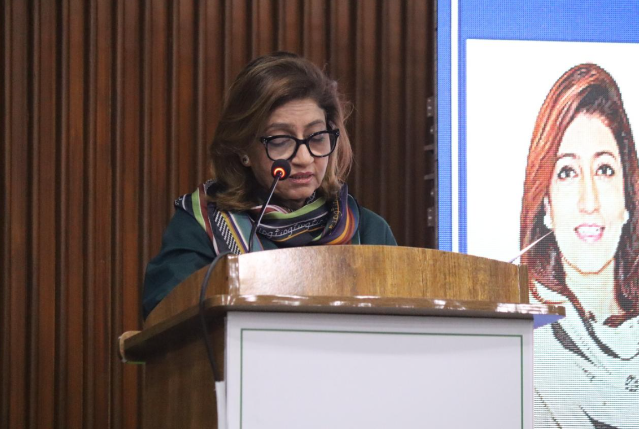
In her welcome address, Prof Dr Huma Baqai commended the editor and contributors for bringing together diverse perspectives on the May 2025 crisis.
She described the publication as a valuable resource for scholars, policymakers, practitioners and students of international relations and strategic studies.
Former ambassador Mustafa Kamal Kazi said the book documented India’s longstanding challenges to Pakistan’s security and sovereignty.
He highlighted Pakistan’s deterrence capabilities, operational resolve and military professionalism during the May 2025 conflict, while questioning India’s aspirations for global power status under the ideological influence of Hindutva.
University of Mirpurkhas Vice Chancellor, Prof Dr Rafique Ahmed Memon, identified Kashmir and the weaponisation of water as two major nuclear flashpoints in South Asia.
He also expressed concern over alleged Indian state involvement in terrorism beyond its borders, warning that such developments threatened regional and international peace.
DHA Suffa University Vice Chancellor Prof Dr Ahmed Saeed Minhas said the book addressed the fragile security equilibrium in South Asia and explored how coercive provocations, deterrence and strategic restraint shaped regional crises.
Drawing comparisons with the February 2019 Balakot crisis and the May 2025 confrontation, he underscored the importance of maintaining credible deterrence to prevent escalation.
University of Sindh Vice Chancellor Prof Dr Fateh Muhammad Marri appreciated the contributions of the authors, saying the publication added to the discourse on regional security and strategic stability.
He also highlighted concerns surrounding India’s regional policies, the paralysis of SAARC and the suspension of the Indus Waters Treaty.
Chief guest Javed Jabbar praised Pakistan’s national leadership and armed forces, saying their preparedness and measured approach had played a significant role in the country’s response during the May 2025 conflict.
He said the book’s relevance extended beyond Pakistan and India and urged that it be translated into major world languages to reach a wider international audience.
Mr Jabbar also noted that Pakistan’s ability to respond to a much larger neighbour demonstrated the importance of national resolve, strategic planning and institutional preparedness.
The book also examines India’s strategic culture, developments in occupied Kashmir, alleged false flag operations, state-sponsored terrorism, human rights concerns and the growing risks associated with water security and nuclear deterrence.
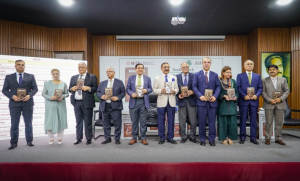
More than 200 people, including academics, former senior military officers, foreign diplomats, policy analysts, students and media representatives, attended the launch.