ISLAMABAD, Nov 05 (APP):The outgoing cabinet of the Supreme Court Bar Association (SCBA), led by Haroon ur Rasheed, and the newly elected cabinet, headed by Syed Amjad Shah, called on the Chief Justice of Pakistan at the Supreme Court premises here today. The Chief Justice congratulated the newly elected office-bearers and appreciated the outgoing cabinet’s cooperation during its tenure. Emphasising that the Bench and Bar are integral to the administration …
CJP welcomes newly elected cabinet of SCBA, bid farewell to outgoing cabinet
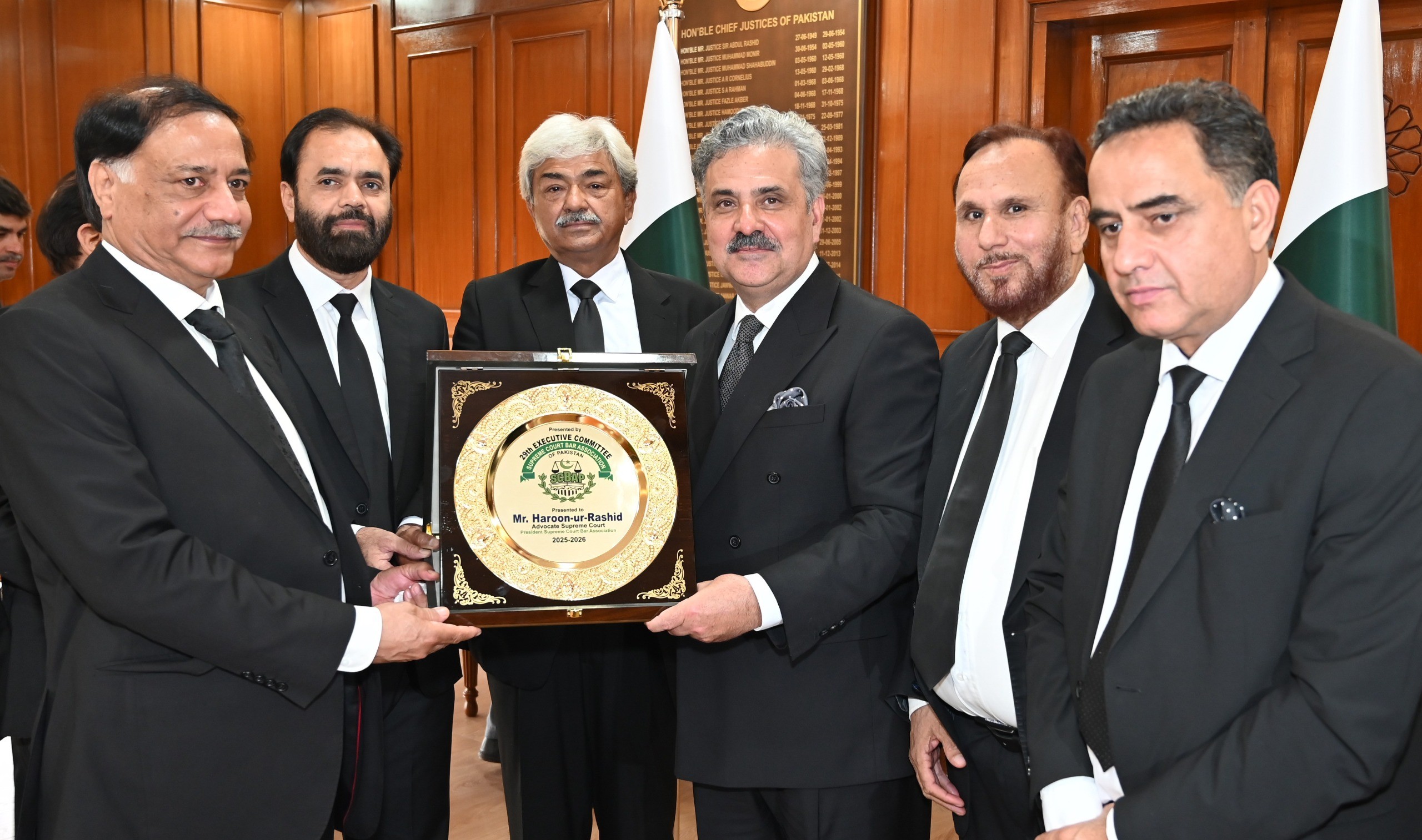
ISLAMABAD, Nov 05 (APP):The outgoing cabinet of the Supreme Court Bar Association (SCBA), led by Haroon ur Rasheed, and the newly elected cabinet, headed by Syed Amjad Shah, called on the Chief Justice of Pakistan at the Supreme Court premises here today.
The Chief Justice congratulated the newly elected office-bearers and appreciated the outgoing cabinet’s cooperation during its tenure. Emphasising that the Bench and Bar are integral to the administration of justice, he underscored the importance of sustained coordination, mutual respect and constructive engagement in strengthening public confidence in the justice system.
Briefing the delegation on institutional reforms, the Chief Justice highlighted improvements in case management, digital transformation, judicial infrastructure and public facilitation. He informed the participants that comprehensive Standard Operating Procedures (SOPs) have been implemented for case fixation and early hearing, establishing transparent criteria and regulating discretionary powers. Old and new cases are fixed in the cause lists according to a prescribed ratio, while applications for early hearing are considered on merit upon submission of valid supporting evidence establishing urgency.
The CJP further informed the delegation that approximately 20 to 30 cases are fixed before each Bench daily, with dedicated Benches for criminal and service matters. Death appeals instituted up to 2025 have been decided, while those instituted in 2026 are being heard. He also highlighted the target of disposing of pending cases concerning women’s inheritance and partition by August 30, 2027.
Highlighting digital reforms, the Chief Justice apprised that case records have been digitised with Optical Character Recognition (OCR) functionality and barcoding for efficient retrieval and tracking. The e-Office system has been activated to facilitate paperless workflows, while a dedicated Data Centre is being established to host the Court’s digitised records. He also referred to the Smart Judicial Assistant, e-filing, electronic certified copies and ongoing ISO certification efforts aimed at improving judicial efficiency and accessibility.
The newly elected cabinet raised concerns regarding deficiencies in courtroom sound and video-link systems. The Chief Justice informed the delegation that these systems are being revamped, with completion targeted by November 30, 2026.
The delegation also proposed permanent Benches at the Supreme Court’s branch registries to facilitate litigants at provincial headquarters. He informed the participants that a permanent Bench is already functioning at the Lahore Branch Registry, while Benches at other registries would be constituted subject to the availability of Hon’ble Judges.
Referring to public-oriented initiatives, the Chief Justice highlighted Public Facilitation Centres at the Principal Seat and branch registries, the 1818 Legal Call Centre providing free legal guidance and facilitating access to legal aid, and the Court-Annexed Mediation Centre promoting amicable dispute resolution.
The Chief Justice highlighted the Supreme Court’s expanding international judicial cooperation through Memoranda of Understanding (MoUs) signed with the Supreme Court of the People’s Republic of China, the Constitutional Court of Türkiye and the Supreme Court of the Republic of Korea. Similar agreements with the Court of Cassation of Türkiye and the Supreme Court of Azerbaijan are under process. As part of these collaborative initiatives, delegations comprising judicial officers and professionals from across Pakistan have visited China to gain practical insights into artificial intelligence, cybersecurity, e-filing and emerging judicial technologies. The Chief Justice emphasised that such exchanges strengthen institutional capacity, facilitate knowledge-sharing and promote the adoption of international best practices in the administration of justice.
The newly elected cabinet thanked the Chief Justice and proposed regular meetings between the SCBA and the Chief Justice, with available cabinet members accompanying the President. The CJP welcomed the proposal and assured the delegation of continued constructive engagement and due consideration of Bar-related matters.
The outgoing cabinet appreciated the Chief Justice’s cooperation and engagement with Bar representatives nationwide, including in remote areas. The newly elected cabinet reaffirmed its commitment to advancing professional excellence, institutional cooperation and accessible justice.
At the conclusion of the meeting, the Chief Justice presented commemorative shields to members of the outgoing cabinet in recognition of their services and as a gesture of goodwill. The outgoing cabinet reciprocated by presenting a memento to the CJP.