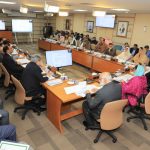
Water experts and journalists have called for greater media attention to Pakistan’s growing water challenges, stressing the need for sustained, evidence-based and solution-oriented reporting to make water security a prominent public-interest issue.
Water experts call for data-driven journalism, media fellowships to strengthen accountability

ISLAMABAD, Nov 03 (APP):Water experts and journalists have called for greater media attention to Pakistan’s growing water challenges, stressing the need for sustained, evidence-based and solution-oriented reporting to make water security a prominent public-interest issue.
The call was made during a panel discussion titled “Making Water Front-Page News with Evidence, Not Just Weather Reporting” on the second day of the sixth Pakistan Water Week 2026, a five-day international conference being held in Islamabad from November 2 to 6. The discussion focused on strengthening data-driven journalism, improving access to reliable information and encouraging closer collaboration between media organisations, researchers and relevant institutions.
The panel brought together prominent journalists and communications professionals, including Amber Rahim Shamsi, an award-winning senior journalist and former BBC World Service reporter; Aoun Abbas Sahi, senior journalist and Consulting Editor at Ibex Media Network; Hina Durrani, reporter at the Associated Press of Pakistan (APP); and Moqadas Hanif, a communications professional at the Akhter Hameed Khan Foundation (AHKF), Islamabad.
Participants observed that water-related issues continued to receive limited media attention despite their far-reaching consequences for people’s lives, economic development and environmental sustainability. They noted that coverage generally intensified during floods, droughts and seasonal water shortages but often overlooked the underlying causes of water scarcity and its long-term implications.
The speakers emphasised that water journalism should move beyond weather-related reporting to examine critical issues affecting agriculture, food security, livelihoods, public health and the national economy. They urged media organisations to treat water as a dedicated public-interest beat, deserving consistent editorial attention and investigative reporting.
Highlighting the importance of credible information, the panelists called on government departments and relevant institutions to ensure timely and transparent access to reliable data on river flows, groundwater levels, reservoir storage, water consumption and water quality. They also stressed the need for regular media briefings and improved access to technical experts to help journalists produce accurate and well-informed reports.
The discussion underscored the importance of field-based journalism, with speakers maintaining that exposure visits to water projects and direct interaction with affected communities were essential for understanding the realities behind official statistics and policy statements. Such engagement, they said, enabled journalists to verify information, identify implementation gaps and highlight the human and economic consequences of water-related challenges.
The panelists pointed out that statistics alone could not adequately convey the hardships experienced by communities facing water shortages, deteriorating water quality and climate-related disasters. They encouraged reporters to combine data-driven investigations with human-interest stories that reflect the everyday experiences of affected populations.
They also called on research organisations and academic institutions to make their findings and statistical information more accessible to journalists by presenting them in concise, clear and media-friendly formats. Stronger cooperation among journalists, universities, researchers, water authorities and policymakers, they added, was necessary to bridge the gap between scientific research, policymaking and public awareness.
Emphasising the need to strengthen professional capacity, the speakers recommended specialised workshops, training programmes and fellowships for journalists covering water-related issues. Such initiatives would help reporters develop a better understanding of water governance, scientific information, climate challenges and the broader implications of water insecurity.
The panelists further stressed that effective water journalism should connect technical and scientific issues with public-interest concerns, ensuring that the voices of affected communities remain central to media coverage. They called for more exclusive, impactful and solution-oriented stories capable of bringing water challenges into national discussions and encouraging meaningful institutional responses.
The speakers agreed that sustained and responsible reporting could play a vital role in raising public awareness, promoting transparency, strengthening institutional accountability and encouraging evidence-based solutions to Pakistan’s growing water security challenges.
The sixth Pakistan Water Week 2026 is being held in Islamabad from November 2 to 6 under the broader theme of translating commitments into practical action to strengthen water security and develop climate-resilient food systems. The five-day international conference brings together stakeholders to discuss challenges, share knowledge and explore strategies for sustainable water management and climate resilience.