The Central Shura and Executive Committee of the Pakistan Ulema Council, while reviewing the national and international situation, decided to organize nationwide conventions of religious scholars and spiritual leaders to eliminate extremism, promote inter-sect harmony and strengthen national unity.
Important meeting of Pakistan Ulema Council’s Central Shura, executive committee held
ISLAMABAD, Nov 2 (APP): The Central Shura and Executive Committee of the Pakistan Ulema Council, while reviewing the national and international situation, decided to organize nationwide conventions of religious scholars and spiritual leaders to eliminate extremism, promote inter-sect harmony and strengthen national unity.
A landmark initiative was also taken to establish “Dar-ul-Sulh” (Centres for Reconciliation) in all mosques affiliated with the Council to prevent growing family disputes, divorces and violent social attitudes.
The meeting strongly condemned attacks by Houthi terrorists on Makkah Mukarramah, Madinah Munawwarah and Saudi Arabia. It fully endorsed the Government of Pakistan’s policy regarding the security of the Two Holy Mosques and the Kingdom of Saudi Arabia, expressed solidarity with the Saudi leadership and people, assured all possible cooperation, and reaffirmed support for the legitimate government of Yemen.
The meeting also paid glowing tribute to Field Marshal Syed Asim Munir for his ongoing conciliatory and courageous efforts for global peace, unity of the Muslim Ummah and regional stability, and unanimously adopted several comprehensive resolutions.
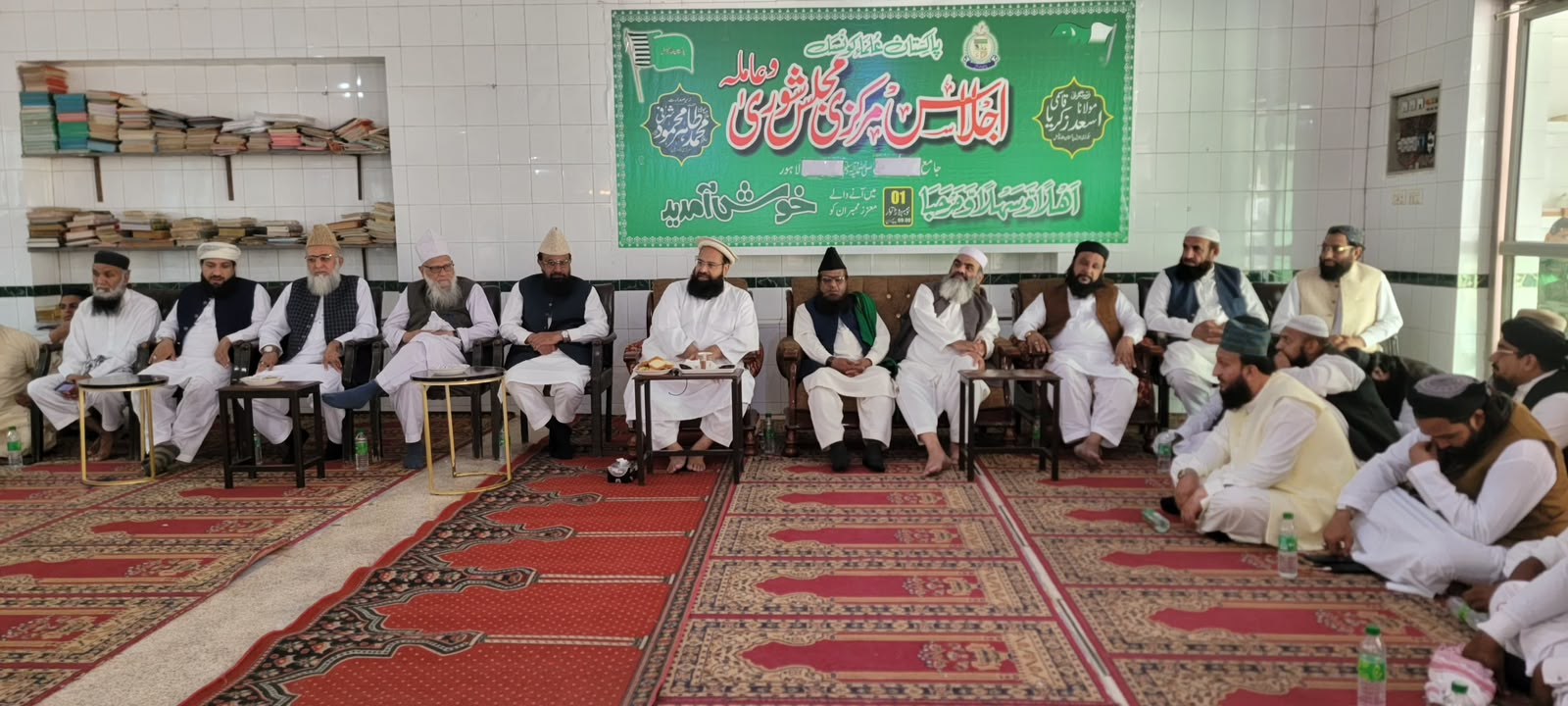
The important meeting was held at Jamia Manzoor-e-Islamia, Lahore, under the chairmanship of Pakistan Ulema Council Chairman Hafiz Muhammad Tahir Mehmood Ashrafi.
Members of the Central Executive Committee and Shura from across the country attended the meeting, including Maulana Nauman Hashir, Hafiz Maqbool Ahmed, Maulana Ubaidullah Gormani, Maulana Tahir Aqeel Awan, Maulana Muhammad Aslam Siddiqui, Maulana Muhammad Ashfaq Patafi, Maulana Aziz Akbar Qasmi, Qari Muhammad Ashiq, Samar Abbas, Maulana Muhammad Ilyas, Qari Sultan Mahmood, Hafiz Muhammad Kifayatullah, Muhammad Ashraf Bhatti, Shehzad Saadi, Zafar Iqbal, Allama Shabbir-ul-Haq Qasmi, Maulana Dr. Haq Nawaz Khan, Hafiz Usman Shakir, Maulana Muhammad Rizwan, Maulana Muhammad Salamat Dar, Qari Abdul Rauf, Hafiz Muhammad Jabir, Muhammad Mehran, Malik Nawaz, Maulana Muhammad Zubair Khattana, Shabbir Ahmed Khattana, Hafiz Ehtisham-ul-Haq, Muhammad Ahmed Baloch, Muhammad Rafiq, Muhammad Hammad, Sahibzada Hamza Tahir-ul-Hassan, Rashid Javed, Muhammad Ijaz Malik, Qari Muhammad Qasim Sangi, Muhammad Bilal Saqib, Mufti Muhammad Imran Muawiya, Qari Muhammad Akram Farooqi, Mufti Muhammad Irfan Gormani, Maulana Qazi Inam Bari, Maulana Tanveer Ahmed Chauhan, Qari Muhabbat Ali Qasmi, Maulana Imdad Makki, Qari Ismatullah Muawiya, Maulana Muhammad Yasir Alvi, Qari Hafeezullah, Qari Qamar Ashraf Shirazi, Muhammad Shoaib Bukhari, Hafiz Muhammad Bilal, Qari Muhammad Zubair Latif, Maulana Imran Zia, Qari Ghulam Yaseen Ranjha, Master Noor Abbas, Maulana Abdul Majid Siddiqui, Mufti Hafiz Abdul Qadir Qadri, Pir Qari Muhammad Abu Bakr Naqshbandi, Qari Muhammad Tayyab, Maulana Ghulam Mustafa, Qari Haq Nawaz, Maulana Abdul Qadeer, Umar Farooq, Maulana Sarfraz Ali, Mufti Samar Iqbal, Noor Faraz Khan and Maulana Mubashir Rahimi, among others. Nearly 200 prominent religious scholars, spiritual leaders and central members participated in the meeting.
According to the declaration issued after the meeting, the Council reiterated its resolve to further strengthen, organize and activate the Pakistan Youth Council. Under this initiative, dialogue sessions will be held with students and young people at universities, colleges, religious seminaries and mosques across the country to listen to their problems, grievances and suggestions, make practical efforts to address them, and provide them opportunities to play an effective role in national development, peace, tolerance and social reform.
During the meeting, the attacks by Houthi terrorists on Makkah Mukarramah, Madinah Munawwarah and Saudi Arabia were strongly condemned. The meeting fully endorsed the Government of Pakistan’s policy regarding the security of the Two Holy Mosques and the Kingdom of Saudi Arabia, expressed solidarity with the Saudi leadership and people, assured all possible cooperation, and reaffirmed support for the legitimate government of Yemen.
Expressing concern over growing political tensions, intolerance and violent attitudes in the country, the meeting appealed to all political and religious parties to give priority to mutual respect, tolerance, understanding and national interests, and play a collective role in promoting peace and stability.
Regarding the situation in Khyber Pakhtunkhwa, the meeting observed that although the imposition of governor’s rule would be a difficult decision, under the prevailing circumstances the federal and provincial governments, along with all political and religious parties, had a responsibility to rise above political differences and cooperate in restoring law and order and eliminating terrorism.
The meeting expressed full support for the efforts of Pakistan’s armed forces and security institutions against Fitna al-Khawarij and Fitna al-Hindustan, making it clear that the entire nation stands shoulder to shoulder with its armed forces in the fight against extremism and terrorism.
The meeting also endorsed the unanimous declaration and fatwa issued by the National Paigham-e-Aman Committee in Balochistan on October 27, 2026. It reiterated that there is no room in Islam for suicide attacks, the killing of innocent people or any form of terrorism. In particular, misleading, blackmailing or exploiting innocent girls and female students to use them for suicide attacks is a crime contrary to Islam, humanity and Baloch traditions.
The meeting appealed to the people of Balochistan, parents, religious scholars, spiritual leaders and representatives of educational institutions to unite to protect their children from such elements and cooperate with the government in promoting the national narrative of Paigham-e-Pakistan.
At the conclusion, the meeting welcomed the legislation undertaken by the federal and Punjab governments to facilitate the registration of religious seminaries and resolve issues relating to their bank accounts. It extended special thanks to Prime Minister Muhammad Shehbaz Sharif, Field Marshal Syed Asim Munir and Punjab Chief Minister Maryam Nawaz Sharif.
The meeting also appreciated the joint efforts of the Muttahida Madaris Council, National Paigham-e-Aman Committee, all federations of religious seminaries and religious education boards, expressing hope that effective implementation of these measures would also help resolve the issues faced by seminaries in other provinces.
The meeting concluded with the resolve that the Pakistan Ulema Council would continue its efforts for peace, national unity, religious tolerance, inter-sect harmony, guidance of the younger generation, strengthening of the family system and social reform in the country.