Federal Minister for Planning, Development and Special Initiatives Professor Ahsan Iqbal on Monday said continuity in sustainable development policies, institutional preparedness and long-term strategic planning was essential for countries to navigate global uncertainty arising from emerging technologies, climate change, geopolitical tensions and economic challenges.
Continuity in sustainable development policies vital amid global uncertainty: Ahsan
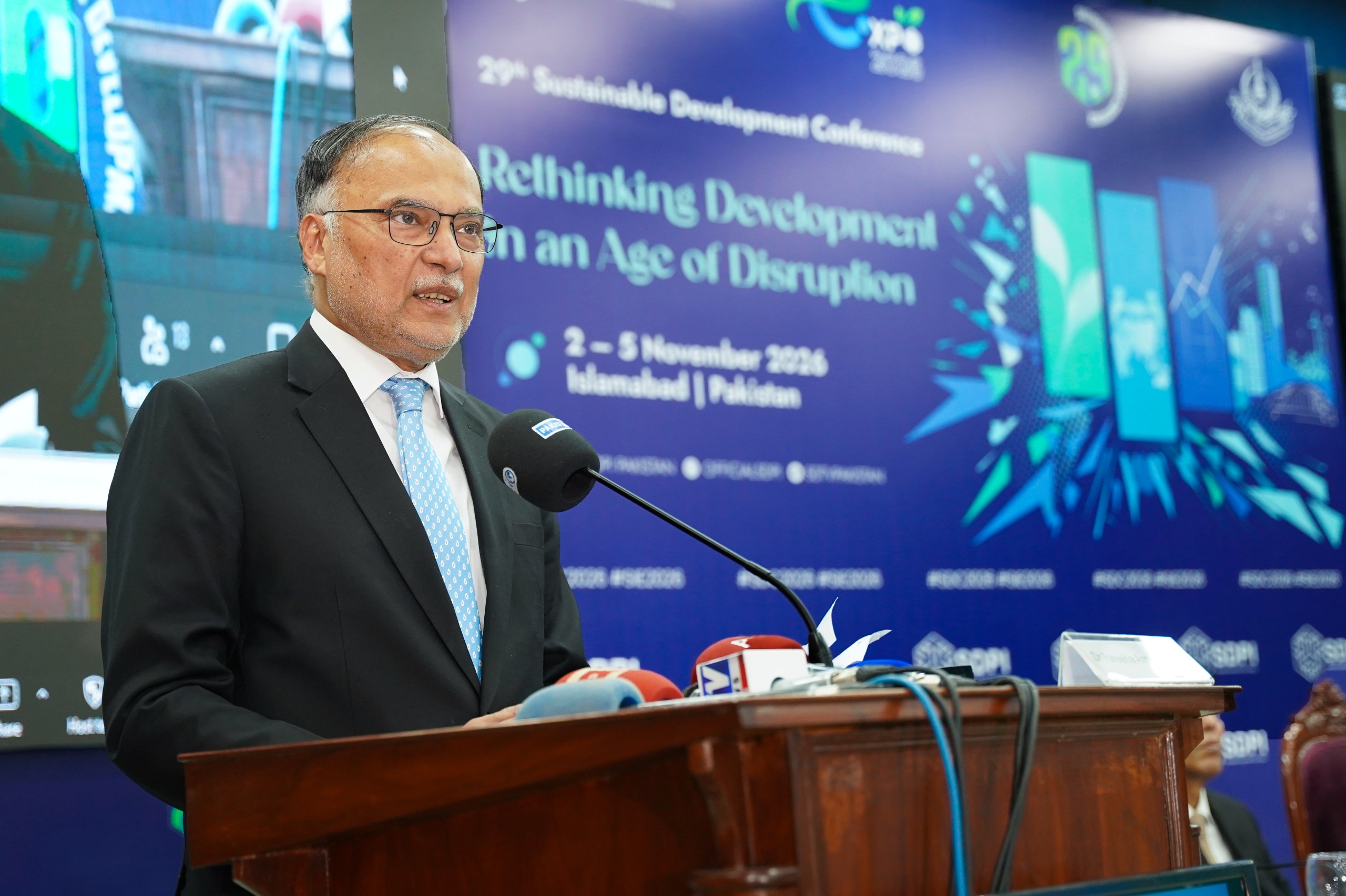
ISLAMABAD, Nov 2 (APP): Federal Minister for Planning, Development and Special Initiatives Professor Ahsan Iqbal on Monday said continuity in sustainable development policies, institutional preparedness and long-term strategic planning was essential for countries to navigate global uncertainty arising from emerging technologies, climate change, geopolitical tensions and economic challenges.
Addressing the 29th Sustainable Development Conference and 4th Sustainability Investment Expo, organized by the Sustainable Development Policy Institute (SDPI) at Allama Iqbal Open University, Islamabad, the minister said rapidly evolving technologies and growing climate challenges were fundamentally transforming economies and societies, requiring countries to adopt proactive and forward-looking strategies.
He said nations had two choices in the face of inevitable change: either remain apprehensive and suffer its consequences or develop proactive strategies to transform emerging challenges into opportunities.
Highlighting Pakistan’s commitment to technological advancement, he said the government had established national centres of excellence in Artificial Intelligence, Cyber Security, Big Data and Cloud Computing to equip the country’s youth with skills required to compete in the rapidly evolving global economy.
Emphasizing the growing link between geopolitics and economic stability, Ahsan Iqbal said conflicts and geopolitical rivalries, including the Russia-Ukraine war, were having far-reaching consequences for the global economy, affecting energy markets, food security, international trade and global supply chains.
He observed that international tensions were no longer confined to diplomatic and strategic arenas but were increasingly affecting household budgets and the cost of living.
A conflict thousands of kilometres away, he said, could increase fertilizer prices for a Pakistani farmer or raise food costs for an ordinary household, reflecting the growing interconnectedness of the global economy.
The minister said global political and economic realignments were reshaping development priorities, while international supply chains were increasingly being reorganized not only on the basis of cost and efficiency but also strategic and political considerations.
He stressed that developing countries needed to strengthen economic resilience, diversify international partnerships and expand regional connectivity to remain competitive in the changing global environment.
Drawing attention to challenges facing the international financial system, Ahsan Iqbal said billions of people worldwide were living in countries where debt-servicing obligations exceeded public expenditure on health and education.
He said the growing debt burden was severely constraining the fiscal space available to developing countries for investment in human development, infrastructure and sustainable economic growth.
The minister underscored that the impact of external shocks and international crises depended not merely on their magnitude but also on a country’s preparedness, export diversification and the skills and capabilities of its workforce.
Countries with diversified economies, strong institutions, technological capacity and skilled human resources were better positioned to withstand global disruptions and turn challenges into opportunities, he added.