Estimated national opium production jumped nearly five-fold, rising from around 300 metric tons in 2025 to around 1,500 metric tons in 2026, aided by favorable rainfall and higher per-hectare yields.
UNODC Report: Afghanistan opium production jumps fivefold to nearly 1,500 tons
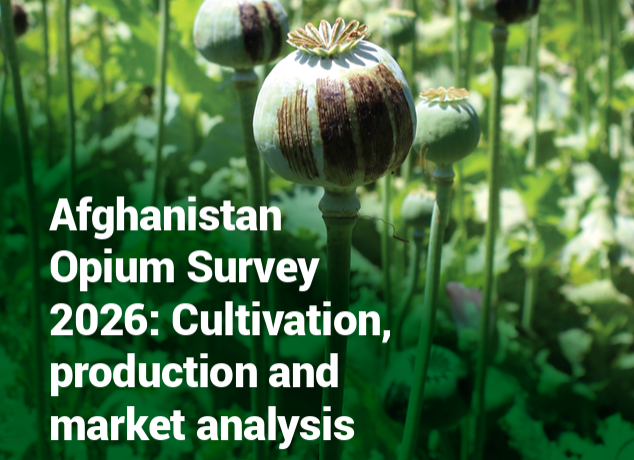
ISLAMABAD, Oct 30 (APP): Opium poppy cultivation and opium production in Afghanistan have experienced a massive surge in 2026, signalling a weakening of the illicit drug ban enforced in recent years, according to the latest report released by the United Nations Office on Drugs and Crime (UNODC).
The Afghanistan Opium Survey 2026: Cultivation, Production and Market Analysis, published this month, highlighted that illicit poppy cultivation expanded sharply across multiple provinces, driven by high market prices, concealed farming tactics, and persistent economic hardships facing rural households.
The U.N. agency said cultivation was up 330% and production rose by 400% compared with last year. Cultivation rose to more than 43,000 hectares (106,000 acres) in 2026 from 10,000 hectares (24,700 acres) a year earlier, it said.
Estimated national opium production jumped nearly five-fold, rising from around 300 metric tons in 2025 to around 1,500 metric tons in 2026, aided by favorable rainfall and higher per-hectare yields.
The North-Eastern region—primarily Badakhshan (29,482 ha) and Takhar (3,401 ha)—has consolidated its position as Afghanistan’s main opium hub, accounting for 76% of the total cultivated land and 74% of national production.
Farmers were concealing small poppy plots within cereal fields or inside walled compounds to evade detection, the report said.
The increase in opium poppy cultivation shows the difficulty in sustaining decreases in illicit opium cultivation when poor farmers have no alternatives to feed their families,” a statement quoted the agency’s executive director, Monica Juma, as saying.
She said that the Taliban authorities and the international community need to work together to support farming communities by investing in livelihoods, farming infrastructure and access to markets.
As per the report, opium poppy was detected in 16 out of 34 provinces (five more than in 2025), with provinces such as Balkh, Day Kundi, Farah, Herat, Laghman, and Nangarhar losing their poppy-free status.
Income generated from first-level dry opium sales surged to USD 525 million in 2026 (up from USD 134 million in 2025). The total value of opium sales represents roughly 2.7% of Afghanistan’s national GDP and 8.5% of its agricultural sector.
The survey highlights that Afghan farmers adapted heavily to enforcement pressures by employing deliberate concealment strategies as over 50% of poppy fields in Hilmand were hidden within larger wheat and barley fields. Over 40% of cultivation in Hilmand was hidden inside traditional walled mud or stone compounds.
While national average prices for dry opium fell 12% from USD 570/kg in 2025 to USD 500/kg in 2026, they remain more than five times higher than pre-ban levels.
The U.N. agency said that while cultivation and production remained below levels prior to the 2022 narcotics ban, the increase was the highest since the ban came into effect.
The agency said that continued monitoring was required as it was too early to determine whether the increase was temporary or an indication of a resurgence in opium cultivation and production.
The report called on the international community to provide support to farmers to help curb reliance on illicit crops.