UNITED NATIONS, Oct 24 (APP):Pakistan has underscored the fundamental importance of equitable, non-discriminatory civil nuclear cooperation to help secure its national energy future. "Efforts to prevent the proliferation of weapons of mass destruction ... must not impede international cooperation in the peaceful uses of dual-use technologies, which is vital for the economic development of the Global South," Pakistani delegate Syed Atif Raza told the United Nations General Assembly on Wednesday …
At UN, Pakistan pushes for equitable civil nuclear cooperation, stresses safety and energy security
UNITED NATIONS, Oct 24 (APP):Pakistan has underscored the fundamental importance of equitable, non-discriminatory civil nuclear cooperation to help secure its national energy future.
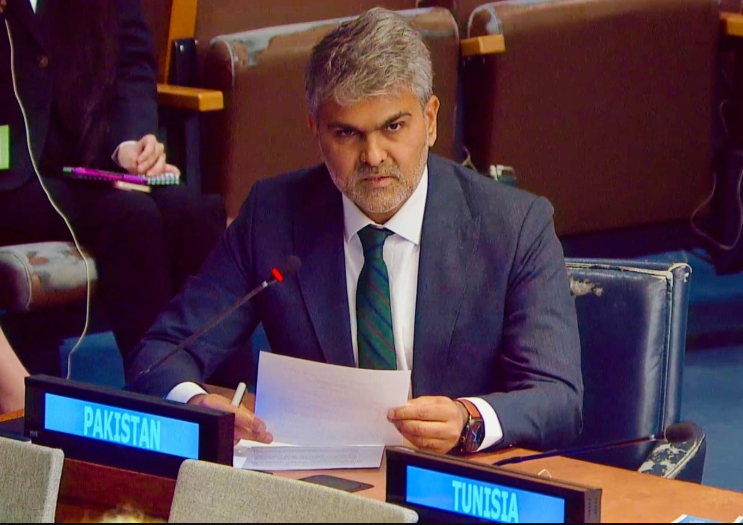
“Efforts to prevent the proliferation of weapons of mass destruction … must not impede international cooperation in the peaceful uses of dual-use technologies, which is vital for the economic development of the Global South,” Pakistani delegate Syed Atif Raza told the United Nations General Assembly on Wednesday during a debate on the annual report of the International Atomic Energy Agency (IAEA), the Vienna-based UN organization.
At the same time, Raza, a counsellor at the Pakistan Mission to the UN, highlighted that Pakistan is a party to the principal international instruments of nuclear safety and security.
“All countries must retain their inalienable right to utilize nuclear energy for peaceful purposes, consistent with their respective non-proliferation and international legal obligations,” the Pakistani delegate said.
Pakistan, he said, maintained that compliance or safety issues should be resolved through technical bodies like the IAEA without political bias.
“Outstanding situations must be addressed and resolved through dialogue and diplomacy, in a manner that upholds the non-proliferation regime while ensuring regional and international peace and security,” Atif Raza said.
“Countries should refrain from irresponsible and destabilizing rhetoric, actions, and postures that could escalate tensions and increase the risk of conflict.”
Pakistan, he said, operates six nuclear power reactors – all under IAEA safeguards, supplying about 20 percent of the national energy needs and one-third of low-carbon power generation.
“We support the agency’s work in peaceful applications of nuclear science and technology and look forward to the successful implementation of IAEA’s major initiatives.”
At the outset, Rafael Mariano Grossi, the IAEA Director-General, briefed the General Assembly on Syria, Iran and Ukraine, noting that the agency had gained access to previously restricted facilities in Syria after nearly two decades. “All the nuclear material in Syria is now under monitoring and verification”, he said, describing this as a major step towards Damascus’ reintegration into the international community.
“Discreet diplomacy, perseverance, factual, objective, technical work also pay off”, he added.
On Iran, the IAEA chief said the Agency had completed most of the technical preparations needed to verify its nuclear activities, expressing hope that negotiations between Tehran and Washington would produce an agreement.
“There will not be a lasting, stable solution without a diplomatic agreement”, he stressed, adding: “For a diplomatic agreement to happen, we need the verification.”
On Ukraine, he warned of continuing nuclear safety risks at the Zaporizhzhia Nuclear Power Plant, where IAEA has maintained a presence for nearly five years. The Agency recently negotiated its eighth localized ceasefire between the Russian Federation and Ukraine, allowing essential repairs to prevent a nuclear accident.
Grossi also highlighted the Agency’s independent monitoring of treated water discharges from Japan’s Fukushima nuclear power plant. Turning to the peaceful uses of nuclear technology, he stressed the need to expand access to nuclear energy in developing countries and welcomed the World Bank’s decision to finance nuclear projects as a “watershed” moment.