The deputy prime minister said that eradication of terrorism remained a national priority for Pakistan, emphasising that the nation had suffered losses exceeding 90,000 lives and direct economic damage over $150 billion, surpassing the country’s total external debt of $130 billion, during the war against terrorism.
KP emergency not a political move but against terrorism; to be implemented in totality: DPM Dar
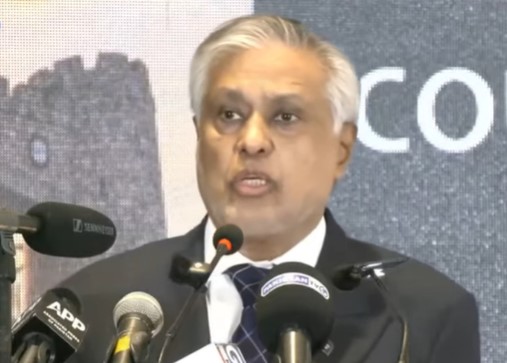
ISLAMABAD, Oct 12 (APP): Deputy Prime Minister and Foreign Minister Senator Ishaq Dar on Monday said that the imposition of emergency and governor’s rule in Khyber Pakhtunkhwa was not a political move but was aimed at combating the menace of terrorism, and that the people would see the difference in the months to come.
“It is not a political move…I can guarantee you… It is surely against the menace of terrorism with which the province has been hit in the last decade and a half…This government does not believe in political victimisation,” the deputy prime minister remarked in his keynote address at the International Conference on “Pakistan’s evolving terrorism landscape” organised by the Institute of Strategic Studies Islamabad.
He said the federal government has a duty to protect people’s lives and property anywhere in the country, and that there was no better solution than what the federal government did on Sunday.
“You will find the difference (in KPK) in weeks to come and months to come. And I am sure the province will be quite happy to see peace back, their lives and properties saved, and radicalisation end,” the deputy prime minister added.
Referring to the PDM government, he said that they had paid a very high political cost by assuming the government amid unpopularity, but they saved the country from the brink of default.
He told the gathering that eradication of terrorism remained a national priority for Pakistan, emphasising that the nation had suffered losses exceeding 90,000 lives and direct economic damage over $150 billion, surpassing the country’s total external debt of $130 billion, during the war against terrorism.
Reiterating the government’s resolve to eliminate terrorist networks through the National Action Plan and the Azm-e-Istehkam framework, he said that Pakistan upgraded its economic representation to ambassadorial level with Afghanistan, signed the Framework Agreement for the feasibility study of the Uzbekistan-Pakistan Railway through Afghanistan, and facilitated the CASA-1000 project, but Afghan authorities have yet to deliver on concrete commitments to stop TTP sanctuaries operating from across the border.
Deputy Prime Minister Dar said that border fencing alone could not replace active counter-terrorism action, while highlighting Pakistan’s goodwill in allowing 1,000 humanitarian aid containers into Afghanistan following severe security disruptions along the border.
“This concern is not Pakistan’s alone. It has consequences for the security of the wider region. Just imagine if Pakistan was not fighting this war as a front-line fighter—this terrorism, God knows, would have spread by now to which parts of the globe… Terrorism never respects frontiers. Ignoring the TTP and its patrons will not make this threat go away. It will only give them time to grow.”
He highlighted external patronage and state sponsorship of banned outfits including the TTP and BLA, citing dossiers submitted to the United Nations and historical cases such as Indian agent Kulbhushan Jadhav, who confessed his involvement in terrorist activities against Pakistan.
Highlighting Pakistan’s active role on the UN Security Council for the 2025–2026 term, its chairmanship of SCO-RATS, and the Makkah Joint Defence Agreement signed in August for regional self-defense under UN Charter Article 51, he urged global partners to bolster intelligence sharing, technology transfer, and joint action against digital propaganda, cryptocurrency financing, and emerging drone threats.
“No state or society can combat these challenges alone. We need to share technology, intelligence, and experience. Above all, we need strong political resolve to act against terrorism in all its forms and manifestations, without distinction or excuse.”
Highlighting Pakistan’s peace and diplomatic efforts in the region, he said that those who used to call Pakistan a state fighting terrorism now call it a peacemaker state.
“We did everything possible for US-Iran mediation. For the first time after 47 years, we brought them to direct talks at the same table. They shook hands, they sat together… But it is most unfortunate that there were violations from both sides,” he said and reiterated that Pakistan had not given up but was making all possible efforts.
Regarding the Makkah Joint Defence Agreement, he said that it was totally defensive in nature and not against any international law or charter.
“That is the line on which NATO was created. So our real objective is to create peace in this region and bring closeness among our nations. It is not restricted to these three countries. It has very clear clauses that will allow other countries, once we are fully established.”