Federal Minister for Parliamentary Affairs, Dr Tariq Fazal Chaudhry on Wednesday said the Khyber Pakhtunkhwa government had almost no writ in 12 districts of the province, including eight former tribal districts.
KP government has no writ in 12 districts: Dr. Tariq Fazal
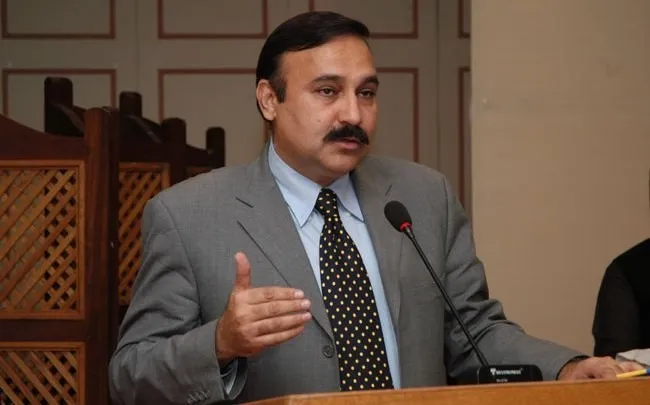
ISLAMABAD, Oct 07 (APP): Federal Minister for Parliamentary Affairs, Dr Tariq Fazal Chaudhry on Wednesday said the Khyber Pakhtunkhwa government had almost no writ in 12 districts of the province, including eight former tribal districts.
Talking to reporters at the Parliament House, he said the KP government needed to understand the seriousness of the situation and cooperate with security agencies in the fight against terrorism.
“If they first commit themselves to cooperating with the security agencies and then ensure its implementation, the federal government will fully support them and move forward,” he said.
However, he said the situation would require a different approach if the provincial government did not commit itself to cooperation, either verbally or practically.
He said the KP government should support the federal government in the fight against terrorism and seek greater federal assistance and resources to deal with the security situation.
“The situation is such that we are asking the KP government to support us in the fight against terrorism. There is a need for a change in its attitude,” he said.
Responding to a question, he said the sisters of PTI founder Imran Khan had continued to meet him before the Sept 27 long march call. Some of the meetings were reported in the media while others were not.
He said the government had provided the best possible medical facilities to the PTI founder and had fulfilled its responsibility regarding his health.
He said it was the government’s responsibility to ensure that the PTI founder received proper medical care and all facilities available to him under the jail manual. “The government has no intention of causing PTI founder any difficulty. We are fulfilling our responsibility regarding his health and ensuring that he receives all facilities available to him under the rules,” he said.
To a question he said no march would be allowed to enter Islamabad because the capital was the country’s seat of government and housed sensitive installations and diplomatic missions.
He said the government was responsible for protecting sensitive buildings, diplomats and residents of Islamabad.
He said these factors would be considered while dealing with any march towards the federal capital.
Responding to another question the minister said the government-opposition talks held on Oct 2 failed mainly because of the opposition’s misplaced priorities.
“Our priority is KP, while their priority is their founder. We want peace in KP, while they want to please their founder,” he said.
He said no government or state system could function properly without setting political priorities.
He urged the opposition to first focus on the security situation in KP and then pursue issues concerning its political leader. “We have no objection to that, but priorities have to be set,” he added.
Responding to a question, Dr Tariq Fazal Chaudhry said the option of imposing an emergency in KP remained under serious consideration, but the federal government had no desire to take such a step.
He said an emergency would only be imposed because of the provincial government’s lack of cooperation in the fight against terrorism.
Responding to a query, he said the Constitution granted certain powers to every provincial chief minister, including the KP chief minister, and those powers could not be exercised on someone else’s directions. He said if the KP government continued its current policy of non-cooperation in the fight against terrorism, the federal government could impose an emergency in the province through constitutional means. He said imposing an emergency was a constitutional option available to the federal government in extraordinary circumstances.
“If the KP government maintains its current non-cooperative approach in the fight against terrorism, emergency could be imposed in the province in accordance with the Constitution,” he said.
He said the use of constitutional provisions during extraordinary situations was not unprecedented and had occurred in the country in the past. “This is a constitutional option and would not be something new,” he added.
He termed the KP government’s refusal to implement the federal government’s counter terrorism policy a serious and dangerous development. “If you want to run a province by completely disconnecting it from the federation, particularly a province facing terrorism and where security personnel are being martyred on a daily basis, this cannot continue,” he said.
He said the federal government could not stop intelligence-based operations in KP because of the provincial government’s position. “These operations will continue until the last terrorist is eliminated. The federal government, intelligence agencies and security institutions are fighting terrorism and will continue to do so,” he said.
He said continued non-cooperation by the KP government could create circumstances for imposing an emergency in the province. Referring to the political situation, he said it was the right of the PTI founder to issue directions to his party.
However, he said constitutional appointments could not be made on the directions of anyone who was disqualified or convicted.
On negotiations, he said Prime Minister Shehbaz Sharif had made it clear that political issues should be resolved through dialogue rather than street protests. He said the government was ready to sit with the opposition and resolve political issues through talks and consultation. “Stop the political activities on the streets and come to the table. We are ready to resolve issues through dialogue and negotiations,” he said.
To another question, he said the opposition’s lack of cooperation was creating hurdles in the appointment process for the Election Commission of Pakistan. He said the Constitution provided a clear mechanism for such appointments, beginning with consultations between the prime minister and the leader of the opposition.
He said Prime Minister Shehbaz Sharif had personally invited the opposition leader more than twice for consultations, but the opposition had chosen to respond through letters instead of holding talks. He said refusing to visit the Prime Minister’s House or the office of the National Assembly speaker could not be justified. “The Prime Minister’s House is not anyone’s personal property. It belongs to the state,” he said.
The minister said visiting the Prime Minister’s House and fulfilling constitutional requirements for important appointments was the opposition’s responsibility. He said the opposition was currently failing to fulfil that responsibility through its lack of practical cooperation. He added that political differences should not become a reason for obstructing constitutional and institutional processes.