ISLAMABAD, Oct 07 (APP):Deputy Prime Minister/Foreign Minister (DPM/FM), Senator Mohammad Ishaq Dar on Tuesday condemned India's weaponization of water and underlined that the Indus Waters Treaty (IWT) remains fully in force and that India's unilateral action to place it in abeyance has no legal basis. Addressing the "International Water Symposium" at the Diplomatic Academy of Vienna through a video message, he said shared rivers must serve peace and cooperation, not …
Dar condemns India’s weaponization of water, says Indus Waters Treaty remains in force
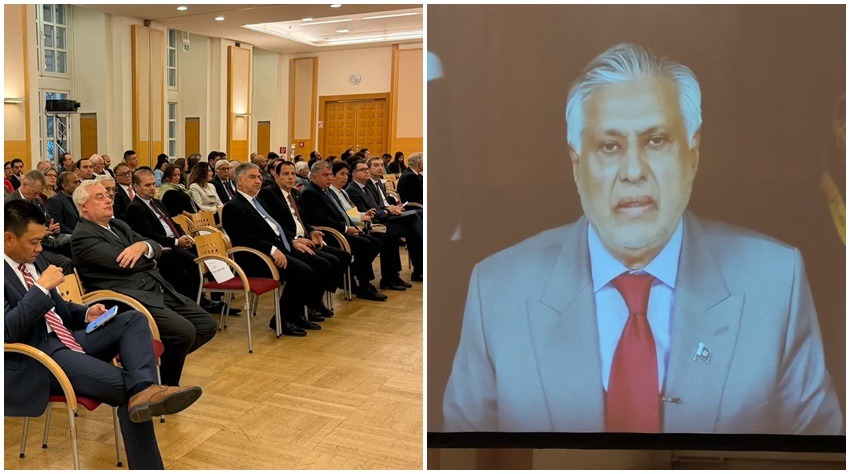
ISLAMABAD, Oct 07 (APP):Deputy Prime Minister/Foreign Minister (DPM/FM), Senator Mohammad Ishaq Dar on Tuesday condemned India’s weaponization of water and underlined that the Indus Waters Treaty (IWT) remains fully in force and that India’s unilateral action to place it in abeyance has no legal basis.
Addressing the “International Water Symposium” at the Diplomatic Academy of Vienna through a video message, he said shared rivers must serve peace and cooperation, not coercion.
The symposium was convened by the Embassy of Pakistan in Austria in collaboration with the Diplomatic Academy. It brought together diplomats, academics and international experts to discuss water security and international cooperation, with a separate session on transboundary river governance, water rights and obligations under international law, a DPM’s Office news release said.
The deputy prime minister said India unilaterally placed the Treaty in abeyance in April 2025, although it contains no provision allowing either party to suspend, terminate or hold it in abeyance.
He highlighted the unanimous Award on the Status of the Treaty, rendered by the Court of Arbitration on August 31, 2026. After examining the grounds advanced by India, including material breach, fundamental change of circumstances, armed conflict and countermeasures, the Court concluded that none justified suspension or termination of the Treaty.
“The Court unequivocally confirmed that the Treaty remains fully in force and that India continues to be bound by its obligations,” he said, including those governing the design and operation of hydroelectric projects on the Western Rivers. He described this as a reaffirmation of the principle of pacta sunt servanda, that agreements must be kept.
Senator Dar also noted that on the same day the Court issued an Order on Interim Measures concerning India’s Ratle Hydro-Electric Plant. It restricted the completion of specified components of the project above prescribed levels until ninety days after the Neutral Expert’s final decision, and directed India to provide information on the project’s construction schedule.
He said that despite these pronouncements, which endorse Pakistan’s position and reject India’s actions, India “continues its intransigent behaviour and illegal actions” with regard to the Treaty.
Underlining the importance of the Indus system, the deputy prime minister said it sustains the lives and livelihoods of more than 250 million Pakistanis, supporting agriculture, food security, energy production and economic development. “For Pakistan, water security is inseparable from food security, economic security, and ultimately national security,” he said.
He warned that using water as an instrument of pressure against such a population would have profound humanitarian, economic and security implications. India’s action, he added, would also set a dangerous precedent for other transboundary river basins, where millions depend on the faithful implementation of international agreements.
He said Pakistan has consistently sought to resolve differences through dialogue, diplomacy and the Treaty’s dispute resolution mechanisms. Pakistan is also participating in the Neutral Expert proceedings, administered by the Vienna Office of the Permanent Court of Arbitration at the Hofburg Palace, and has engaged constructively in both processes.
The deputy prime minister outlined three principles: The Treaty must be respected and implemented in letter and spirit, and its obligations cannot be made contingent on political relations or unilateral considerations. All questions, differences and disputes must be addressed through the Treaty’s mechanisms, and decisions rendered through them must be respected and implemented. Both countries must strengthen technical engagement, transparency and data-sharing in accordance with the Treaty.
He underscored the crucial role of the international community in upholding international law and treaty-based cooperation. “Amidst challenges to the international law-based world order, the international community should be strengthening treaty-based cooperation, not permitting its erosion,” he said.
Reiterating Pakistan’s position, he said, “Our preference remains clear: cooperation over coercion, dialogue over confrontation, and the rule of law over unilateralism.”
At the same time, he said, there should be no misunderstanding about Pakistan’s resolve to safeguard its legitimate rights and interests under the Treaty and international law. “Any attempt to deprive Pakistan of the waters rightfully allocated to it would have serious implications for regional peace and security,” he warned.
The deputy prime minister wished the symposium fruitful deliberations and expressed hope that it would contribute to strengthening international cooperation on water governance.