Minister for Defence Khawaja Muhammad Asif on Monday said terrorism, rather than politics, was the main issue between the federal government and the Khyber Pakhtunkhwa government, urging the provincial authorities to address gaps in policing, counter-terrorism capacity and governance.
Terrorism main issue between Centre, KP government: Khawaja Asif
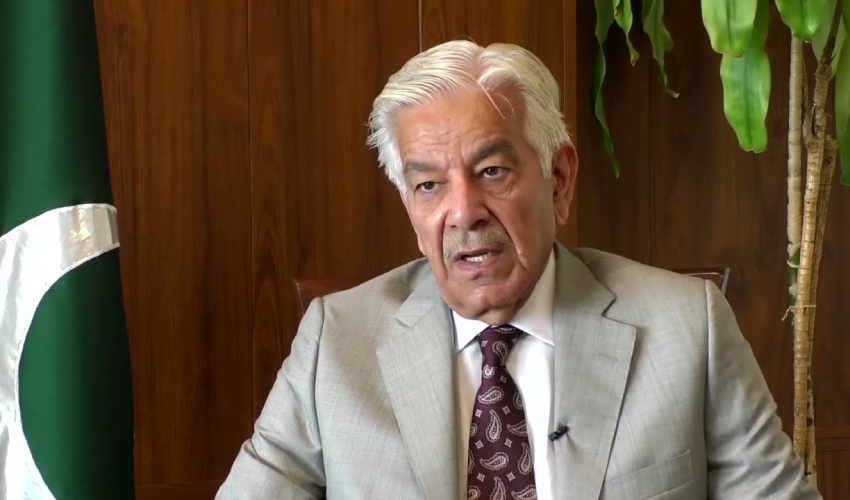
ISLAMABAD, Oct 05 (APP): Minister for Defence Khawaja Muhammad Asif on Monday said terrorism, rather than politics, was the main issue between the federal government and the Khyber Pakhtunkhwa government, urging the provincial authorities to address gaps in policing, counter-terrorism capacity and governance.
Around 6,200 terrorism-related incidents had been reported in Khyber Pakhtunkhwa over the past two years, resulting in around 1,200 fatalities, the minister said in a post on social media platform X.
He said that Afghan nationals had carried out 37 suicide attacks during the period, while 14 such attacks had taken place during the current year, with the majority allegedly involving Afghan nationals.
Khawaja Asif said the KP Police had a total strength of around 125,000 personnel, of whom 13,000 were deployed on VIP protocol duties, while 17,000 sanctioned posts remained vacant.
He said the Counter-Terrorism Department (CTD) in the merged districts was almost non-functional, with only 17 bulletproof vehicles and a total strength of around 3,300 personnel, adding that only 25 of them were permanent employees while the rest were working on contracts.
The minister said that political use of the Police Act had also affected the operational capacity of the police.
He said the police had sought Rs42 billion for reconstruction of police posts to counter terrorist attacks, but the KP government had released only Rs1.2 billion.
He said that although documents showed expenditure of Rs42 billion, the actual amount had been misappropriated.
Responding to PTI’s argument that if the Army was deployed along the border, terrorists could not enter the country, Khawaja Asif questioned the party’s approach towards militancy.
He said PTI had remained in power or exercised political influence in KP for the past 13 years, adding that former prime minister Imran Khan had consistently favoured engagement and negotiations with the Tehreek-e-Taliban Pakistan (TTP).
The minister said that after becoming prime minister, Imran Khan had advocated dialogue with terrorists and claimed to know how to end terrorism in KP.
He said that Lt Gen (R) Faiz Hameed was also used to advance that policy, adding that the consequences of the policy had been borne by KP and Pakistan.
Khawaja Asif said the Pakistan Army had made the state’s policy clear that terrorists would be eliminated and that the state policy was based on action against terrorists rather than negotiations with them.
“Your policy is completely contrary to the state policy,” he said, referring to PTI, adding that negotiations and engagement with terrorists were incompatible with the state’s policy of eliminating terrorism.
The Defence Minister also questioned the PTI’s allegation that the military was supporting terrorism, asking who was fighting terrorists if the Army was allegedly supporting them.
He further asked PTI to explain how much financial assistance Pakistan had received from the United States in recent years for counter-terrorism and security purposes.
Referring to drone attacks in Kohat and Peshawar and attacks by the Tehreek-e-Taliban Afghanistan on Pakistani security posts, he asked whether such incidents were not a reality and questioned why the military could not use drones for self-
defence if terrorists were themselves employing them.
Khawaja Asif also raised questions regarding the functioning of the civilian administration and justice system in the merged districts.
He asked how many courts and police stations there were fully operational, how many judges and police personnel were performing their duties there, and how many meetings of apex committees had been held to review the terrorism situation.
He also asked the provincial government to explain its own policy for eliminating terrorism.
On PTI’s claim that KP had not received adequate funds, the minister cited federal financial assistance to the province from 2010 to 2025, putting the total at around Rs8.5 trillion.
According to figures shared by him, KP received Rs5,867 billion under the 7th National Finance Commission (NFC) Award during 2010-2025, Rs705 billion under the one per cent share of the divisible pool for war against terrorism, and Rs704
billion for the merged districts since 2019.
He said Rs482.78 billion had been provided through direct transfers, including royalties and GDS, while Rs481.433 billion had been spent under the Benazir Income Support Programme in KP from fiscal year 2016 to 2025.
He said that Rs117.166 billion had been provided for internally displaced persons (IDPs), while the latest NFC payment of Rs46.44 billion was made on December 17, 2025.
The minister said the divisible pool share was also being transferred regularly, adding that around Rs8,500 billion had been provided to KP in total, including Rs704 billion specifically for the merged districts.
Khawaja Asif said that more than 3,000 terrorism-related cases were pending before the prosecution, but no terrorist had so far been executed or convicted.
He said the state’s clear policy was “Hold, Build and Transfer”—first securing and holding an area, then rebuilding it and developing institutional infrastructure, and finally transferring it to the civilian administration.
The Defence Minister questioned why the provincial authorities were not implementing the “Hold, Build and Transfer” approach and urged the civilian administration and courts to move forward and take responsibility for administering the merged districts.