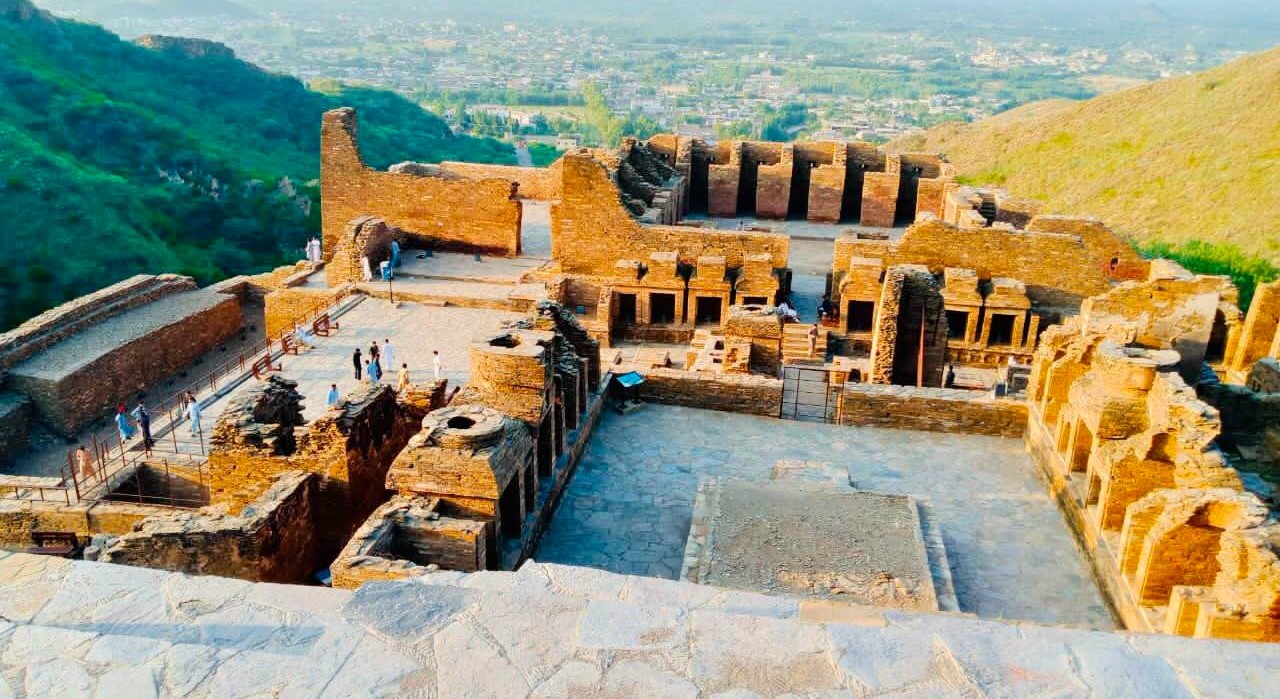
As the first rays of sunlight touch the rugged hills of district Mardan, the ancient stones of Takhtbhai emerge from the morning mist, casting long shadows across courtyards where Buddhist monks once walked, prayed, studied and meditated.
Fakhar-e-Alam
TAKHTBHAI, Oct 4 (APP):As the first rays of sunlight touch the rugged hills of district Mardan, the ancient stones of Takhtbhai emerge from the morning mist, casting long shadows across courtyards where Buddhist monks once walked, prayed, studied and
meditated.
For centuries, the winds have swept across these ancient walls, while seasons have come and gone and civilizations have risen and faded. Yet, the ruins of Takhtbhai remain steadfast, defying the relentless passage of time.
Perched on a hilltop, the ancient Buddhist monastic complex of Takhtbhai is far more than an archaeological site. It is a surviving chapter of Gandhara’s remarkable story a place where religion, philosophy, scholarship, architecture and art once converged.
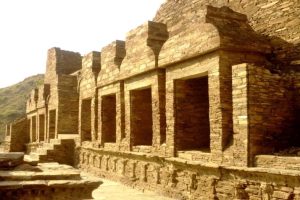
“At Takhtbhai, history is not buried beneath layers of earth. It stands in the open in stone stairways worn by countless footsteps, meditation cells, courtyards, stupas and massive walls constructed with the distinctive Gandhara diaper-style masonry,” said Bakhtzada Khan, Director, Archaeology and Museums KP, while talking to APP.
“Every stone here speaks,” says Bakhtzada Khan, adding it is not just an archaeology site but a narrative carved in stone that dates back to the early centuries before Christ, through the zenith of the Kushan dynasty and beyond,” he told APP.
Recognized as a UNESCO World Heritage site in 1980, Takhtbhai is regarded as one of the best-preserved Buddhist monastic complexes in South Asia.
Its archaeological importance lies not merely in its age, but in what its physical remains reveal about the society that created it.
He said the complex developed through successive phases and remained in use until around the 7th century CE. Its architectural remains provide valuable evidence of the evolution of Buddhist monastic life in Gandhara, where monks lived, taught and pursued meditation and spiritual discipline.
Its unique architecture itself is a testimony to cultural interaction. Built largely with locally available stone and employing the characteristic diaper masonry technique, the complex reflects a distinctive synthesis of South Asian traditions and Hellenistic influences that became a hallmark of Gandharan art and
architecture.
For archaeologists, these stones are therefore not simply building material but they are evidence clues through which the political, religious and cultural history of an ancient civilization can be
reconstructed.
The stupas, monastic cells, assembly areas and other structures suggest a highly organized religious institution that was once part of a much wider Buddhist cultural network stretching across ancient Gandhara and
beyond.
Every year, pilgrims, Buddhist monks, historians, researchers and cultural tourists arrive at Takhtbhai from different parts of the world.
Last week, visitors from Korea, Nepal and China explored the ancient complex of Takhtbhai, walking along its time-worn paths and pausing before structures that have survived for nearly two millennia.
For some, the journey is archaeological; for others, spiritual. But for almost every visitor, the experience is one of the depth of history.
The ruins also gain greater significance when viewed as part of the wider archaeological landscape of
Mardan.
Around five kilometers from Takhtbhai lies Sahr-i-Bahlol, an ancient fortified settlement believed to date from the Kushan period.
Built on a mound around nine meters high, it retains portions of its defensive walls, also constructed in the distinctive diaper-style masonry.
Nearby Jamal Ghari further expands the archaeological canvas, demonstrating that Takhtbhai was not an isolated centre but part of a broader network of settlements and religious establishments that flourished in ancient Gandhara.
“Together, these sites represent the zenith of Buddhist architectural achievement in the subcontinent,” Bakhtzada Khan said.
Their significance becomes even clearer when placed against the extraordinary scale of Gandhara’s archaeological heritage in Khyber Pakhtunkhwa.
According to the archaeology authorities, around 2,000 religious and heritage sites and nearly 30,000 artefacts associated with Gandharan civilization have been discovered across the province.
Yet many remain understudied, inadequately documented or largely unknown to international audiences.
This presents both a challenge and an opportunity. Manzoorul Haq, former ambassador of Pakistan, believes Takhtbhai has the potential to emerge as a major global cultural tourism destination if promoted through digital and social media.
“I have visited many countries but hardly seen such historical archeological monument,” he said.
“This is Pakistan’s identity,” he told APP.
He said short videos, documentaries and visually compelling digital storytelling could introduce Takhtbhai and Gandhara civilization to a much wider international audience while creating opportunities for cultural tourism and local economic development.
The protection of the site has also received legal recognition. The 445-hectare mountainous area surrounding Takhtbhai has been declared an archaeological reserve to protect it from unchecked urban expansion and encroachments.
Dr Abdul Samad Khan, Director General Archaeology and Museums KP, said the historical site is safeguarded under the Ancient Monuments Preservation Act, 1904, and the Antiquities Act, 1975.
But experts said legislation alone cannot preserve an archaeological treasure of such scale.
Conservation requires sustained funding, specialized archaeological expertise, trained conservation staff, scientific documentation and above all, public ownership of heritage.
For a young visitor like sixth-grade Anaya Bibi and her brother Ismail Khan, however, Takhtbhai offered something more immediate: a journey into a past they had previously encountered only through books.
“I had heard a lot about Takhtbhai monument being UNESCO World Heritage site and today everything was found true,” Anaya said after visiting the site with her father.
For Anaya, the ancient monastery transformed the distant history of Gandhara into something tangible.
She believes the site should become part of the school curriculum so that younger generations can learn about the civilizations, cultures and faiths that flourished in the region centuries before the modern state of Pakistan came into existence.
Her observation points to one of the most powerful roles archeology can play by connecting the younger generation with history not as a collection of dates and names, but as a living experience.
The preservation of Takhtbhai is therefore not only about protecting stones but it is about preserving evidence of a civilization that contributed profoundly to the development of Buddhist art, architecture and intellectual traditions across Asia.
It is also about recognizing that present-day Khyber Pakhtunkhwa was once a major crossroads where ideas, artistic traditions, religions and people interacted across vast geographical boundaries.
Dr Abdul Samad said Pakistan’s growing engagement with UNESCO also offers renewed opportunities for highlighting this heritage. The country’s UNESCO World Heritage Tentative List has recently expanded from 25 to 37 properties with the inclusion of 12 new cultural and heritage sites.
Among the additions are the Archaeological Complex of Gor Khatri, Bazira-Barikot, Bhamala Buddhist Complex, Sethi House, Mai Qamro Mosque, Pharwala Fort, Rawat Fort, Tomb of Sultan Muqarrab Khan, Kot Diji Fort, Naukot Fort, Umer kot Fort and Kalasha Valley Cultural Landscape.
He said the additions underline the extraordinary diversity of Pakistan’s archaeological and cultural inheritance in which Takhtbhai occupies a distinctive place in that heritage.
As the sun begins to set over the ancient monastery, the golden light falls across weathered stones that have witnessed the rise and decline of empires, the movement of peoples and the transformation of religious and cultural traditions.
The silence of the ruins can almost feel like a conversation with the past.
Takhtbhai is a window into Gandhara but it is also a mirror reflecting the cultural wealth that survives in modern Pakistan.
Its stones speak of faith and scholarship, of artistic excellence and cultural exchange, of a civilization that flourished here nearly two thousand years ago and whose artistic legacy traveled far beyond these hills.
The challenge for the present generation is to ensure that these voices are not lost to neglect.
For if every stone at Takhtbhai truly speaks, archaeology gives us the means to listen, and heritage preservation gives future generations the chance to hear.