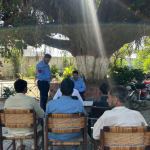
The afternoon was calm on the Margalla Hills. A group of hikers had stopped along the trail to catch their breath, enjoy the cool breeze and admire Islamabad stretching beneath them. From the height of the hills, the capital appeared peaceful and distant, its busy roads and buildings softened by the surrounding green landscape.
Moniba Iftikhar
ISLAMABAD, Oct 04 (APP):The afternoon was calm on the Margalla Hills. A group of hikers had stopped along the trail to catch their breath, enjoy the cool breeze and admire Islamabad stretching beneath them. From the height of the hills, the capital appeared peaceful and distant, its busy roads and buildings softened by the surrounding green landscape.

Then the mood suddenly changed.
A monkey emerged from the trees and moved towards the hikers, its eyes fixed on a packet of biscuits. Within seconds, the quiet break turned into laughter, nervous shouts and hurried steps backwards. The hikers pulled their bags closer as the monkey continued its approach without the slightest hesitation.
“Be careful with the biscuits!” one hiker shouted.
The monkey remained completely unfazed. It had spotted the food and appeared to know exactly what it
wanted.
“These monkeys know exactly who is carrying food,” another hiker joked.
For the hikers, it was an amusing encounter. But for wildlife enthusiasts and officials, scenes like this point to a deeper and increasingly visible problem: wild animals are becoming accustomed to human food.
Across Daman-e-Koh, Trail 3, Trail 5 and other routes through the Margalla Hills, hikers, families, students and fitness enthusiasts regularly share the trails with wildlife. They come for exercise, fresh air, scenic views and a break from the routine of city life.
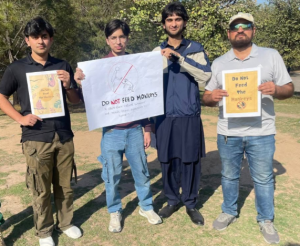
Yet the boundary between observing wildlife and interfering with it can disappear quickly when visitors begin offering food.
“We come here for the views and the peace, but the monkeys have become part of the experience too,” said regular hiker Khalid Malik.
Another hiker summed up the experience with a laugh: “You can forget your water bottle, but never forget to protect your snacks.”
Behind the humour is a serious conservation concern.
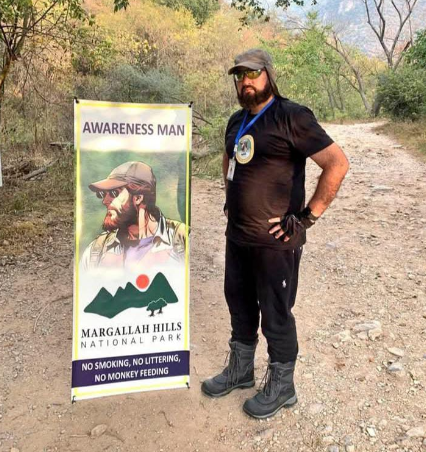
Mansoor Sherwani, a young nature enthusiast and biodiversity advocate who volunteers with the Islamabad Wildlife Management Board (IWMB) has made public awareness about wildlife feeding an important part of his work. He regularly approaches visitors on the trails, asking them not to feed monkeys or other wild animals.
For Mansoor, the issue is not about a single biscuit, sandwich or piece of fruit. It is about what repeated feeding teaches an animal.
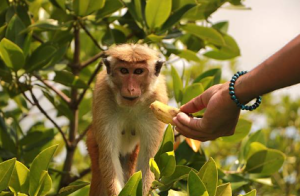
“Wild animals know how to find food in their own habitat,” he explained. “When people keep feeding them, they begin to expect food from humans instead of finding it themselves.”
He believes visitors often feed wildlife with good intentions. A person sees a monkey approaching and assumes that giving it a piece of bread, fruit or a paratha is an act of kindness.
But, he argues, kindness can have unintended consequences.
“When wild animals repeatedly receive food from humans, they begin to associate people with an easy source of food,” Mansoor said. “Instead of maintaining their natural distance, they learn to approach visitors.”
One encounter particularly stayed with him.
A family had arrived on the trail carrying freshly prepared desi ghee parathas. The food had not simply been packed for their own picnic. They had brought the parathas from their village specifically to feed the monkeys.
Several monkeys watched from nearby branches as the family prepared to offer them the food.
Mansoor approached the family and explained why feeding wildlife could interfere with the animals’ natural
behaviour.
Then, hoping humour would make his message easier to remember, he joked: “Why don’t you give those parathas to me instead? I hardly ever get to eat desi ghee parathas like these.”
The family laughed, but their intention remained serious. They told him that they had brought the special food from their village specifically for the monkeys.
For Mansoor, the encounter revealed how deeply the practice is rooted in public perception.
“Many people genuinely believe they are helping animals when they feed them,” he said. “But wildlife does not need to be taught to depend on people.”
Another incident provided an even more direct demonstration.
At Daman-e-Koh, Mansoor encountered a group of female students running along the road. He asked whether they were carrying food. They said they were not. He nevertheless warned them to remain cautious around the monkeys and not to encourage them to approach.
Within minutes, his warning became reality.
A monkey suddenly approached, grabbed one of the girls’ bags and began eating the sandwiches
inside.
What had initially seemed like a harmless wildlife encounter quickly became a scramble as the students watched the animal help itself to their food.
Mansoor said the incident showed how easily monkeys can become comfortable around humans when they associate visitors with food.
On another occasion, he found a family eating along the trail while monkeys gathered nearby. Instead of allowing the family to feed them, he advised them to show the animals their empty hands.
Once the monkeys realized there was no food available, they moved away.
For Mansoor, such moments provide an opportunity to change public behaviour.
His awareness efforts extend beyond individual encounters. He spends considerable time in the forest and uses weekends to speak with families and visitors about wildlife protection.
He has also called for the removal of food baskets and other easily accessible food sources around Daman-e-Koh and locations where monkeys can easily obtain food from visitors.
The message from wildlife officials is equally direct.
Sakhawat Ali, Director (Wildlife) and Deputy Director of Research and Planning at the IWMB, told APP that monkey feeding has become a growing issue on trails and hills around Islamabad.
He said many visitors consider feeding animals a good deed, but greater awareness is needed about its consequences.
“People need to understand that feeding wild animals can disturb the natural balance of the ecosystem,” Sakhawat said.
He stressed that conservation is not only about protecting animals from direct harm; it is also about ensuring they retain their natural behaviour.
“We need to change the behaviour of people and make them responsible tourists,” he said. “Wild animals should not be habituated to humans.”
According to Sakhawat, the IWMB has received several complaints related to monkey feeding, while a related case is also before the Ombudsman. He said strategies have been developed to control the practice and stressed the need for stronger implementation of existing fines for feeding wild animals.
The issue is not limited to hiking trails.
Sakhawat said monkey-related problems have also emerged near Quaid-i-Azam University and in residential areas, including sectors F-6 and F-7, where monkeys frequently enter populated neighborhoods.
Some residents have even installed electrical deterrent systems around their homes to prevent monkeys from entering.
These incidents highlight a larger challenge facing Islamabad: a city where urban life and wildlife increasingly overlap. The Margalla Hills are not a picnic table. They are a natural habitat, home to wildlife that has its own food sources, behaviour and ecological role.
Visitors can enjoy the scenery, photograph animals and watch them from a safe distance. But feeding them can gradually transform a brief wildlife encounter into a long-term behavioural problem.
For hikers, the advice is simple: keep food secured, maintain a safe distance and never encourage wild animals to approach. And if a desi ghee paratha happens to be in your backpack, perhaps keep it there.
The forest already provides what the monkeys need. What they need from us is distance, not food.
The best way to experience wildlife is not to feed it, but to watch it thrive in its natural world.
Love wildlife? Let it stay wild. Let the monkeys roam free, the forest remain their home and the trails belong to both without one taking away from the other.