Deputy Prime Minister and Foreign Minister, Senator Mohammad Ishaq Dar on Friday said that a meeting of the Strategic Political Defence Committee (SPDC), established under the Makkah Agreement among Pakistan, Saudi Arabia and Turkiye, would be held soon in Riyadh to review the prevailing situation on the ground, particularly developments in Saudi Arabia.
SPDC meeting under Makkah Agreement to be held soon in Riyadh to review regional situation: DPM/FM Dar
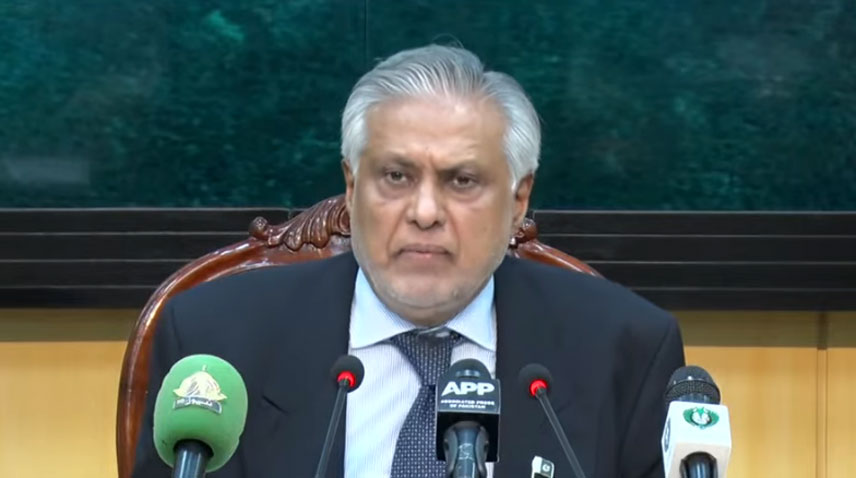
ISLAMABAD, Oct 02 (APP): Deputy Prime Minister and Foreign Minister, Senator Mohammad Ishaq Dar on Friday said that a meeting of the Strategic Political Defence Committee (SPDC), established under the Makkah Agreement among Pakistan, Saudi Arabia and Turkiye, would be held soon in Riyadh to review the prevailing situation on the ground, particularly developments in Saudi Arabia.
“The meeting of the entire Strategic Political Defence Committee (SPDC) will be held soon in Riyadh. The principals are almost ready, and under the Makkah Accord, the current situation on the ground, particularly the situation in Saudi Arabia, will be examined,” the deputy prime minister said while addressing a media briefing here at the Foreign Office.
He said the outcome of the meeting and the future course of action would be shared with the media once finalized.
Highlighting Prime Minister Muhammad Shehbaz Sharif’s extensive engagements during the 81st session of the United Nations General Assembly (UNGA) and his meetings on the sidelines, he said that this year’s diplomatic activities were “more than average”.
Ishaq Dar said the prime minister effectively presented Pakistan’s perspective before the international community during his address to the United Nations General Assembly (UNGA), particularly on the issues of Palestine and Jammu and Kashmir.
He said the prime minister also highlighted Pakistan’s efforts and diplomatic initiatives regarding the Pakistan-India conflict and the US-Iran tensions, besides apprising the international community of Pakistan’s role in promoting dialogue and peace.
DPM/FM Dar said Pakistan had played an important role in bringing the United States (US) and Iran to the negotiating table in Islamabad after 47 years, describing it as an important diplomatic achievement.
The prime minister, he said, also drew attention to the possible implications of tensions around the Strait of Hormuz, warning that any disruption could adversely affect global energy supplies and ordinary people through higher petroleum prices.
The deputy prime minister said the prime minister also highlighted the security threat emanating from Afghanistan and raised the issue of Houthi attacks during his engagements.
He said the prime minister acknowledged the contributions of the Field Marshal and the Foreign Office in advancing Pakistan’s diplomatic efforts.
He said the prime minister’s address received recognition from the audience at the UN General Assembly, reflecting the attention given to Pakistan’s position on important regional and international issues.
Deputy Prime Minister Senator Ishaq Dar said that at least six Muslim countries had expressed keen interest in joining the Makkah Mukarramah defence pact. However, new members could not be considered until the pact’s secretariat was fully operational, which would take not less than a year, he said.
He said the accord was defensive in nature and had no offensive agenda. The document itself, he said, is open to other countries provided they agree to the principles laid down by its three founders.
He added that any decision on membership would be taken jointly by Pakistan, Saudi Arabia and Türkiye, and Pakistan could not decide alone.
He said the prime minister also highlighted terrorism emanating from Afghanistan and the Houthi attacks on Saudi Arabia, and credited Field Marshal Asim Munir, Chief of Defence Forces, for his role in the US-Iran mediation process.
DPM Dar said the country had played a full role in strengthening multilateralism during the United Nations Security Council presidency as a resolution Pakistan moved on multilateralism and peaceful settlement of disputes last year, was adopted unanimously for the first time in 12 years, he said.
On the US-Iran talks, he said that Pakistan had brought the two sides to one table for the first time in 47 years, with six sessions over 21 hours. This led to a signing on June 18.
On the energy crisis stemming from Hormuz and Bab-el-Mandeb, he said the prime minister had flagged its impact on supply chains and prices, which had almost doubled in Pakistan. Despite financial constraints and the IMF programme, he said, the government approved a fuel relief scheme, now benefiting millions, for two-wheelers, three-wheelers and small four-wheelers of up to 800cc.
Answering a question about the Middle East, he said conflict was not a solution to anything. Even after the world wars, he noted, the warring countries had to sit down and build institutions.
Replying to a question, Dar said Pakistan’s stance on Kashmir was “absolutely clear”. The Kashmiri people, he said, must decide their future through a plebiscite under UN Security Council resolutions. India’s actions of August 5, 2019, he added, must be reversed and no demographic change should be allowed in occupied Kashmir.
He said after the Pahalgam incident, Pakistan was blamed at once, and India then used the resulting sentiment to take its next steps.
This time, he said, the Foreign Office did not let India’s narrative take hold internationally and that Pakistan had offered an independent, neutral investigation without delay. When India claimed strikes at 15 places and the downing of F-16s, Pakistan challenged the claims and asked India to say how many aircraft had fallen. India, he said, lost its own credibility.
On the Indus Waters Treaty, he said India’s decision to hold it in abeyance was not accepted by Pakistan. The national security leadership and the civil-military leadership, he said, had resolved not to give up “even a drop” of Pakistan’s water, which he described as a trust of 250 million people.
DPM Dar said he attended a meeting of the Arab-Islamic group of eight countries on Gaza, hosted by Egypt. He also attended the regional four-nation meeting of Pakistan, Saudi Arabia, Türkiye and Egypt, and a UN Security Council briefing on artificial intelligence. He attended OIC Contact Group meetings on Jammu and Kashmir and on Afghanistan, which he said Pakistan had pushed to be held regularly.
On the Makkah accord, the three foreign ministers met in New York and the three army chiefs in Riyadh. The accord was signed on Aug 7, and its first inaugural meeting was held in Istanbul on Aug 31.
He also attended a high-level meeting on pandemic prevention and preparedness, and chaired the informal ECO Council of Ministers meeting on the UN sidelines on Sept 27.
At the high-level international meeting on the two-state solution, hosted by France with leaders of France, the UK and Canada and Saudi Foreign Minister Prince Faisal bin Farhan, he reiterated Pakistan’s position.
He said that Pakistan wants a Palestinian state on the pre-1967 borders with Al-Quds Al-Sharif as its capital.