Pakistan’s High Commissioner to Rwanda, Naeem Khan, has described the finalization of the Pakistan-Rwanda Trade Cooperation Agreement as a major milestone in the economic relationship between the two countries, saying the agreement could open new opportunities for Rwanda to expand trade and investment links with Pakistan and wider international markets.
“Pakistan-Rwanda Trade Agreement” opens new era of economic cooperation
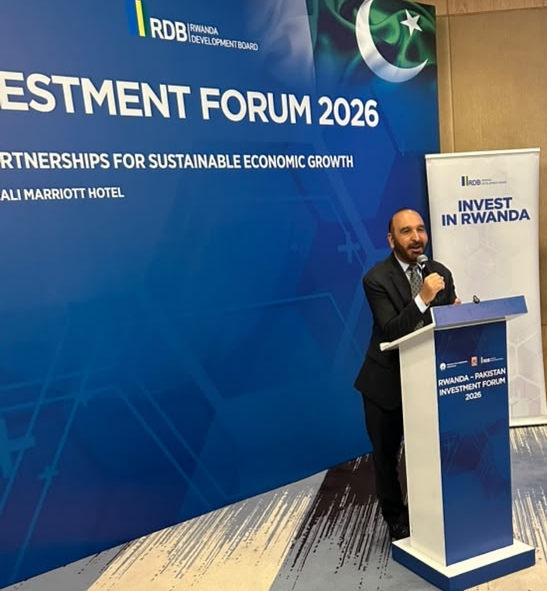
ISLAMABAD, Sep 25 (APP): Pakistan’s High Commissioner to Rwanda, Naeem Khan, has described the finalization of the Pakistan-Rwanda Trade Cooperation Agreement as a major milestone in the economic relationship between the two countries, saying the agreement could open new opportunities for Rwanda to expand trade and investment links with Pakistan and wider international markets.
Addressing the Rwanda-Pakistan Investment Forum 2026 in Kigali, Ambassador Khan said the agreement would provide a stronger framework for expanding bilateral trade, investment and private-sector cooperation while helping connect Pakistan more closely with East Africa through Rwanda.
According to Khan, Rwanda’s position in the region gives it the potential to serve as an important gateway for Pakistani businesses seeking access to East African and broader African markets.
At the same time, he said the agreement would create opportunities for Rwandan products to gain greater access to the Pakistani market.
The envoy said the agreement would promote greater diversification of trade in terms of products and geographical diversification in both markets.
He also pointed to the possibility of deeper trade liberalization in the future, including discussions on a Preferential Trade Agreement (PTA) and, eventually, a Free Trade Agreement (FTA) between the two countries.
The High Commissioner emphasized that the new framework was not limited to conventional trade. He said it could support greater cooperation in investment, manufacturing, value addition, technology, innovation and regional supply-chain integration.
He identified several sectors with strong potential for expanded Rwanda-Pakistan cooperation, including information technology, agriculture and agro-processing, pharmaceuticals, textiles, tourism, healthcare, education, real estate, logistics, e-commerce and the digital economy.
Khan also highlighted the importance of Rwanda’s private sector in turning the agreement into practical business opportunities. Under the new framework, the two countries will cooperate on trade facilitation, information-sharing on investment and commercial opportunities, and stronger links between private-sector institutions.
He specifically pointed to opportunities for cooperation between the Rwanda Private Sector Federation (PSF), chambers of commerce and other business organizations in Pakistan.
The High Commissioner said Rwanda was increasingly positioning itself not only as a consumer market but also as a production base and gateway to wider African markets.
He suggested that this positioning could make the country increasingly attractive to Pakistani companies seeking regional investment and supply-chain opportunities.
The Kigali investment forum brought together government representatives, investors, business leaders and private-sector institutions from both countries. Pakistani companies showcased their products and held business-to-business (B2B) and government-to-government (G2G) discussions with Rwandan counterparts.
The High Commissioner hailed the Pakistani delegation participating in the Rwanda-Pakistan Investment Forum included Ambassador Hamid Asghar Khan, Patron-in-Chief of the Pakistan Africa Economic Council; Misbah Khar, Advisor to the Chairman of the Senate and Ambassador of the Inter-Parliamentary Speakers’ Conference and Dr. Rubina Malik, Focal Person for the Prime Minister’s Youth Programme and Patron of Pakistan Africa House, along with business leaders, investors and private-sector representatives.
The participation of the delegation underscored growing interest among Pakistani businesses in Rwanda and the wider East African market.
For Khan, the agreement represents a foundation for a broader economic partnership in which Rwanda and Pakistan can move beyond traditional trade toward investment, technology cooperation and stronger regional economic integration.