By Shams Abbasi KIGALI, Sep 25 (APP):Rwanda and Pakistan have signed a bilateral Trade Cooperation Agreement aimed at expanding trade and investment between the two countries, diversifying products, strengthening private-sector partnerships and laying the foundation for deeper trade liberalization, including a possible Preferential Trade Agreement (PTA) and, eventually, a Free Trade Agreement (FTA). The agreement was signed by Rwanda’s Minister of Trade and Industry, Antoine Kajangwe, and Pakistan’s High Commissioner …
Rwanda, Pakistan sign “Trade Cooperation Agreement” to expand trade, investment, regional supply chains
By Shams Abbasi
KIGALI, Sep 25 (APP):Rwanda and Pakistan have signed a bilateral Trade Cooperation Agreement aimed at expanding trade and investment between the two countries, diversifying products, strengthening private-sector partnerships and laying the foundation for deeper trade liberalization, including a possible Preferential Trade Agreement (PTA) and, eventually, a Free Trade Agreement (FTA).
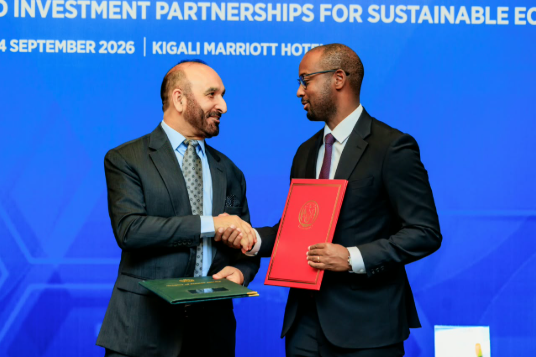
The agreement was signed by Rwanda’s Minister of Trade and Industry, Antoine Kajangwe, and Pakistan’s High Commissioner to Rwanda, H.E. Naeem Khan, during the Rwanda–Pakistan Investment Forum 2026 in Kigali.
Held from September 23 to 24, the two-day forum brought together government officials, investors, manufacturers, business leaders and entrepreneurs from Rwanda and Pakistan to explore opportunities for stronger economic and commercial cooperation.
The Trade Cooperation Agreement is designed to modernize the bilateral trade framework and promote greater trade diversification, while connecting businesses to regional supply chains and strengthening cooperation between private-sector institutions in both countries.
Under the agreement, Rwanda and Pakistan will cooperate in areas including trade facilitation, information-sharing on trade and investment opportunities, and the creation of stronger links between private-sector organizations. This includes cooperation between Rwanda’s Private Sector Federation (PSF) and chambers of commerce and other business organizations in Pakistan.
The two countries also intend to deepen cooperation in industry, manufacturing and technology. Rwanda is particularly seeking increased Pakistani investment in agro-processing, textiles and pharmaceuticals, tourism, youth among other sectors.
Rwandan Minister for trade Kajangwe said the agreement would open a new phase of economic cooperation between Rwanda and Pakistan and help create opportunities for increased bilateral and regional trade.
The minister said the framework would encourage production in both countries, expand trade in locally produced goods and strengthen supply chains across different sectors.
Kajangwe added that Rwanda and Pakistan have the potential to move beyond conventional trade towards production partnerships, value addition and job creation, allowing businesses in both countries to participate more actively in regional and international markets.
Rwanda Development Board (RDB) Deputy Chief Executive Officer Juliana Muganza said the two countries were seeking to transform their longstanding diplomatic relations into stronger commercial and investment ties.
Muganza said Rwanda attracted US$2.6 billion in foreign direct investment last year across about 800 projects in different sectors. She also noted that bilateral trade between Rwanda and Pakistan reached US$236.4 million between 2023 and 2025, while Rwanda recorded seven Pakistani investment projects worth more than US$2 million during the period.
Pakistan’s High Commissioner to Rwanda, Naeem Khan, highlighted the complementary strengths of the two economies and identified opportunities for Pakistan to increase imports of Rwandan products.
He cited coffee and tea, digital and knowledge economy, Information technology, agriculture, real estates, education, tourism and health sector are the potential areas in bilateral coopertaion and agriculture goods vocados, beans, lentils and pulses among products with potential for greater access to the Pakistani market.
The Pakistani delegation included Ambassador Hamid Asghar Khan, Patron-in-Chief of the Pakistan Africa Economic Council; Misbah Khar, Advisor to the Chairman of the Senate and Ambassador of the Inter-Parliamentary Speakers’ Conference; and Dr. Rubina Malik, Focal Person for the Prime Minister’s Youth Programme, as well as business leaders, investors and private-sector representatives.
The forum featured business-to-business (B2B) and government-to-government (G2G) meetings, during which Pakistani companies showcased their products and held discussions with Rwandan businesses, institutions and government representatives to strengthen institutional and commercial cooperation.
The two sides also identified opportunities to expand cooperation in industry and manufacturing, agriculture and agro-processing, pharmaceuticals, textiles, information technology, tourism, logistics, e-commerce, the digital economy and youth development.
Rwanda is positioning itself not only as a consumer market but also as a production base and gateway to wider African markets. RDB highlighted its investor-support services, including business registration, licensing, access to investment incentives and industrial infrastructure, as well as assistance in connecting foreign investors with local businesses.
The new agreement provides a framework for both countries to expand beyond traditional trade and pursue greater investment, manufacturing, value addition, technology cooperation and regional supply-chain integration, with further discussions expected on deeper trade arrangements, including a PTA and an eventual FTA.