ISLAMABAD, Sep 23 (APP):Federal Minister for Finance and Revenue, Senator Muhammad Aurangzeb, held high-level meetings on the sidelines of the 81st Session of the United Nations General Assembly (UNGA) to advance partnerships in key economic sectors. Accompanying the Prime Minister of Pakistan on the second day of his official visit, the Minister engaged international stakeholders to secure strategic cooperation in energy security, aviation development, healthcare delivery, and climate finance According …
Finance minister advances energy, aviation, healthcare, climate goals at UNGA
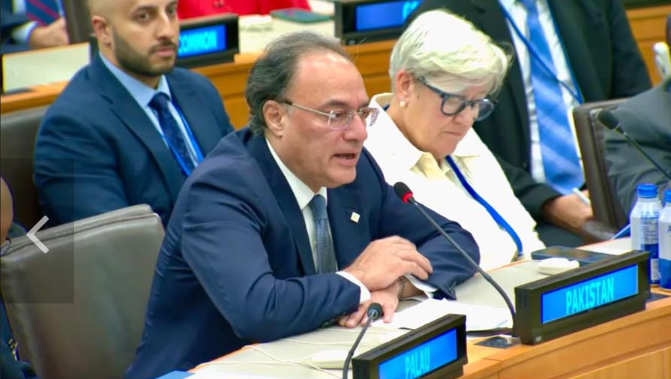
ISLAMABAD, Sep 23 (APP):Federal Minister for Finance and Revenue, Senator Muhammad Aurangzeb, held high-level meetings on the sidelines of the 81st Session of the United Nations General Assembly (UNGA) to advance partnerships in key economic sectors.
Accompanying the Prime Minister of Pakistan on the second day of his official visit, the Minister engaged international stakeholders to secure strategic cooperation in energy security, aviation development, healthcare delivery, and climate finance
According to a press release issued by finance minister here, the minister participated in a high-level dialogue hosted by the World Economic Forum (WEF) on “Powering Growth in the New Economy”, where he highlighted that the global focus had shifted from energy transition to the more immediate challenge of energy security, particularly amid ongoing geopolitical conflicts and disruptions to fuel supplies.
He noted that Pakistan had experienced a significant, largely private-sector-led expansion in solar energy, demonstrating the potential of renewable energy to reduce dependence on imported fuels.
He also emphasised that difficulties in securing energy supplies had wider economic consequences, as energy security was closely linked to food security and overall economic resilience.
Aurangzeb also held a meeting with Dr Brendan Nelson, President of Boeing Global, where discussions focused on PIA’s fleet modernization and broader cooperation in Pakistan’s aviation sector.
Senator Muhammad Aurangzeb welcomed Boeing’s confirmation that a revised proposal for the acquisition of new aircraft would be shared with PIA, while options for earlier delivery slots and interim leasing arrangements would also be explored.
The discussion covered financing support from the US Export-Import Bank, engine procurement, spare parts, maintenance and restoration of grounded aircraft. The Finance Minister outlined PIA’s privatization and plans to outsource the management of major airports.
In a separate meeting with a representative of Abbott’s Pharmaceuticals Division, the Finance Minister discussed the implementation of Pakistan’s Hepatitis C elimination programme and broader issues relating to the pharmaceutical sector.
He expressed concern over the slow progress of the programme, noting that only around 100,000 of the approximately three million procured diagnostic tests had been utilized, which was attributable to leadership turnover, inadequate project management and limited public awareness.
The meeting also covered improvements in DRAP’s regulatory capacity, pharmaceutical export diversification, Abbott’s plans for oncology treatment, and delays in resolving hardship medicine-pricing cases.
The Finance Minister also participated in the UN-hosted “Solutions Dialogue on Climate Finance”, where he highlighted Pakistan’s acute vulnerability to climate change and emphasised the Government’s responsibility to establish credible adaptation and disaster-response frameworks, early-warning systems, climate strategies and a pipeline of bankable projects.
He stressed that climate resilience must begin with domestic macroeconomic stability and adequate fiscal and external buffers, while international support should complement national resources.
The minister expressed concern over the slow operationalization of the Loss and Damage Fund and urged the Green Climate Fund and other international institutions to simplify their accreditation, approval and disbursement procedures so that vulnerable countries could access climate finance more efficiently.
Meanwhile, the minister also highlighted Pakistan’s acute vulnerability to climate-related disasters, particularly floods affecting infrastructure and communities, at the World Economic Forum’s “Financing Planet and Prosperity” meeting.
He outlined Pakistan’s efforts to strengthen disaster-response frameworks, early-warning systems, and costed climate-investment plans, stressing that external assistance must be complemented by domestic resources and fiscal buffers.
He noted that financing for relief, adaptation, and reconstruction is being actively mobilized through the World Bank, Asian Development Bank, and international capital markets.
At the same time, the Minister cautioned against complacency and urged international climate funds, including the Green Climate Fund and the Loss and Damage Fund, to simplify their procedures and accelerate access to financing.