Federal Minister for Planning, Development and Special Initiatives Professor Ahsan Iqbal on Tuesday said creativity and innovation had become the key currency of the digital age, stressing the need to transform the education system to promote critical thinking, questioning, observation and problem-solving skills.
Creativity, innovation key currency of digital age: Ahsan
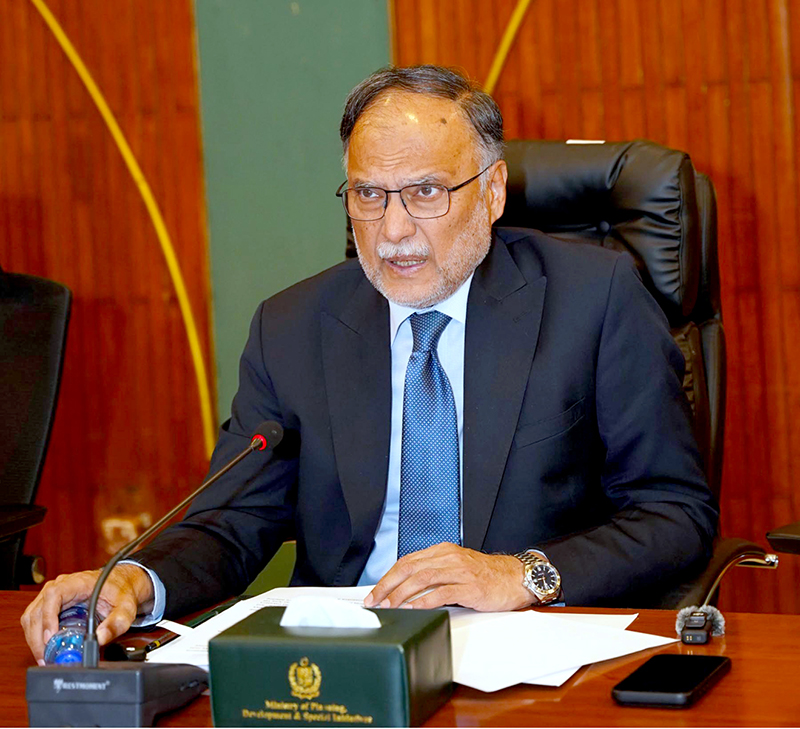
ISLAMABAD, Sep 22 (APP):Federal Minister for Planning, Development and Special Initiatives Professor Ahsan Iqbal on Tuesday said creativity and innovation had become the key currency of the digital age, stressing the need to transform the education system to promote critical thinking, questioning, observation and problem-solving skills.
Addressing the opening ceremony of an international conference on Research & Practices in Education themed “Evolving Learning Ecosystem: Connect, Teach & Grow,” he said the world had entered an era in which transformation was taking place at the “speed of an electron,” while artificial intelligence had brought a major disruption to the existing models of education and work.
“In this era, the currency is creativity and innovation,” the minister said, adding that instead of muscle power, the new knowledge and technology revolution required brain power.
He stressed that education should develop the ability among students to ask questions rather than producing merely compliant workers.
Ahsan Iqbal said the industrial age had focused on preparing people for specific jobs and repetitive tasks, whereas the emerging knowledge economy required individuals capable of creative thinking and innovation.
He said creativity was a function of the ability to ask questions, adding that teachers should become a source of students’ creative abilities rather than merely delivering lectures in classrooms.
“If you do not prompt the human mind, it will never answer. So, the more smart questions you ask, the more smart answers you will get,” he remarked.
The minister said the human brain’s knowledge base was enriched through three major sources including study, experience and observation. The richer the knowledge base, he added, the stronger the ability to respond to questions and solve problems.
He regretted that children who asked more questions were often considered rebellious, saying such an approach created an “anti-question bias” in society and hindered the development of creative minds.
He also stressed the need to encourage questioning at workplaces and in educational institutions.
Ahsan Iqbal said the education system should enable students to develop their ability to observe, think and contemplate, rather than simply consume knowledge.
He said knowledge was no longer confined to books, as the internet and artificial intelligence had connected people with the knowledge and libraries of the entire world.
Students sitting in any part of the country could now access global sources of knowledge, scholars and books, he added.
He stressed the need to connect students with global sources of knowledge, observations of the universe and experiences that could broaden their intellectual capabilities.
He recalled that a curriculum reform initiative had been launched in 2016-17 and said efforts were now being made to reform the curriculum again in accordance with the demands of the new era.
“We have to start from the beginning again,” he said, adding that the new curriculum was being designed to meet the requirements of the digital and knowledge-driven age.