Matiullah Mati Quetta, Sep 21 (APP):About 1.5 kilometers from Mizai Adda Bazaar of Qilla Abdullah in Pakistan's southwestern province, Balochistan, a plate of grapes placed in a garden may appear ordinary at first glance, but a closer look reveals a world of colors and shapes. Light green, yellowish, pink and reddish grapes fill the plate, while deep purple, almost black grapes stand out in a …
Matiullah Mati
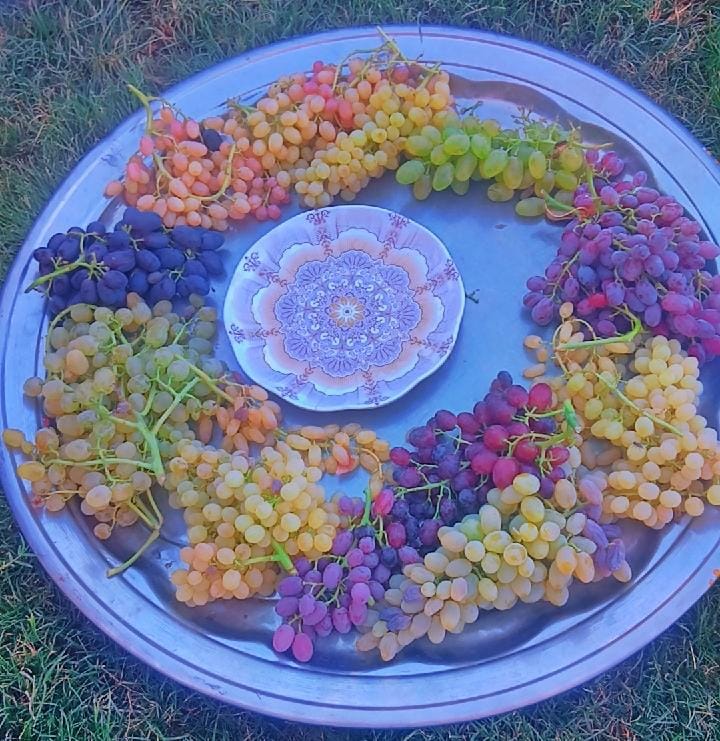
Quetta, Sep 21 (APP):About 1.5 kilometers from Mizai Adda Bazaar of Qilla Abdullah in Pakistan’s southwestern province, Balochistan, a plate of grapes placed in a garden may appear ordinary at first glance, but a closer look reveals a world of colors and shapes.
Light green, yellowish, pink and reddish grapes fill the plate, while deep purple, almost black grapes stand out in a striking display of colours and shapes.
These grapes are not grown for sale in a market or display at an exhibition. They come from the small orchard of Haji Abdul Manan, where growing different varieties of grapes has remained a personal interest for nearly three
decades.
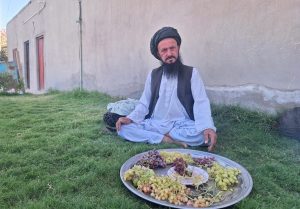
Haji Abdul Manan has been farming for around five decades. He inherited the profession from his father, who was also a farmer. After his father, he continued looking after the family’s land and orchards. Today, his eldest son, Haji Muhammad Iqbal, also helps him with farming.
Most of Haji Abdul Manan’ s agricultural land is devoted to apple orchards. However, the small garden beside his home has developed its own identity, with a variety of grapes growing there.
His interest in growing different grape varieties began almost three decades ago when he asked a friend travelling to Kandahar to bring him grape cuttings.
“I gave my friend Rs500 to purchase cuttings of different varieties,” Haji Abdul Manan
says.
Looking back, he still remembers a conversation connected with that amount. According to him, Rs500 was a considerable sum of money at that time. He told his friend that it was a large amount and asked him to return the remaining money.
His friend replied that he would repay the money, but the two friends never got another opportunity to settle the matter.
Haji Abdul Manan later learned from his friend’s son that his friend had passed away.
The cuttings brought from Kandahar gradually became part of his garden. Over the years, growing different grape varieties became a personal interest that he maintained not as a commercial venture but for his own enjoyment and hospitality.
“I have kept these different varieties for my friends and guests,” he says.
When a guest arrives at his hujra, he picks fresh grapes from the garden and serves them. For much of the year, he says, there is no need to go to the market to buy fruit when guests arrive because different fruits are available in his garden.
For him, the garden is more than a place to grow crops. It is also part of his hospitality, where serving freshly picked fruit to visitors is a part of rural life.
Haji Abdul Manan’ s small garden is also an example of the wider cultivation of grapes in Qilla
Abdullah.
According to the Agriculture Statistics Balochistan 2024-25 report of the Agriculture Department, grape production in Qilla Abdullah stood at 3,317 tonnes.
Farmers in Qilla Abdullah use different sources of water for agriculture, including traditional karezes and tube wells. The district is also known for large-scale cultivation of apples and other fruits, making it one of Balochistan’ s important agricultural areas.
Under the Balochistan Agricultural Policy 2021-30, Qilla Abdullah is included in the Highlands-II agro-ecological zone.
The zone produces a range of fruits, including grapes, apples, peaches, apricots and almonds. Besides Qilla Abdullah, the zone includes Quetta, Pishin, Mastung, Zhob, Loralai and Qilla Saifullah districts.
According to the Pakistan Horticulture Development and Export Company, grape varieties grown in Balochistan include Askari, Haitaia, Kala, White Kishmish, Sahebi, Shandakhani, Tor, Sultania, King Ruby, Flame Seedless, Perlette and Beauty Seedless.
The distinctive feature of Haji Abdul Manan’ s garden is that different varieties, with different colours, shapes and tastes, can be seen growing in one place.
Dr Qasim Kakar, former Director General of Agricultural Research, says Qilla Abdullah is an important agricultural district and its land is suitable for growing different grape varieties. The district’s soil and climate also provide opportunities for farmers to experiment with new varieties alongside traditional ones.
Sirajuddin, a field assistant with the Agriculture Department in Qilla Abdullah, says the area’s soil and climatic conditions are suitable for growing different types of grapes.
“Almost every type of grape variety can be planted in Qilla Abdullah,” he says.
If a farmer does not like a particular variety, another variety can be introduced onto the same plant through grafting.
With grafting, he explains, farmers do not necessarily have to establish a completely new vineyard to try another variety. A different variety can be introduced onto an existing vine, creating opportunities to experiment with and produce multiple varieties in the same area.
Balochistan is among Pakistan’s driest provinces. According to the Pakistan Meteorological Department, the province receives an annual average rainfall of around 210 millimeters over the long term, although rainfall varies considerably from one area to another. In such an environment, access to water is critical for agricultural production.
In Qilla Abdullah, orchards are irrigated through different sources, including karezes and tube wells. The grapes growing in
Haji Abdul Manan’ s garden are also part of this agricultural environment, where suitable land provides opportunities for fruit cultivation while access to water remains essential for sustaining orchards.
Nearly three decades after he first brought grape cuttings from Kandahar, Haji Abdul Manan’ s interest in different varieties continues.
For him, the grapes are no longer simply an agricultural product. They carry memories of a friendship, decades of farming and a tradition of welcoming guests.
When the grapes ripen, a plate of them travels not to the market but to the guest room, where visitors are served grapes of different colours and tastes.
For Haji Abdul Manan, the greatest harvest of this small garden is not the grapes, but the memories woven into its vines. Nearly 30 years ago, a few cuttings arrived from Kandahar; today, they continue to yield fresh fruit for his guests while preserving the quiet memory of a friendship that time could not erase.