Federal Minister for Finance and Revenue Senator Muhammad Aurangzeb on Thursday said Pakistan’s focus on macroeconomic stability, structural reforms and the digital economy was creating a conducive environment for greater investor confidence and sustainable growth.
Business Summit: Aurangzeb highlights reforms, digital economy to boost investor confidence
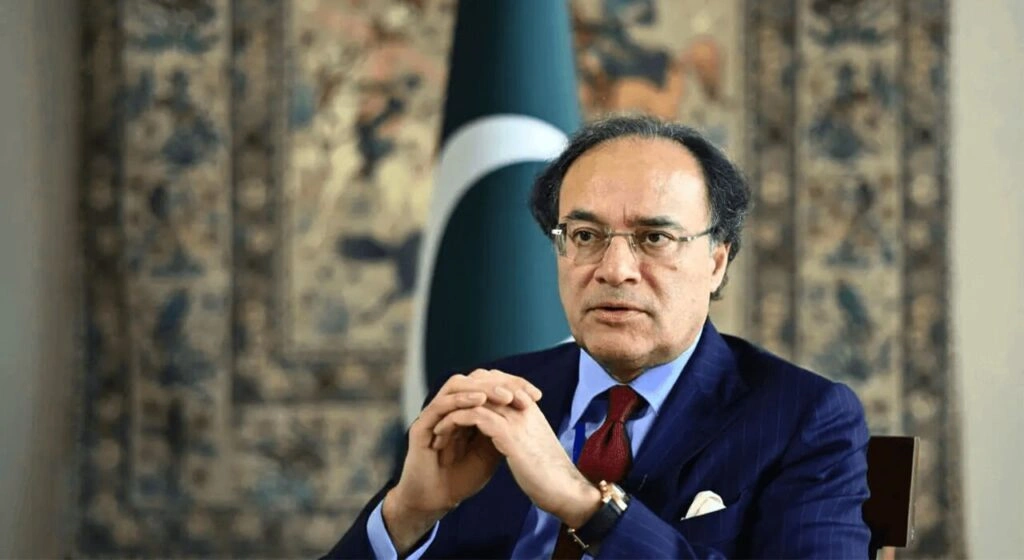
ISLAMABAD, Sep 17 (APP):Federal Minister for Finance and Revenue Senator Muhammad Aurangzeb on Thursday said Pakistan’s focus on macroeconomic stability, structural reforms and the digital economy was creating a conducive environment for greater investor confidence and sustainable growth.
“Once you get the basic hygiene, you first need to get the local investors moving. If the local investors are not satisfied or they are not confident either where we are in the economy or certainly the direction of travel, then it’s very difficult to go and talk to the foreign investors,” he said.
Addressing the 9th edition of Leaders in Islamabad Business Summit (LIIBS)-2026, themed “The Next Move”, via video link, he said the country had successfully managed the immediate impact of the ongoing regional conflict, while the government was closely monitoring its second- and third-order effects on inflation and economic growth.
He said Pakistan had faced no fuel shortages or queues at petrol stations despite disruptions, adding that the government was covered for September and essentially covered for October, while planning for November was already under way.
“Despite that, our Minister of Petroleum, the NCMC, which is now the structural way of how we are looking at and monitoring the situation on a daily basis,” he said, referring to an effective
mechanism for monitoring the situation.
Aurangzeb said the closure of the Strait of Hormuz and difficulties around the Bab al-Mandab had affected regional energy routes, while the East-West pipeline had also been impacted.
He stressed the importance of maintaining fiscal discipline and economic buffers as the government assessed the wider implications of the conflict.
Turning to structural reforms, the minister said the government was already implementing reforms in taxation, energy, state-owned enterprises (SOEs) and public finance.
He said Federal Board of Revenue (FBR) revenues had increased by 40 per cent over the past couple of years, mainly through deepening, but further work was required to broaden the tax base.
The minister said the new FBR operating model would move income tax and sales tax processes towards a faceless system, with the pilot scheduled for October 1.
“The end state is going to be where the income tax officer, he or she, all discretionary powers are going to be taken away,” he said, adding that the reform was critical for restoring trust and credibility in the tax authority.
Aurangzeb said 27 SOEs had been handed over to the Privatization Commission, while entities including Utility Stores Corporation, PASCO and PWD had either been closed or were in the process of being wound up.
On public finance, he said pension reforms had shifted new entrants into the civil government towards defined-contribution schemes, while similar discussions were under way with the armed forces.
He said domestic debt-management measures had reduced rollover risks and increased maturities to around four years. Against a budgeted debt-servicing figure of Rs8.2 trillion last year, actual debt servicing stood at Rs6.9 trillion.
The minister said macroeconomic stability was the “basic hygiene” required to enable businesses to operate, open letters of credit and repatriate dividends and profits.
He said the government’s $3 billion Eurobond transaction, after about four years of renewed market access, had attracted a diversified investor base from Asia, the Middle East, Europe and the United States.
Aurangzeb said the transaction’s 5.5-year and 10-year maturities also indicated that investors were looking beyond the IMF programme.
Highlighting the new economy, he said Pakistan’s IT and IT-enabled services exports had reached $4.6 billion at the end of the previous year and were projected to approach $5.5 billion during the current year.
He said freelancers accounted for $1.6-$1.7 billion of the $4.6 billion, underscoring the contribution of young Pakistanis to the economy.
The minister said the rollout of 5G connectivity and efforts to upskill and reskill young people in areas such as blockchain could help Pakistan raise the value of its digital exports.
“We have a real, real opportunity to leapfrog while we deal with the old economy,” he remarked.