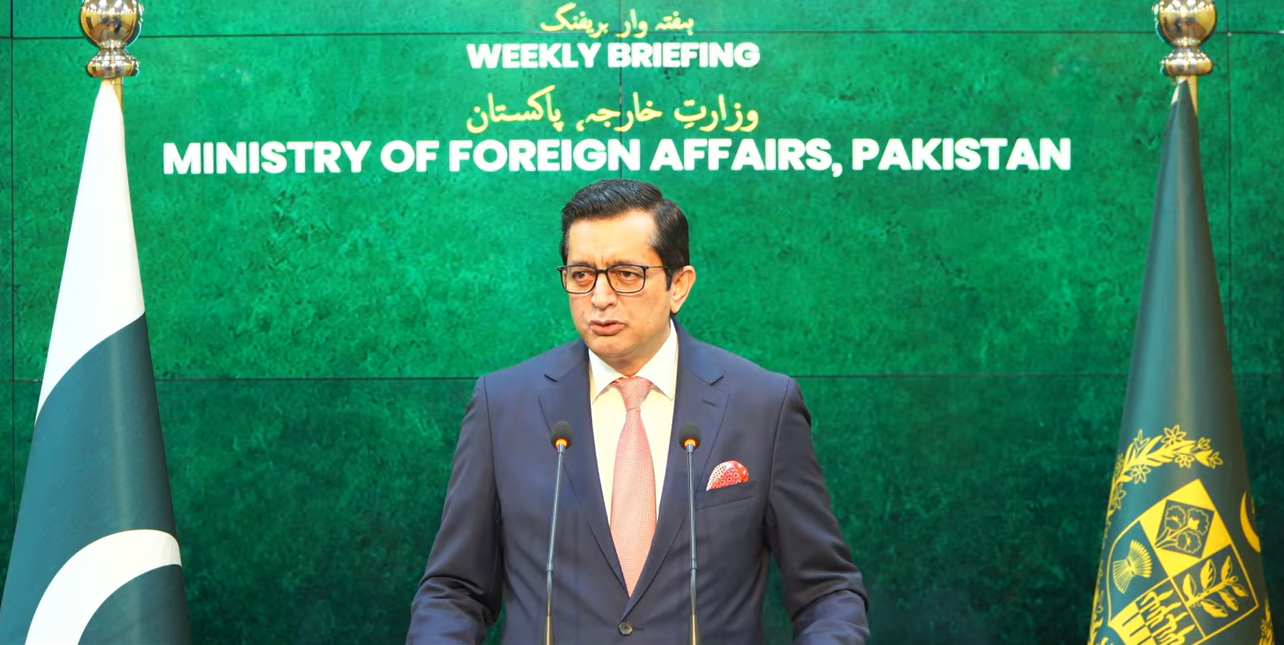
FO spokesperson told the media that Prime Minister Shehbaz Sharif would lead Pakistan’s delegation to the high-level segment of the 81st Session of the UN General Assembly in New York next week.
Pakistan ready to open borders, resume trade with Afghanistan if Kabul cracks down on terror: FO
ISLAMABAD, Sep 17 (APP): Pakistan on Thursday said that it was ready to reopen border crossings, restore transit trade, and utilise Afghanistan as a regional connectivity hub, provided Kabul takes decisive and verifiable action against anti-Pakistan militant groups.
“If they cooperate on terrorism, there is no reason for Pakistan to continue with this process. We are ready to open our borders, do trade, use Afghanistan as a connecting hub, and the entire region can actually benefit from a peaceful region. Our policy has been a peaceful Afghanistan which is peaceful within as well as peaceful with neighbouring countries,” Foreign Office spokesperson Sajjad Haider Khan said at his weekly press briefing.
Referring to last year’s visit by Deputy Prime Minister and Foreign Minister Senator Ishaq Dar to Afghanistan, he said Pakistan offered many concessions on transit trade, reduced tariffs, and asked them to stop terrorism emanating from their side.
“Unfortunately, the action now rests on the other side,” he said, recalling that Pakistan had also used the medium of friendly countries like Qatar, Turkiye, and China, though the efforts could not come to fruition due to non-cooperation from the Afghan side.
The spokesperson said that not only Pakistan, but China also had similar observations about terrorist activities taking place, and Central Asian countries were also unhappy over the security situation in Afghanistan.
He said China, Qatar, and Turkey played a very constructive role in terms of mediation, as Pakistan engaged twice with Kabul last year in Qatar and Istanbul, but the Afghan reaction had been negative, and they refused to give assurances of stopping terrorism from Afghan soil.
“Pakistan is keen to resolve all our issues through peaceful means, of course, through dialogue and diplomacy. We have clearly mentioned our red line, and now it is for Afghanistan to see how it can stop terrorism, because you cannot continuously allow terrorists to flow from one side and then expect a different outcome from Pakistan’s side.”
He told the media that Prime Minister Shehbaz Sharif would lead Pakistan’s delegation to the high-level segment of the 81st Session of the UN General Assembly in New York next week, accompanied by DPM Ishaq Dar and other federal ministers. There, he would highlight Pakistan’s perspective on regional and global developments, outline priorities on counter-terrorism and Islamophobia, and draw attention to the situations in Indian Illegally Occupied Jammu & Kashmir (IIOJK) and Palestine.
During the visit, he will participate in high-level events and hold bilateral meetings with world leaders and the UN Secretary-General, highlighting Pakistan’s commitment to multilateralism, the UN Charter, regional peace, and international cooperation.
The spokesperson rejected India’s objections to the 1963 Boundary Agreement and Joint Commission, calling Kashmir a disputed UN-resolved territory and urging India to rescind its Aug 5, 2019, decisions.
“India’s claims regarding Jammu and Kashmir are equally untenable, as Jammu and Kashmir remains an internationally recognised disputed territory whose final disposition is to be determined in accordance with United Nations Security Council resolutions and the aspirations of the Kashmiri people, through a UN-led, UN-sponsored plebiscite,” he said, urging India to carry out its own introspection, especially regarding its illegal and unilateral decisions.
He said Pakistan summoned the Indian Chargé d’Affaires over an aggressive manoeuvre and contact by an Indian naval ship in Pakistan’s EEZ on Sept 15, violating bilateral and international norms, and that a demarche would be issued by the Pakistan High Commission in New Delhi to the Indian Ministry of External Affairs later in the day.
He highlighted that this year Pakistan issued over 2,800 visas to Indian pilgrims for Vaisakhi alone in April, over 700 for Guru Arjan Dev’s martyrdom day, and 438 for the death anniversary of Maharaja Ranjit Singh in June, and that Pakistan was also ready to welcome Sikh pilgrims for the upcoming Vaisakhi festival.
He told the media that the Indian Chargé d’Affaires in Islamabad participated in and represented India at the SCO-RATS council meeting held earlier this week, and expressed the hope that Indian participation in SCO would continue as Pakistan is going to host the SCO Heads of State summit next year.
To a question, he said Pakistan remains committed in spirit to the Strategic Mutual Defence Agreement and Makkah Joint Defence Agreement.
He said that Pakistan’s partnership with Saudi Arabia and Turkiye in the area of security and defence was well recognised, and the Makkah pact formalised and further strengthened many aspects of ongoing cooperation and existing long-standing bilateral cooperation among these three countries.
“The agreement is purely for defensive purposes; it is neither directed against any country nor formally constitutes a new bloc,” the spokesperson explained.
He strongly condemned Israel’s planned Gaza ground offensive and reiterated that Pakistan backed a two-state solution anchored to 1967 borders with Jerusalem as capital.
Regarding the bounty on Masood Azhar, he rejected Indian criticism, saying that Pakistan was fully cognizant of its obligations under international law and routinely undertakes necessary measures and actions in fulfilment of its international obligations and in accordance with applicable laws.
Asked about the status of Afghan medical students in Pakistan, he reiterated that students on a valid visa and registered for a valid course would continue and complete their education.
As regards the sanctions on Iran’s Mahan Air, he said Pakistan’s relevant authorities were working on the matter, as the airline operates not only in Pakistan but at other destinations too.
On US-Iran mediation, he said Pakistan brought the two conflicting nations to a dialogue table for the first time in 47 years, which led to the Islamabad Memorandum of Understanding.
“If we follow through the provisions given in the Islamabad MoU, peace and stability can be achieved. We are a strong proponent of dialogue and diplomacy, which we will continue on our part.”
He regretted the BCCI’s decision to disallow the Indian women’s team from going on stage and receiving the trophy from ACC President Mohsin Naqvi and urged India not to weaponise sports.
On Pakistan’s decision not to send the hockey team to India, he said Pakistan would be very happy to play with India on a third-country platform, as it does with cricket.
Rebuffing media claims as “sensationalism,” the spokesperson stated that the foreign ministry processes 17,000 to 18,000 documents daily across dual shifts, cuts diaspora costs via a 120-country apostille framework and digital processing of documents, and has generated Rs 3.4 billion over two years through cashless and digital payment systems.
He said that the ministry had taken various steps for facilitation and documentation, including the introduction of a QR code system and a courier system, digital verification of powers of attorney, and integration of the database with the HEC and IBCC.
Highlighting the diplomatic engagements during the previous week, he reiterated condemnation of the attempted drone attack against the Holy Site of Makkah Al-Mukarramah and appreciated the extraordinary vigilance, courage, and professionalism demonstrated by the Royal Saudi Armed Forces in their swift and heroic response.
He also highlighted the telephonic conversation between Prime Minister Shehbaz and Saudi Crown Prince Mohammed bin Salman bin Abdulaziz Al Saud, the visit of Lebanese Interior Minister Ahmad Al-Hajjar to Pakistan and his interactions with top leadership, and the presentation of diplomatic credentials by Ambassador Shafqat Ali Khan as Pakistan’s first Ambassador to the Republic of Armenia.