Ahead of the UN General Assembly’s high-level week, Secretary-General Antonio Guterres said the world had entered “an era of deep uncertainty” and urged governments to embrace international cooperation to address global threats.
AI risks, climate change, and global conflicts top UNGA agenda: UN chief
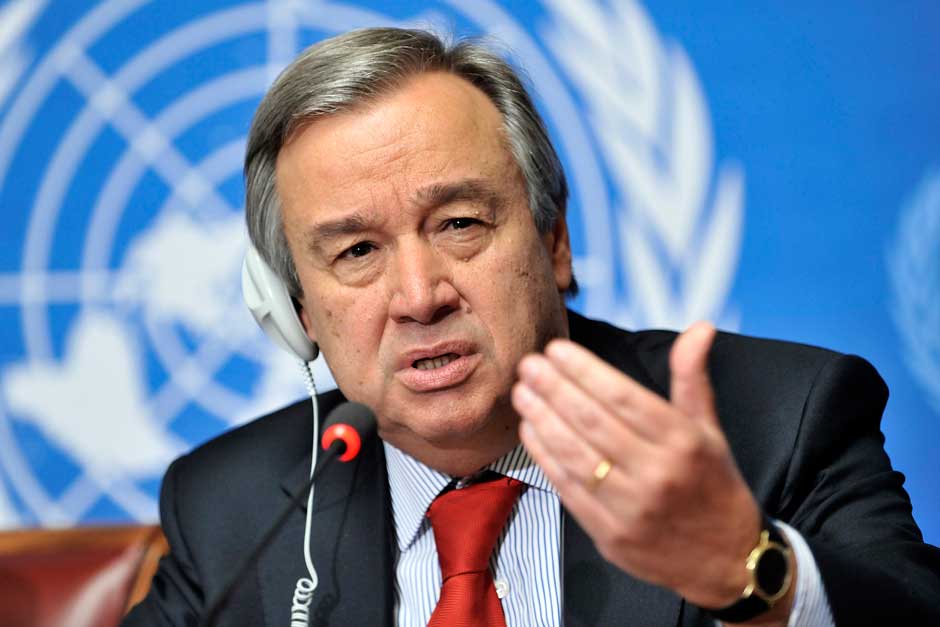
UNITED NATIONS, Sep 17 (APP):Ahead of the UN General Assembly’s high-level week, Secretary-General Antonio Guterres said the world had entered “an era of deep uncertainty” and urged governments to embrace international cooperation to address global threats.
Speaking to reporters six days before world leaders gather in New York, the UN chief identified “three existential threats”: runaway artificial intelligence (AI), the climate crisis and deepening inequalities.
He also reiterated calls for a two-State solution in the Middle East and for a ceasefire between Russia and Ukraine.
By longstanding tradition, Brazil always speaks first at the 193-member Assembly’s general debate, which opens on Sep 22, followed by the United States as the host country
More than 100 world leaders, including Pakistan Prime Minister Shehbaz Sharif, are set to address the Asswmbly, as New York prepares to impose strict security measures during the week here. PM Shehbaz is scheduled to address the Assembly on Sep 25
While he acknowledged the need to reform global institutions, including the UN itself, the Secretary-General stressed that the UN’s promises to maintain peace and protect human rights remain the same.
“Updating our structures can never mean abandoning our principles – it must mean applying those principles with even greater determination,” Mr. Guterres said.
Now more than ever, Guterres called for Member States to uphold the UN Charter, defend international law, protect human rights, invest in sustainable development and push for peace everywhere.
He highlighted the decimation of Gaza and the Russia-Ukraine war as areas of particular concern, urging leaders to work towards “de-escalation, diplomacy and dialogue” to end these conflicts.
“At this crucial moment in the Middle East, de-escalation must be priority one, priority two and priority three,” the Secretary-General said.
All parties to the conflict in the Middle East must respect navigational rights in the Hormuz and Bab al-Mandab Straits and must not harm civilians, Mr. Guterres said.
He also called attention to the suffering of the Palestinian people in Gaza and said Israel’s annexation of the West Bank “must stop.”
More than four years after Russia’s invasion of Ukraine, Guterres said there is “no end in sight,” calling for an immediate ceasefire as the first step towards a “just, lasting and comprehensive peace.”
The General Assembly is expected to debate both conflicts next week.
The Secretary-General dedicated nearly half his remarks to what should be done about the rapid advancement of AI technology.
He recognized AI’s “enormous potential” on issues surrounding health, education and climate, but added that the world “cannot afford to ignore concerns” that AI development is progressing faster than human understanding of its risks.
Comparing AI to other issues of international concern, Guterres said governments must protect their citizens from AI’s risks and that “global cooperation is indispensable.”
As fears mount of an AI arms race between the US and China, the Secretary-General acknowledged “geopolitical divides” and said voluntary pauses on AI development will not work if they are isolated – limited to only a few countries.
“The world cannot afford a race to the bottom on AI safety,” he said.
Guterres pointed to the UN-founded Independent International Scientific Panel on AI, which he said will inform global discussions by providing the best available evidence on AI’s opportunities and risks.
As world leaders prepare to discuss solutions, the Secretary-General called for guardrails that build trust and “make AI safe, transparent and accountable, with human dignity at the centre.”
“International cooperation is more necessary than ever,” he said.
The UN chief also said that lasting peace in the Middle East is impossible without a two-state solution for the Palestinians.
“In the context of upheaval across the Middle East, we must never forget the dramatic suffering of the Palestinian people — both in Gaza and the West Bank,” he said at a news conference ahead of the 81st session of the UN General Assembly.
“The peace plan for Gaza must be fully implemented with unrestricted humanitarian aid,” he said.
Turning to the occupied West Bank, Guterres said, “And the creeping annexation of the West Bank must stop.”
He stressed that a political resolution remains the only path forward. “There will be no peace in the Middle East without realizing the two-state solution,” he said.