Federal Minister for Information Technology and Telecommunication Shaza Fatima Khawaja on Wednesday invited Japanese companies to explore investment and partnership opportunities in Pakistan’s technology sector and other areas where technology can support economic activity.
Shaza Fatima invites Japanese firms to explore Pakistan’s technology sector
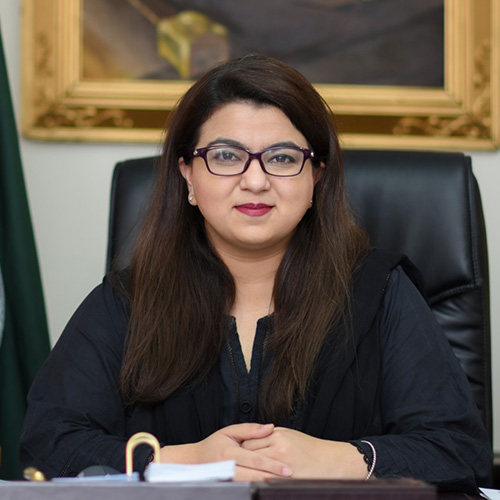
ISLAMABAD, Sep 16 (APP):Federal Minister for Information Technology and Telecommunication Shaza Fatima Khawaja on Wednesday invited Japanese companies to explore investment and partnership opportunities in Pakistan’s technology sector and other areas where technology can support economic activity.
Addressing a virtual keynote at the Pakistan Business Seminar in Tokyo titled “Pakistan’s Digital Transformation and Opportunities for Partnership with Japan”, she said Pakistan was ready to work directly with Japanese companies interested in the country’s technology sector and other areas where technology could support economic activity.
The minister invited Japanese companies to visit Pakistan, interact with young engineers, technology companies, universities, academicians, startups and innovators, and assess the capabilities already available in the country.
She said Pakistan was a young, innovative and entrepreneurial country, with 68 per cent of its population of around 240 million people under the age of 30.
Pakistan produces more than 75,000 IT graduates and software engineers annually. At the same time, its ICT export pipeline had grown by almost 20 per cent annually over the past four to five years, she added.
Shaza Fatima said Japan was expected to face a shortage of around 800,000 IT professionals by 2030, while Pakistan continued to produce tens of thousands of IT graduates and software engineers every year.
She proposed greater cooperation through Japanese research and development centres in Pakistan, stronger university-industry partnerships and joint product development by Pakistani and Japanese engineers.
She identified artificial intelligence (AI), robotics, semiconductors, chip design, smart manufacturing, electric mobility, cybersecurity and clean technologies as areas with significant potential for cooperation.
She also highlighted Pakistan’s emerging capabilities in very-large-scale integration (VLSI), chip verification and embedded systems, saying these could create further opportunities in semiconductors and advanced engineering.
“Pakistan does not want to remain simply a consumer of technologies for the future. We want to help build them,” she said.
The minister said investment decisions required predictability, intellectual property protection, skilled human capital and confidence in government policies.
Recalling the longstanding Pakistan-Japan relationship, she said the two countries had supported each other’s economic development through different phases.
“From cotton to code, from trade to technology, that is the offer that we want to make,” she said, expressing Pakistan’s desire to move from cooperation towards co-creation.
She cited “shinrai” (trust) and “showa” (harmony) as two Japanese concepts that could define the next phase of bilateral cooperation.
“Japan brings technological excellence and precision. Pakistani youth brings talent and ambition,” she said.
The minister said Pakistan and Japan already had a strong foundation of friendship and cooperation and could now work together to develop technologies and products for global markets.
Referring to the Special Investment Facilitation Council (SIFC), she said the whole-of-government platform provided investors with a coordinated interface across government departments.
She said the SIFC aimed to make it easier for investors to enter, invest, operate and grow in Pakistan by reducing administrative hurdles, accelerating decision-making and improving policy coordination.
She said the Digital Nation Pakistan Act, passed by Parliament last year, provided a framework for the digital transformation of the economy, governance and society.
Pakistan currently has around 161 million broadband subscriptions and more than 17,000 kilometres of optic fibre backbone, while 750 megahertz of spectrum was utilised and available for next-generation connectivity and 5G, she said.
The minister said connectivity was meaningful only when it created opportunities, enabling Pakistani developers and professionals to work with companies and industries around the world.
She said the National AI Policy aimed to develop one million AI professionals by 2027, describing Pakistan’s young population as a major digital advantage.