
Local vendors and small traders in Indian illegally occupied Jammu and Kashmir (IIOJK) are facing growing economic hardship and livelihood insecurity in their own homeland, as outsiders from different parts of India set up roadside businesses in their cities.
Outsiders grab space, locals struggle for livelihood in IIOJK: Report
ISLAMABAD, Sep 16 (APP):Local vendors and small traders in Indian illegally occupied Jammu and Kashmir (IIOJK) are facing growing economic hardship and livelihood insecurity in their own homeland, as outsiders from different parts of India set up roadside businesses in their cities.
According to Kashmir Media Service, people from outside the occupied territory are increasingly setting up stalls in Jammu, while local vendors struggle to find even a small space to earn a living in their own city.
Local residents and small business operators have expressed concern over intensifying competition and difficulties in securing viable commercial spaces and stable incomes.
The Bharatiya Janata Party (BJP) and Rashtriya Swayamsevak Sangh (RSS), which supported the Indian government’s post-Article 370 policies, had claimed that opening the disputed region to non-residents would bring investment, employment, tourism and economic integration. However, locals say they continue to face challenges in securing fair economic opportunities.
The debate highlights a stark gap between macro-level claims of development and tourism growth and the micro-level hardships faced by traditional residents, workers and small vendors in an increasingly competitive marketplace.”Development should not simply be measured by investment figures or tourism numbers. It should also be measured by whether an ordinary local vendor can find a fair opportunity to earn a dignified livelihood in his own city,” locals said.
A vendor during a protest in Jammu said, “Those who were celebrating with sweets after the abrogation of Articles 370 and 35A—can they today understand the pain and hardship of the Jammu vendor? People from outside states are coming here and setting up roadside stalls, while a local from Jammu is struggling to find even a small space to earn a livelihood in his own city.”
He questioned whether local people have fair economic space and adequate opportunity in Jammu city of IIOJK.
Civil society in Jammu and Kashmir, however, points to concerns over demographic change and the continuing struggle of local residents to secure jobs and economic stability after the Indian government abrogated Article 370 and altered Article 35A in 2019, arguing that the move would stimulate investment and integration.
Similar concerns are being reported from the Kashmir Valley, where locals say the post-2019 changes have weakened their control over resources and economic opportunities, while outsiders have increasingly entered local markets.
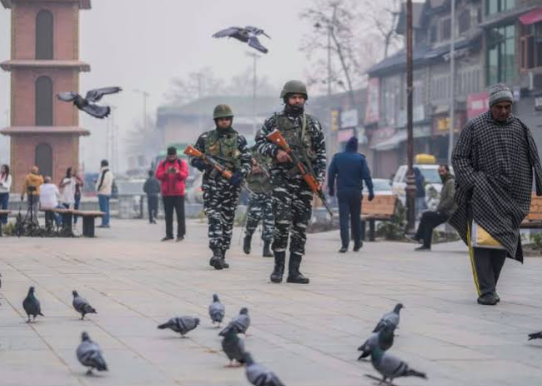
In Srinagar, non-local vendors have reportedly set up small carts and roadside businesses in and around Lal Chowk, while local vendors said they face restrictions and hurdles in obtaining permission or suitable spaces.
Local traders question why they face difficulties in establishing small businesses in their own city while outsiders are able to operate in prominent commercial areas. They argue that development must ensure equitable opportunities for locals and protect the livelihoods of small traders who have traditionally depended on these markets.
The concerns voiced in both Jammu region and the Kashmir Valley point to a wider debate over who benefits from the economic changes introduced after 2019 and whether local residents are getting a fair share of emerging opportunities. For many small vendors, the issue is about access to space, livelihood security and the right to earn a dignified living in their own homeland.

